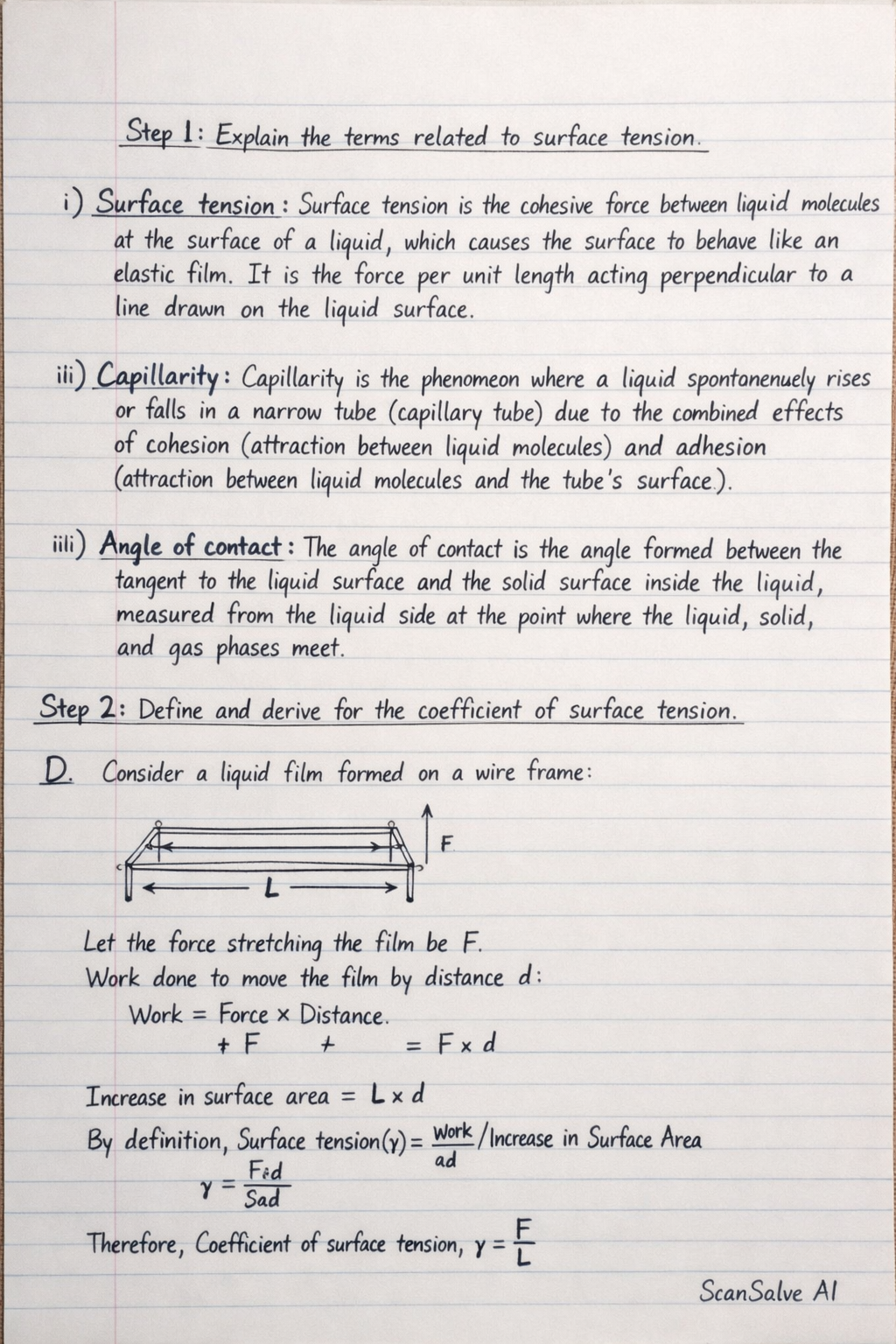
Define and derive the coefficient of surface tension, including explanations of surface tension, capillarity, and the angle of contact.
|Physics
Define and derive the coefficient of surface tension, including explanations of surface tension, capillarity, and the angle of contact.
ScanSolve AI Answer
Answer
N/m
Step 1: Explain the terms related to surface tension.
i) Surface tension: Surface tension is the cohesive force between liquid molecules at the surface of a liquid, which causes the surface to behave like an elastic film. It is the force per unit length acting perpendicular to a line drawn on the liquid surface.
ii) Capillarity: Capillarity is the phenomenon where a liquid spontaneously rises or falls in a narrow tube (capillary tube) due to the combined effects of cohesion (attraction between liquid molecules) and adhesion (attraction between liquid molecules and the tube's surface).
iii) Angle of contact: The angle of contact is the angle formed between the tangent to the liquid surface and the solid surface inside the liquid, measured from the liquid side at the point where the liquid, solid, and gas phases meet.
Step 2: Define and derive for the coefficient of surface tension.
i) Define the coefficient of surface tension: The coefficient of surface tension (σ or γ) is defined as the force per unit length acting perpendicular to a line drawn on the liquid surface, or as the work done per unit area in increasing the surface area of the liquid.
ii) Derive the S.I. unit of surface tension:
Surface tension is defined as force per unit length.
σ=LengthForce
The S.I. unit of force is Newton (N) and the S.I. unit of length is meter (m).
Therefore, the S.I. unit of surface tension is mN.
Alternatively, it can be expressed as energy per unit area: m2J.
N/m
iii) Derive the dimension of surface tension:
From the S.I. unit mN, we know that Force has dimensions of [MLT−2] and Length has dimensions of [L].
Dimensionofsurfacetension=[L][MLT−2]=[MT−2][MT−2]
Step 3: Deduce the physical laws of motion from first principles.
i) First equation of motion (V=u+at):
Acceleration is defined as the rate of change of velocity.
a=dtdV
Rearranging and integrating from initial velocity u at time t=0 to final velocity V at time t:
∫uVdV=∫0tadt
Assuming constant acceleration a:
[V]uV=a[t]0tV−u=atV=u+at
ii) Second equation of motion (S=ut+21at2):
Velocity is defined as the rate of change of displacement.
V=dtdS
Substitute V=u+at:
dtdS=u+at
Rearranging and integrating from initial displacement S=0 at t=0 to final displacement S at time t:
∫0SdS=∫0t(u+at)dt[S]0S=[ut+21at2]0tS=ut+21at2S = ut + \frac{1{2} at^2}
iii) Third equation of motion (V2=u2+2aS):
From the definition of acceleration, a=dtdV. We can write dt=adV.
From the definition of velocity, V=dtdS. We can write dt=VdS.
Equating the expressions for dt:
adV=VdSVdV=adS
Integrating from initial velocity u at S=0 to final velocity V at displacement S:
∫uVVdV=∫0SadS
Assuming constant acceleration a:
[2V2]uV=a[S]0S2V2−2u2=aSV2−u2=2aSV2=u2+2aS
Step 4: Calculate the acceleration and time for the car.
Given:
Initial velocity u=18 km/h
Final velocity V=54 km/h
Distance S=50 km
First, convert all units to S.I. units (m/s and m):
u=18km/h=18×3600s1000m=5m/sV=54km/h=54×3600s1000m=15m/sS=50km=50×1000m=50000m
i) Find acceleration (a):
Use the third equation of motion: V2=u2+2aS.
(15m/s)2=(5m/s)2+2×a×(50000m)225m2/s2=25m2/s2+100000m×a225−25=100000a200=100000aa=100000200m/s2a=0.002m/s2
The acceleration is 0.002m/s2.
ii) Find time (t):
Use the first equation of motion: V=u+at.
15m/s=5m/s+(0.002m/s2)×t15−5=0.002t10=0.002tt=0.00210st=5000s
The time to travel this distance is 5000s.
Step 5: Explain the radius of gyration and calculate it for various objects.
a) Explain what is meant by radius of gyration of an object:
The radius of gyration (k) of an object about an axis is the perpendicular distance from the axis of rotation to a point where, if the entire mass of the object were concentrated, it would have the same moment of inertia as the actual object. It is a measure of how the mass of a rigid body is distributed with respect to an axis of rotation. Mathematically, it is defined by the relation I=Mk2, where I is the moment of inertia and M is the total mass of the object.
b) Calculate the radius of gyration (k) for the following:
The general formula for radius of gyration is k=MI.
i) A uniform rod about an axis through one end:
The moment of inertia I=31ML2.
k=M31ML2=31L2=3L\frac{L{\sqrt{3}}}
ii) A sphere about its centre:
The moment of inertia I=52MR2.
k=M52MR2=52R2=R52
Was this helpful?
Need help with your own homework?
Get instant step-by-step solutions to any question. Free to start.
Explain the terms related to surface tension. i) Surface tension:* Surface tension is the cohesive force between liquid molecules at the surface of a liquid, which causes the surface to behave like an elastic film.
Define and derive the coefficient of surface tension, including explanations of surface tension, capillarity, and the angle of contact.
This physics problem tests your understanding of fundamental physical laws and their applications. The step-by-step solution below breaks down the problem using relevant equations and physical reasoning.
ScanSolve AI Answer
Step 1: Explain the terms related to surface tension. i) Surface tension:* Surface tension is the cohesive force between liquid molecules at the surface of a liquid, which causes the surface to behave like an elastic film. It is the force per unit length acting perpendicular to a line drawn on the liquid surface. ii) Capillarity:* Capillarity is the phenomenon where a liquid spontaneously rises or falls in a narrow tube (capillary tube) due to the combined effects of cohesion (attraction between liquid molecules) and adhesion (attraction between liquid molecules and the tube's surface). iii) Angle of contact:* The angle of contact is the angle formed between the tangent to the liquid surface and the solid surface inside the liquid, measured from the liquid side at the point where the liquid, solid, and gas phases meet. Step 2: Define and derive for the coefficient of surface tension. i) Define the coefficient of surface tension:* The coefficient of surface tension ( or ) is defined as the force per unit length acting perpendicular to a line drawn on the liquid surface, or as the work done per unit area in increasing the surface area of the liquid. ii) Derive the S.I. unit of surface tension:* Surface tension is defined as force per unit length. = ForceLength The S.I. unit of force is Newton (N) and the S.I. unit of length is meter (m). Therefore, the S.I. unit of surface tension is Nm. Alternatively, it can be expressed as energy per unit area: Jm^2. N/m iii) Derive the dimension of surface tension:* From the S.I. unit Nm, we know that Force has dimensions of [MLT^-2] and Length has dimensions of [L]. Dimension of surface tension = [MLT^-2][L] = [MT^-2] [MT^-2] Step 3: Deduce the physical laws of motion from first principles. i) First equation of motion (V = u + at):* Acceleration is defined as the rate of change of velocity. a = (dV)/(dt) Rearranging and integrating from initial velocity u at time t=0 to final velocity V at time t: _u^V dV = _0^t a\,dt Assuming constant acceleration a: [V]_u^V = a[t]_0^t V - u = at V = u + at ii) Second equation of motion (S = ut + (1)/(2) at^2):* Velocity is defined as the rate of change of displacement. V = (dS)/(dt) Substitute V = u + at: (dS)/(dt) = u + at Rearranging and integrating from initial displacement S=0 at t=0 to final displacement S at time t: _0^S dS = _0^t (u + at)\,dt [S]_0^S = [ut + (1)/(2) at^2]_0^t S = ut + (1)/(2) at^2 S = ut + (1)/(2) at^2 iii) Third equation of motion (V^2 = u^2 + 2aS):* From the definition of acceleration, a = (dV)/(dt). We can write dt = (dV)/(a). From the definition of velocity, V = (dS)/(dt). We can write dt = (dS)/(V). Equating the expressions for dt: (dV)/(a) = (dS)/(V) V\,dV = a\,dS Integrating from initial velocity u at S=0 to final velocity V at displacement S: _u^V V\,dV = _0^S a\,dS Assuming constant acceleration a: [(V^2)/(2)]_u^V = a[S]_0^S (V^2)/(2) - (u^2)/(2) = aS V^2 - u^2 = 2aS V^2 = u^2 + 2aS Step 4: Calculate the acceleration and time for the car. Given: Initial velocity u = 18 km/h Final velocity V = 54 km/h Distance S = 50 km First, convert all units to S.I. units (m/s and m): u = 18 km/h = 18 × 1000 m3600 s = 5 m/s V = 54 km/h = 54 × 1000 m3600 s = 15 m/s S = 50 km = 50 × 1000 m = 50000 m i) Find acceleration (a):* Use the third equation of motion: V^2 = u^2 + 2aS. (15 m/s)^2 = (5 m/s)^2 + 2 × a × (50000 m) 225 m^2/s^2 = 25 m^2/s^2 + 100000 m × a 225 - 25 = 100000a 200 = 100000a a = (200)/(100000) m/s^2 a = 0.002 m/s^2 The acceleration is 0.002 m/s^2. ii) Find time (t):* Use the first equation of motion: V = u + at. 15 m/s = 5 m/s + (0.002 m/s^2) × t 15 - 5 = 0.002t 10 = 0.002t t = (10)/(0.002) s t = 5000 s The time to travel this distance is 5000 s. Step 5: Explain the radius of gyration and calculate it for various objects. a) Explain what is meant by radius of gyration of an object:* The radius of gyration (k) of an object about an axis is the perpendicular distance from the axis of rotation to a point where, if the entire mass of the object were concentrated, it would have the same moment of inertia as the actual object. It is a measure of how the mass of a rigid body is distributed with respect to an axis of rotation. Mathematically, it is defined by the relation I = Mk^2, where I is the moment of inertia and M is the total mass of the object. b) Calculate the radius of gyration (k) for the following:* The general formula for radius of gyration is k = sqrt((I)/(M)). i) A uniform rod about an axis through one end:* The moment of inertia I = (1)/(3) ML^2. k = sqrt((1)/(3) ML^2)M = sqrt((1)/(3) L^2) = (L)/(sqrt(3)) (L)/(sqrt(3)) ii) A sphere about its centre:* The moment of inertia I = (2)/(5) MR^2. k = sqrt((2)/(5) MR^2)M = sqrt((2)/(5) R^2) = Rsqrt((2)/(5)) Rsqrt(2)