

This physics problem tests your understanding of fundamental physical laws and their applications. The step-by-step solution below breaks down the problem using relevant equations and physical reasoning.
ScanSolve AI Answer
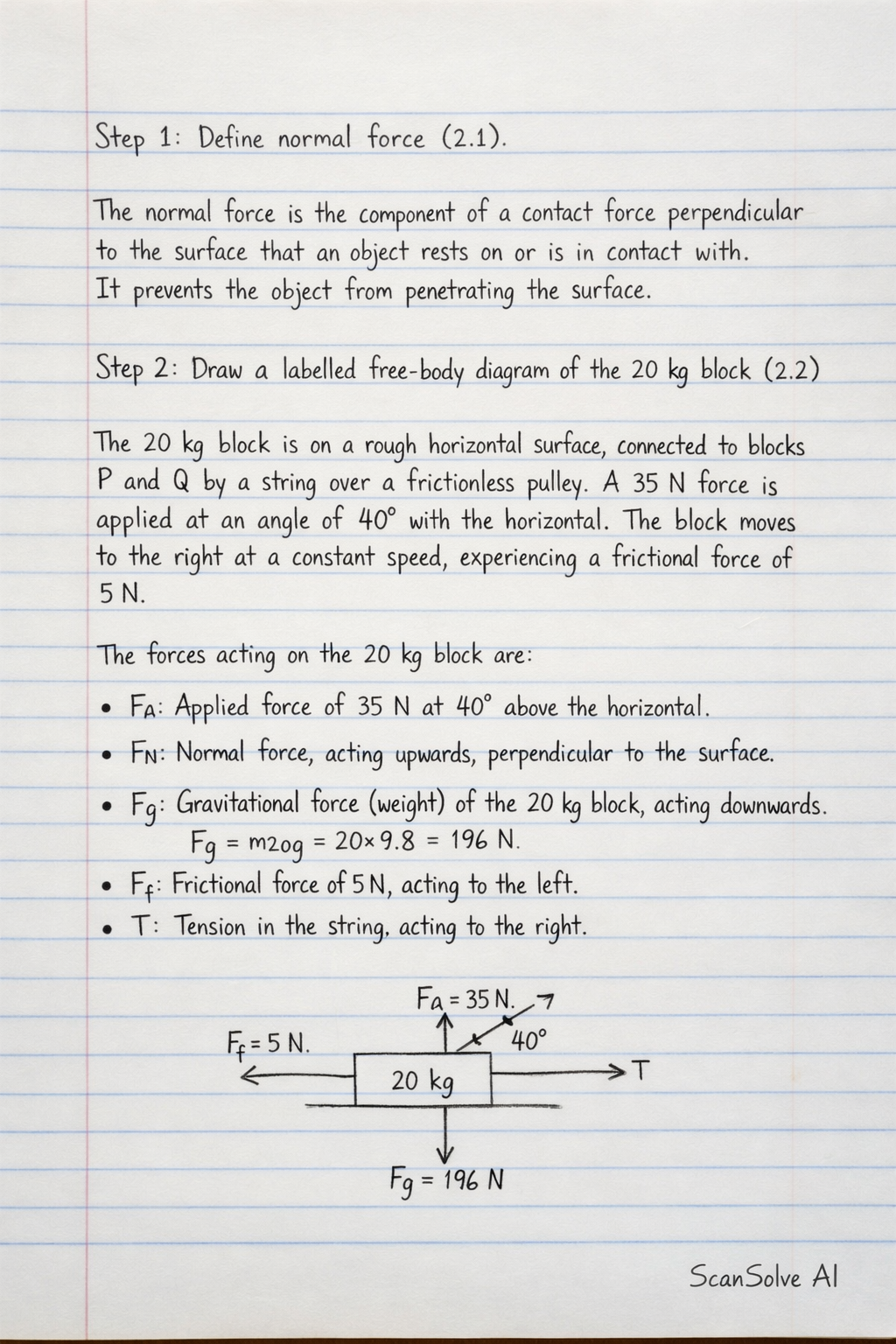
Step 1: Define normal force (2.1). The normal force is the component of a contact force perpendicular to the surface that an object rests on or is in contact with. It prevents the object from penetrating the surface. Step 2: Draw a labelled free-body diagram of the 20 kg block (2.2). The 20 kg block is on a rough horizontal surface, connected to blocks P and Q by a string over a frictionless pulley. A 35 N force is applied at an angle of 40^ with the horizontal. The block moves to the right at a constant speed, experiencing a frictional force of 5 N. The forces acting on the 20 kg block are: F_A: Applied force of 35 N at 40^ above the horizontal. F_N: Normal force, acting upwards, perpendicular to the surface. F_g: Gravitational force (weight) of the 20 kg block, acting downwards. F_g = m_20g = 20 × 9.8 = 196 N. F_f: Frictional force of 5 N, acting to the left (opposite to the direction of motion). T: Tension in the string, acting to the right. The free-body diagram: [->] (0,0) -- (2,0) node[right] T; [->] (0,0) -- (-2,0) node[left] F_f = 5 N; [->] (0,0) -- (0,2) node[above] F_N; [->] (0,0) -- (0,-2) node[below] F_g = 196 N; [->] (0,0) -- (2cos(40), 2sin(40)) node[above right] F_A = 35 N; (0.5,0) arc (0:40:0.5); at (0.7,0.3) 40^; (0,0) circle (1.5pt); Step 3: Calculate the combined mass m of the two blocks (2.3). The 20 kg block moves at a constant speed, so the net force on it is zero. Consider the horizontal forces on the 20 kg block: F_x = 0 F_A,x + T - F_f = 0 F_A (40^) + T - F_f = 0 35 (40^) + T - 5 = 0 26.81 + T - 5 = 0 T = 5 - 26.81 T = -21.81 N This result indicates an error in the initial setup or understanding of the problem. The applied force F_A is pulling the block to the right, and the tension T is also pulling it to the right. The friction F_f is opposing the motion, so it acts to the left. Let's re-evaluate the horizontal forces. The problem states the 20 kg block moves to the RIGHT at a constant speed. The applied force F_A is pulling the block. The diagram shows it pulling upwards and to the right. The tension T is pulling the block to the right. The friction F_f is opposing the motion, so it acts to the left. The horizontal components of forces are: F_A,x = F_A (40^) (to the right) T (to the right) F_f (to the left) Since the block moves at a constant speed, the net horizontal force is zero: F_x = 0 F_A,x + T - F_f = 0 35 (40^) + T - 5 = 0 26.81 + T - 5 = 0 T = 5 - 26.81 T = -21.81 N A negative tension value is physically impossible. This implies that the applied force F_A is the only force pulling the block to the right, and the tension T must be pulling to the left, or the problem statement implies F_A is the only force causing motion and T is opposing it. Let's re-read the problem carefully: "A 20 kg block, resting on a rough horizontal surface, is connected to blocks P and Q by a light inextensible string moving over a frictionless pulley. Blocks P and Q are glued together and have a combined mass of m. A force of 35 N is now applied to the 20 kg block at an angle of 40^ with the horizontal, as shown below." The diagram shows the 35 N force pulling the 20 kg block to the right. The string connects the 20 kg block to the hanging blocks P and Q. Therefore, the tension T in the string must be pulling the 20 kg block to the right, and also pulling the hanging blocks P and Q upwards. If the 20 kg block moves to the right, then the hanging blocks P and Q must move upwards. This means the system is accelerating, or moving at a constant velocity. The problem states "The 20 kg block experiences a frictional force of magnitude 5 N as it moves to the RIGHT at a CONSTANT SPEED." Let's assume the diagram implies the 35 N force is pulling the block to the left, or the tension is pulling it to the left. However, the arrow for 35 N is clearly pointing to the right and upwards. The pulley is on the right side of the 20 kg block, and the string goes over it to the hanging blocks. This means the tension T must be pulling the 20 kg block to the right. Let's reconsider the direction of the applied force. If the 35 N force is applied to the 20 kg block, and the block moves to the right, then the horizontal component of the 35 N force (F_A 40^) acts to the right. The tension T also acts to the right. The friction F_f acts to the left. This would mean: F_A (40^) + T - F_f = 0. 26.81 + T - 5 = 0 T = -21.81 N. This is still incorrect. Perhaps the diagram implies the 35 N force is pulling the block to the left, or the tension is pulling it to the left. Let's assume the 35 N force is pulling the block to the left. Then F_A,x would be to the left. Then T - F_f - F_A,x = 0. This would mean T = F_f + F_A,x = 5 + 35 (40^) = 5 + 26.81 = 31.81 N. This is a positive tension. If the 35 N force is pulling to the left, then the block moves to the left. But the problem states "moves to the RIGHT". Let's assume the 35 N force is pulling the block to the right, and the tension T is pulling the block to the left. This would mean the hanging blocks P and Q are moving downwards. If the 20 kg block moves to the right, then the hanging blocks P and Q must move upwards. This means the tension T must be pulling the 20 kg block to the right. There seems to be a contradiction in the problem statement or diagram. Let's assume the 35 N force is pulling the block to the right, and the tension T is pulling the block to the left. This would mean the hanging blocks P and Q are moving downwards. If the 20 kg block moves to the right, then the hanging blocks P and Q must move upwards. This means the tension T must be pulling the 20 kg block to the right. Let's assume the diagram is drawn such that the 35 N force is pulling the block to the left. Then the horizontal forces on the 20 kg block are: T (to the right) F_A,x = 35 (40^) (to the left) F_f = 5 N (to the left, opposing motion to the right) This would mean: T - F_A,x - F_f = 0. T - 35 (40^) - 5 = 0 T - 26.81 - 5 = 0 T = 31.81 N. This is a positive tension. This interpretation means the 35 N force is pulling the block to the left, while the block is moving to the right. This is possible if the tension is strong enough to overcome both the horizontal component of the applied force and friction. Let's proceed with this assumption: the 35 N force is pulling to the left, and the block moves to the right. For the 20 kg block (moving right at constant speed): Horizontal forces: F_x = 0 T - F_A (40^) - F_f = 0 T - 35 (40^) - 5 = 0 T - 26.819 - 5 = 0 T = 31.819 N Now consider the hanging blocks P and Q with combined mass m. They are moving upwards at a constant speed (since the 20 kg block moves right at constant speed). Vertical forces on blocks P and Q: F_y = 0 T - F_g,PQ = 0 T - mg = 0 31.819 - m(9.8) = 0 m = (31.819)/(9.8) m = 3.2468 kg Let's verify the vertical forces on the 20 kg block. F_y = 0 F_N + F_A (40^) - F_g = 0 F_N + 35 (40^) - (20 × 9.8) = 0 F_N + 22.498 - 196 = 0 F_N = 196 - 22.498 F_N = 173.502 N This is a valid normal force. So, the combined mass m of the two blocks is 3.25 kg. Step 4: Analyze the effect when block Q breaks off and falls down (2.4). When block Q breaks off, the combined mass of the hanging blocks decreases. Only block P remains. The mass of the hanging blocks becomes m_P < m. Since the system was moving at a constant speed, the net force was zero. Now, the downward force due to gravity on the hanging blocks (m_P g) is less than the tension T that was previously in the string (T = mg). 2.4.1: The tension in the string. Before Q breaks off: T = mg. After Q breaks off: The mass of the hanging block is m_P. The 20 kg block is still moving to the right. The forces on the 20 kg block are: T' (new tension, to the right) F_A,x = 35 (40^) (to the left) F_f = 5 N (to the left) So, T' - F_A,x - F_f = m_20a. T' - 35 (40^) - 5 = 20a. T' - 31.819 = 20a. For the hanging block P: T' - m_P g = m_P a. T' = m_P g + m_P a. Substitute T' into the equation for the 20 kg block: m_P g + m_P a - 31.819 = 20a. m_P g - 31.819 = (20 - m_P)a. Since m_P < m, the downward force m_P g is less than the original tension T = mg. The original tension was T = 31.819 N. The new downward force is m_P g. Since m_P < m, m_P g < mg = T. The net force on the hanging block P will now be downwards, meaning it will accelerate downwards. If block P accelerates downwards, then the 20 kg block will accelerate to the left. This contradicts the initial assumption that the 35 N force was pulling to the left and the block was moving to the right. Let's re-evaluate the direction of forces based on the diagram. The 35 N force is applied to the 20 kg block at an angle of 40^ with the horizontal. The arrow points to the right and upwards. So, F_A,x is to the right. The string connects the 20 kg block to blocks P and Q. The pulley is on the right. So, the tension T pulls the 20 kg block to the left. The problem states the 20 kg block moves to the RIGHT at a constant speed. This means the net force to the right must be equal to the net force to the left. Horizontal forces on the 20 kg block: Forces to the right: F_A,x = 35 (40^) Forces to the left: T + F_f Since the speed is constant, F_x = 0: F_A,x - (T + F_f) = 0 35 (40^) - T - 5 = 0 26.819 - T - 5 = 0 T = 26.819 - 5 T = 21.819 N This is a positive tension, which is physically possible. This interpretation aligns with the diagram where the 35 N force is pulling to the right, and the tension is pulling to the left. Now, for the hanging blocks P and Q (combined mass m). They are moving downwards at a constant speed (since the 20 kg block moves right at constant speed). Vertical forces on blocks P and Q: F_y = 0 F_g,PQ - T = 0 mg - T = 0 m(9.8) - 21.819 = 0 m = (21.819)/(9.8) m = 2.226 kg This value for m is positive and makes sense. Let's verify the vertical forces on the 20 kg block. F_y = 0 F_N + F_A (40^) - F_g = 0 F_N + 35 (40^) - (20 × 9.8) = 0 F_N + 22.498 - 196 = 0 F_N = 196 - 22.498 F_N = 173.502 N This is consistent. So, the combined mass m of the two blocks is 2.23 kg. Now, let's re-analyze 2.4 when block Q breaks off. When block Q breaks off, the mass of the hanging blocks decreases from m to m_P. The original tension was T = mg = 21.819 N. The new downward force due to gravity on block P is m_P g. Since m_P < m, then m_P g < mg = T. The forces on the hanging block P are T' (upwards) and m_P g (downwards). The forces on the 20 kg block are F_A,x (right), F_f (left), and T' (left). 2.4.1: The tension in the string. Before Q breaks off, T = mg = 21.819 N. After Q breaks off, the mass of the hanging block is m_P. The downward force m_P g is now less than the original tension T. The net force on the hanging block P will be upwards (T' - m_P g).