
We read your photo as:
Which of the following best describes the relationship between momentum and time for an object in free fall, starting from rest?
Physics
ScanSolve AI Answer
Answer
D
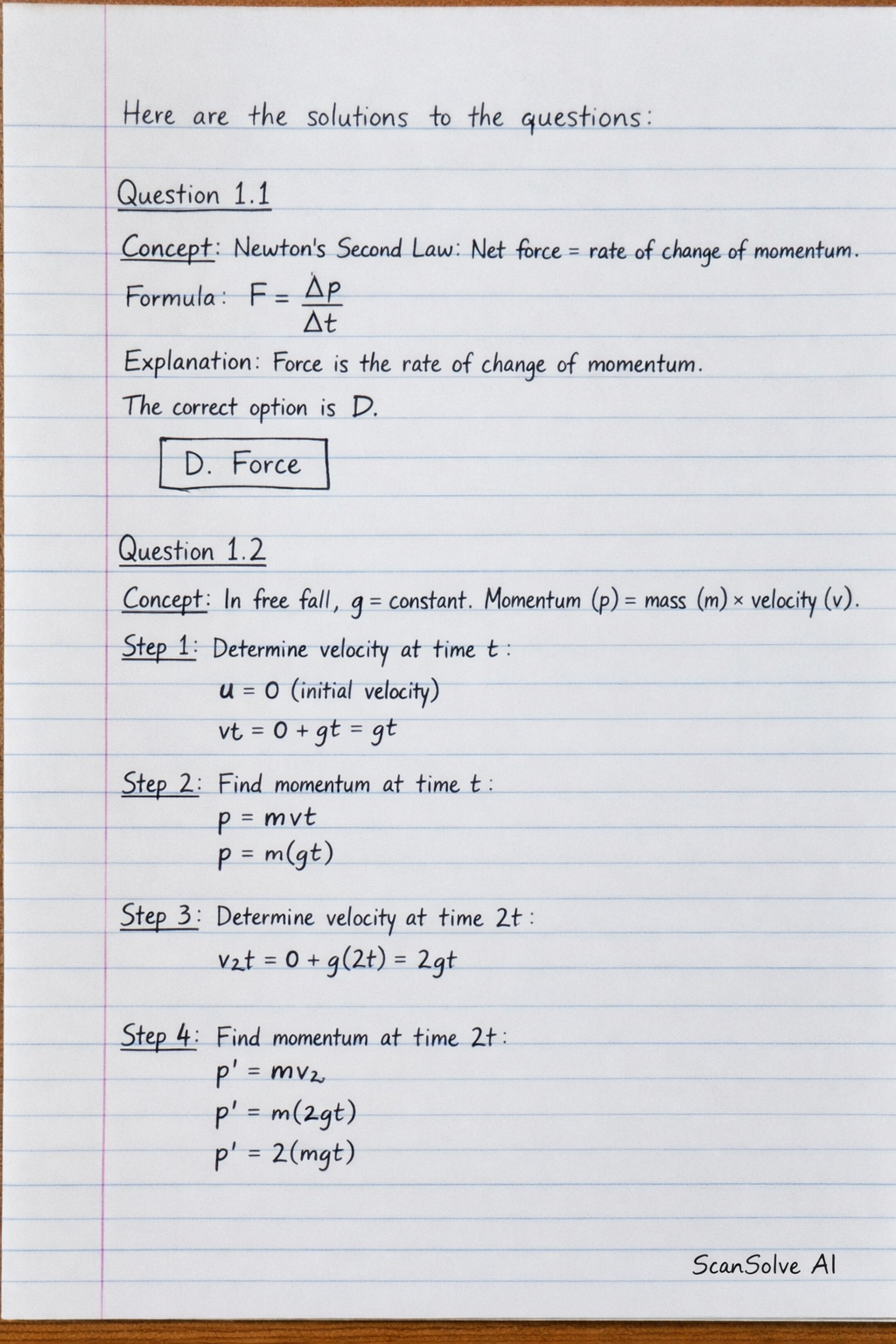
Here are the solutions to the questions:
Question 1.1
- Concept: Newton's Second Law of Motion states that the net force acting on an object is equal to the rate of change of its momentum.
- Formula:
- Explanation: This formula directly defines force as the rate of change of momentum.
The correct option is D.
Question 1.2
- Concept: For an object in free fall (ignoring air friction), the acceleration due to gravity () is constant. Momentum () is the product of mass () and velocity ().
- Step 1: Determine velocity at time . Since the object is dropped, its initial velocity . Using the kinematic equation , where :
- Step 2: Express momentum at time .
- Step 3: Determine velocity at time .
- Step 4: Express momentum at time . Let the momentum at time be .
- Step 5: Relate to . Since , we can substitute this into the expression for :
The correct option is C.
Question 1.3
- Concept: According to Newton's Third Law of Motion, for every action, there is an equal and opposite reaction. If the boy exerts a force on the box, the box exerts an equal and opposite force on the boy.
- Explanation: The boy pushes the box with a force of 250 N. Therefore, the box exerts a force of 250 N back on the boy. The frictional force of 50 N acts on the box, opposing its motion, but it is not part of the action-reaction pair between the boy and the box.
The correct option is C.
Question 1.4
- Concept: Positional isomers are compounds that have the same molecular formula and the same carbon skeleton, but differ in the position of a functional group, substituent, or multiple bond.
- Step 1: Determine the molecular formula and identify the carbon skeleton for each compound.
- I:
- Molecular formula:
- Name: But-1-yne (4-carbon chain, triple bond at position 1)
- II:
- Molecular formula:
- Name: Pent-2-yne (5-carbon chain, triple bond at position 2)
- III:
- Molecular formula:
- Name: But-2-yne (4-carbon chain, triple bond at position 2)
- IV:
- Molecular formula:
- Name: Propyne (3-carbon chain, triple bond at position 1)
- I:
- Step 2: Identify compounds with the same molecular formula and carbon skeleton but different positions of the multiple bond.
- Compounds I and III both have the molecular formula and a 4-carbon chain (butyne).
- In compound I, the triple bond is between the first and second carbon atoms (But-1-yne).
- In compound III, the triple bond is between the second and third carbon atoms (But-2-yne).
- They differ only in the position of the triple bond.
Therefore, compounds I and III are positional isomers.
Was this helpful?
Try one yourself
A new problem that tests the same skill.
Still stuck on this one?
Ask a follow-up, and the answer starts from this question.
Got a different question?Ask your own question
More Physics Questions
QRecall the formula for momentum.QDefine the term momentum.QState the law of conservation of momentum.
Browse by topic:Mechanics
Handwritten Step-by-Step Solution
Get this as a handwritten image on WhatsApp — like a tutor wrote it for you.
Try on WhatsApp