
We read your photo as:
Calculate P1, P2, P3 and enter the values in the table. Find all the unknown values of E, I, R and P for the Parallel circuit above.
ScanSolve AI Answer
Step-by-step solution
7 stepsFor a parallel circuit, the voltage across each component is the same as the total voltage.
Determine voltages across resistors.
The total voltage is given as .
In a parallel circuit, the voltage across each resistor is equal to the total voltage.Calculate currents through each resistor.
We use Ohm's Law, .
Given and .Calculate total current.
The total current in a parallel circuit is the sum of the individual branch currents.
Calculate power dissipated by each resistor.
We use the power formula, .
Calculate total power.
The total power is the sum of the power dissipated by each resistor.
Alternatively, .
Calculate total resistance.
For parallel resistors, the reciprocal of the total resistance is the sum of the reciprocals of individual resistances.
Enter the values into the table.
The completed table is:
VCE (V) I (mA) R (k) P (mW) 9 9 1 81 9 0.9 10 8.1 Total 9 9.9 0.909 89.1 The unknown values are:
Still stuck on this one?
Ask a follow-up, and the answer starts from this question.
More Physics Questions
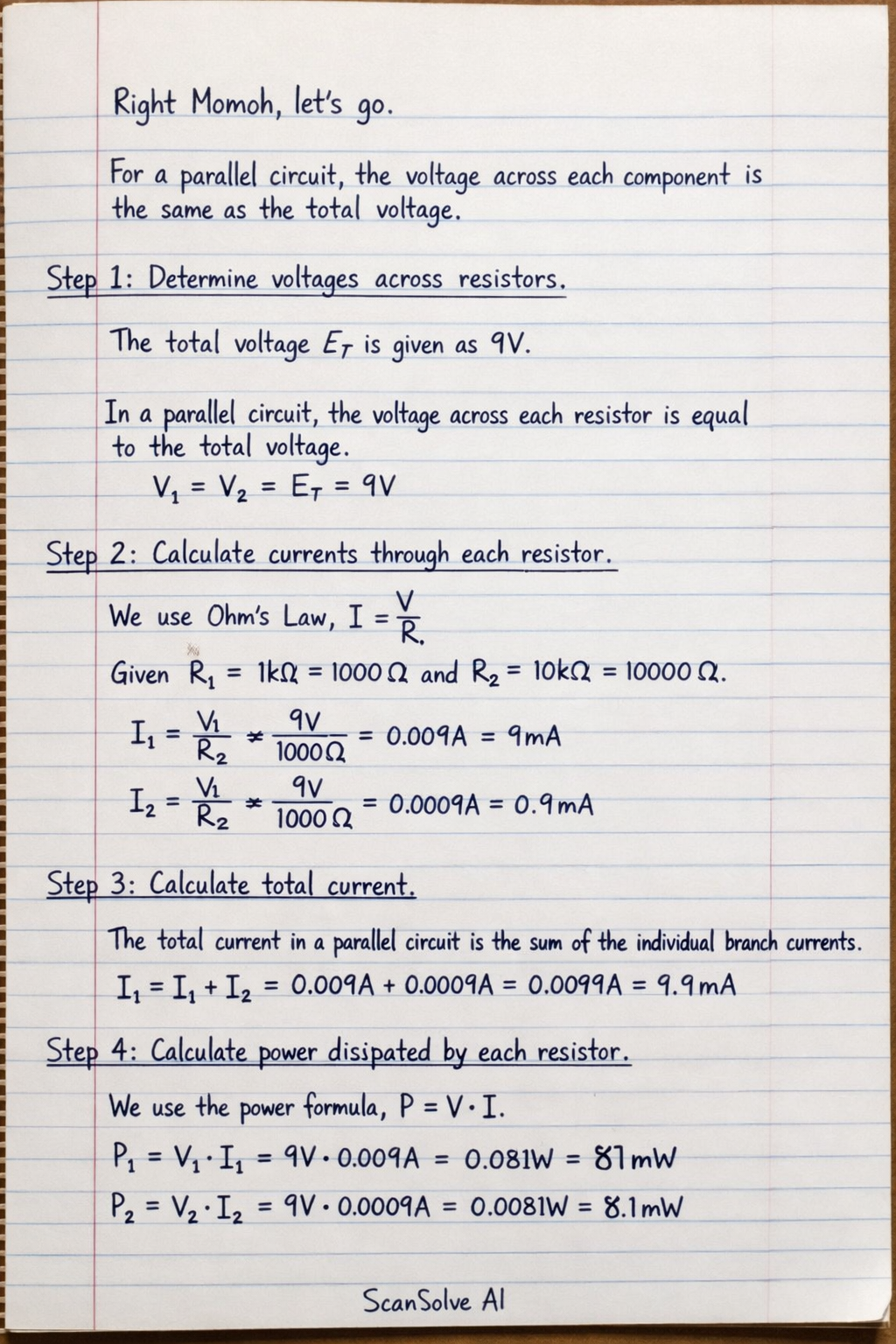
Handwritten Step-by-Step Solution
Get this as a handwritten image on WhatsApp — like a tutor wrote it for you.
Try on WhatsApp