
We read your photo as:
Physics - SSS 2 Third Term Examination. Answer Question One and any Other Three (3). 1. A simple pendulum for 20 oscillations.
ScanSolve AI Answer
Here are the solutions to the physics questions.
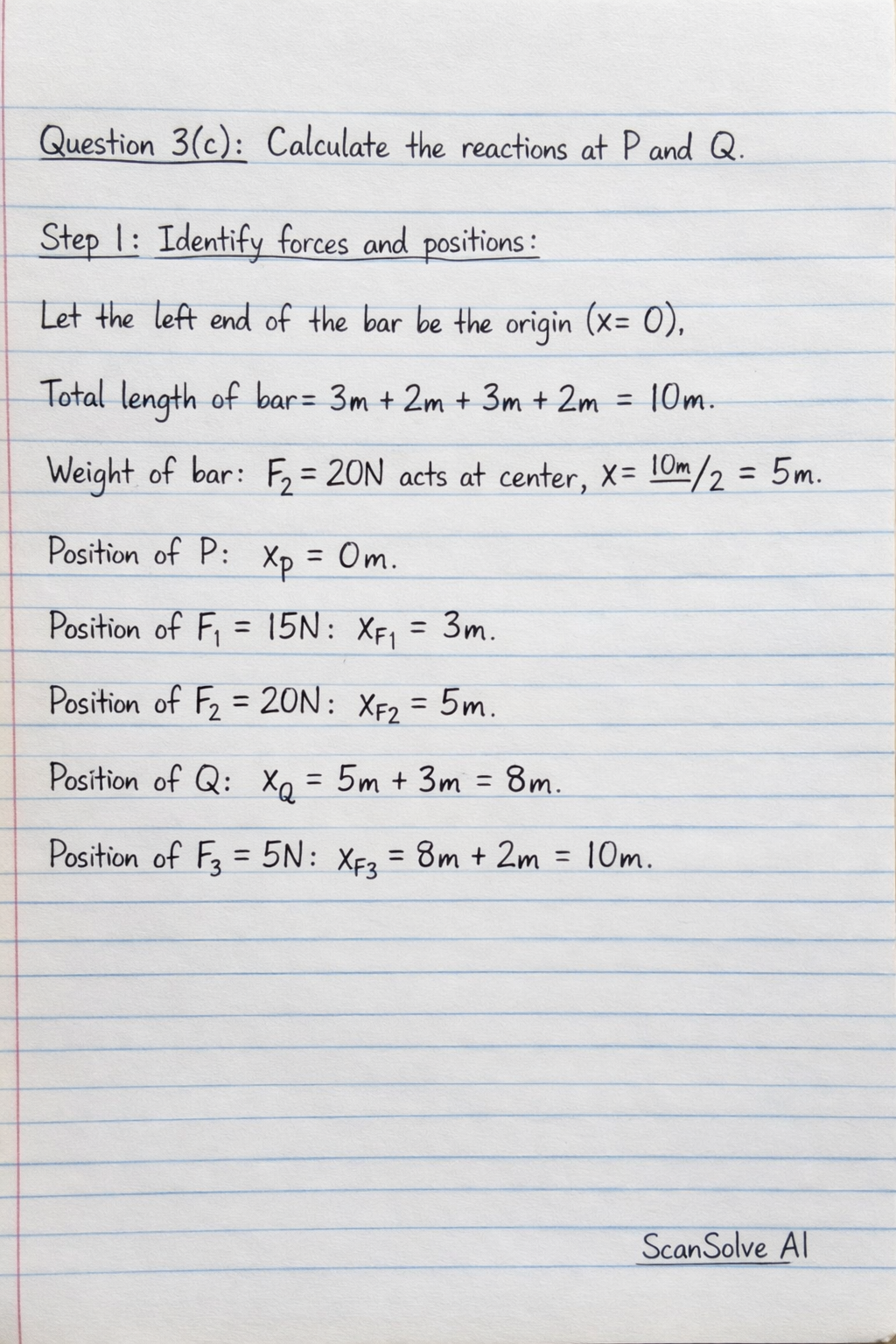
Question 3(c): Calculate the reactions at P and Q.
-
Step 1: Identify forces and positions. Let the left end of the bar be the origin (). The total length of the bar is . The weight of the uniform bar, , acts at its center, which is at . The supports are at P (reaction ) and Q (reaction ). From the diagram: Position of P: (assuming P is at the left end) Position of : Position of : Position of Q: Position of :
-
Step 2: Apply the first condition for equilibrium (sum of vertical forces is zero). Assuming upward forces are positive:
-
Step 3: Apply the second condition for equilibrium (sum of moments about a point is zero). Take moments about point P (). Clockwise moments are negative, anti-clockwise moments are positive.
-
Step 4: Calculate using Equation 1.
-
Step 5: Verify by taking moments about Q (). Anti-clockwise moments are positive, clockwise moments are negative.
The negative sign for indicates that the force at P would need to be acting downwards to maintain equilibrium, or the bar would lift off the support at P. However, since the question asks for the reaction force, we provide the calculated value.
The reactions at P and Q are:
Question 2(c): SHM Calculation
Given displacement .
Initial displacement (): .
Initial velocity (): .
-
Step 1: Calculate (amplitude). At , the displacement is . Given :
Using a calculator, .
-
Step 2: Calculate (angular frequency). First, find the velocity equation by differentiating the displacement equation with respect to time:
At , the velocity is . Given :
We know and .
-
Step 3: Calculate (period). The period is related to the angular frequency by the formula .
-
Step 4: Calculate velocity at . Using the velocity equation :
Using a calculator, .
The calculated values are:
- (i) , ,
- (ii) Velocity at
Still stuck on this one?
Ask a follow-up, and the answer starts from this question.
More Physics Questions
Handwritten Step-by-Step Solution
Get this as a handwritten image on WhatsApp — like a tutor wrote it for you.
Try on WhatsApp