
We read your photo as:
Explain the principle of conservation of linear momentum and solve related problems.
ScanSolve AI Answer
Step-by-step solution
3 stepshere are the solutions to the questions:
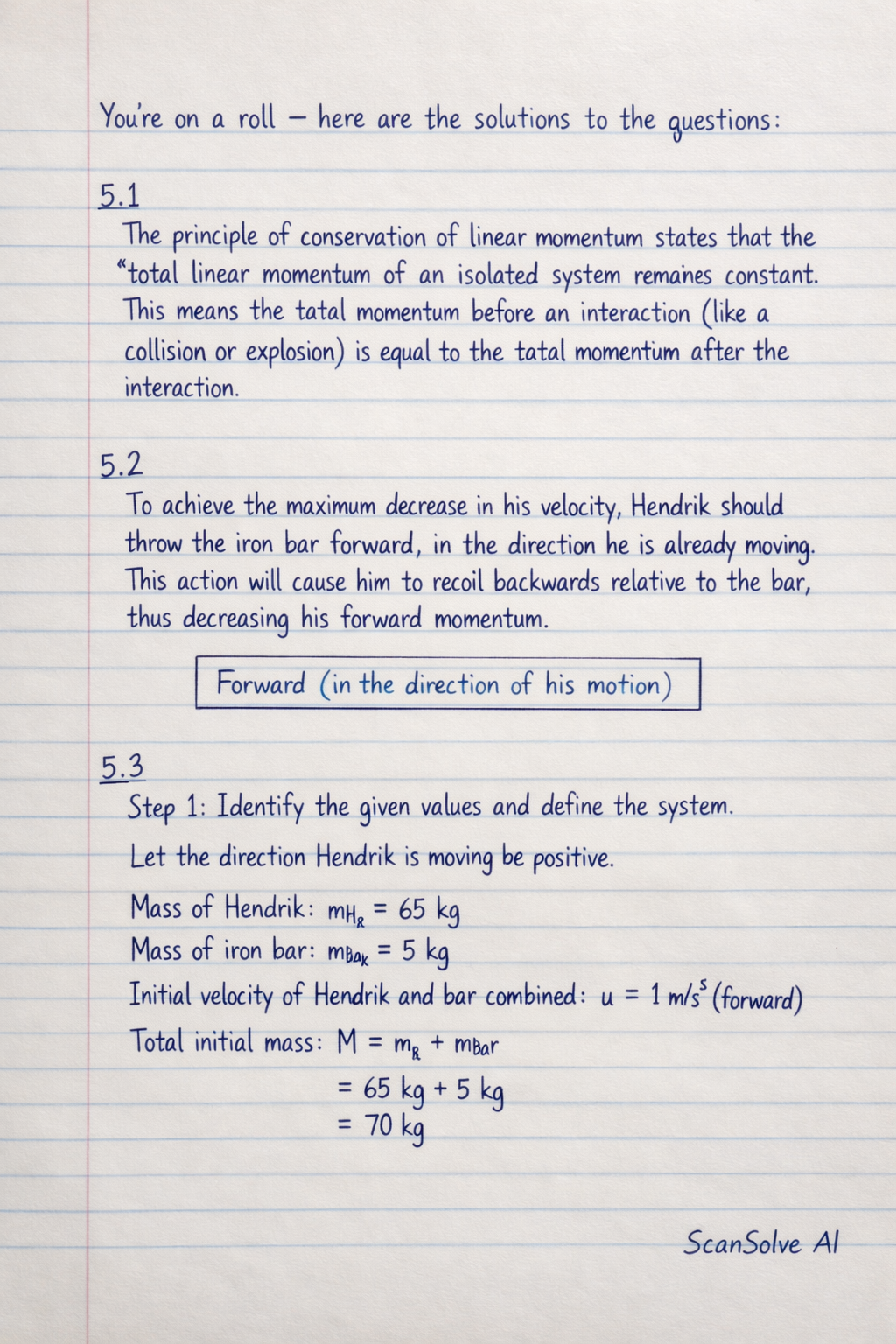
Part 5.1
The principle of conservation of linear momentum states that the total linear momentum of an isolated system remains constant. This means the total momentum before an interaction (like a collision or explosion) is equal to the total momentum after the interaction.
Part 5.2
To achieve the maximum decrease in his velocity, Hendrik should throw the iron bar forward, in the direction he is already moving. This action will cause him to recoil backwards relative to the bar, thus decreasing his forward momentum.
Part 5.3· 3 steps
Identify the given values and define the system.
Let the direction Hendrik is moving be positive.
Mass of Hendrik:
Mass of iron bar:
Initial velocity of Hendrik and bar combined: (forward)
Total initial mass:To get the maximum decrease in his velocity, Hendrik throws the bar forward.
The speed at which he throws the bar away from himself is . This is the velocity of the bar relative to Hendrik.
Let Hendrik's final velocity be .
The velocity of the bar relative to the ground, , is .Apply the principle of conservation of linear momentum.
The total momentum before throwing the bar equals the total momentum after throwing the bar.
Calculate Hendrik's final velocity.
Since is positive, Hendrik's final velocity is in the forward direction (the original direction of motion).
Still stuck on this one?
Ask a follow-up, and the answer starts from this question.
More Physics Questions
Handwritten Step-by-Step Solution
Get this as a handwritten image on WhatsApp — like a tutor wrote it for you.
Try on WhatsApp