
We read your photo as:
Explain the principles, classifications, purpose of heat treatment processes in brief, with neat sketches.
ScanSolve AI Answer
Here are the explanations for the remaining questions.
5) Explain the principles, classifications, purpose of heat treatment processes in brief, with neat sketches.
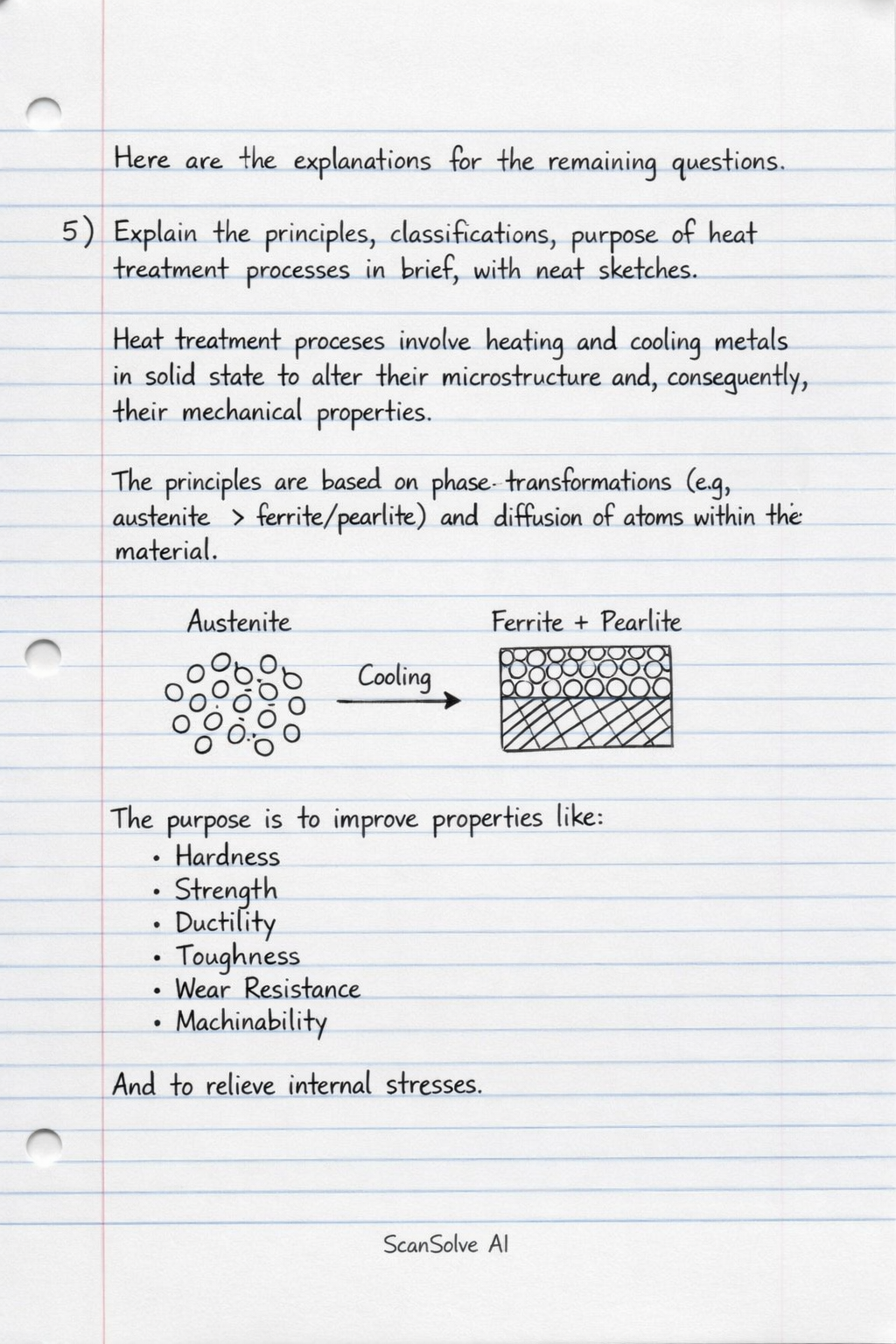
Heat treatment processes involve heating and cooling metals in solid state to alter their microstructure and, consequently, their mechanical properties. The principles are based on phase transformations (e.g., austenite to ferrite/pearlite) and diffusion of atoms within the material. The purpose is to improve properties like hardness, strength, ductility, toughness, wear resistance, or machinability, and to relieve internal stresses.
Classifications of common heat treatment processes include:
- Annealing: Heating to a suitable temperature, holding, and then slowly cooling. This process reduces hardness, increases ductility, refines grain structure, and relieves internal stresses. A sketch would show a slow cooling curve and a microstructure with coarse, soft grains.
- Normalizing: Heating above the critical temperature, holding, and then cooling in still air. This refines grain size, improves strength and toughness, and homogenizes the microstructure. A sketch would show air cooling and a finer, more uniform grain structure than annealed material.
- Hardening (Quenching): Heating to an austenitic temperature, holding, and then rapidly cooling (quenching) in water, oil, or polymer solutions. This transforms austenite into a hard, brittle martensitic structure. A sketch would show a rapid cooling curve and a needle-like martensitic microstructure.
- Tempering: Reheating a hardened (martensitic) steel to a temperature below the critical temperature, holding, and then cooling. This reduces brittleness and internal stresses while improving toughness, at the expense of some hardness. A sketch would show a reheating curve followed by cooling, and a microstructure of tempered martensite.
6) (a) Describe the concept of re-crystallization and grain growth.
Recrystallization is the process where new, strain-free grains nucleate and grow in a deformed (cold-worked) metal, replacing the old, strained grains. This occurs when the metal is heated above its recrystallization temperature but below its melting point. The driving force is the reduction in internal strain energy stored during cold working, leading to increased ductility and reduced strength.
Grain growth is the process that follows recrystallization, where the average size of the grains in a polycrystalline material increases. This occurs at elevated temperatures as larger grains consume smaller grains, driven by the reduction in total grain boundary energy. While it can improve creep resistance, excessive grain growth can lead to reduced strength and toughness.
6) (b) Explain in detail yield point phenomena with neat sketch.
Yield point phenomena are observed in some materials, particularly low-carbon steels, where the stress-strain curve exhibits a distinct upper and lower yield point. When such a material is subjected to tensile loading, the stress initially increases elastically. At the upper yield point, there is a sudden drop in stress, followed by plastic deformation at a nearly constant or slightly fluctuating stress, known as the lower yield point. After this, the material continues to strain harden.
This phenomenon is attributed to the pinning of dislocations by interstitial impurity atoms (like carbon or nitrogen) in the crystal lattice. These impurity atoms form "atmospheres" around dislocations, hindering their movement. To initiate plastic deformation, a higher stress (upper yield point) is required to unpin these dislocations. Once unpinned, the dislocations can move more freely, leading to a drop in stress (lower yield point) and subsequent plastic flow.
A sketch of a stress-strain curve for mild steel would show:
- An initial linear elastic region.
- A peak at the upper yield point.
- A sudden drop in stress.
- A plateau at the lower yield point where plastic deformation begins.
- A region of strain hardening where stress increases with strain.
- Finally, the ultimate tensile strength and fracture point.
Still stuck on this one?
Ask a follow-up, and the answer starts from this question.
More Physics Questions
Handwritten Step-by-Step Solution
Get this as a handwritten image on WhatsApp — like a tutor wrote it for you.
Try on WhatsApp