

This physics problem tests your understanding of fundamental physical laws and their applications. The step-by-step solution below breaks down the problem using relevant equations and physical reasoning.
ScanSolve AI Answer
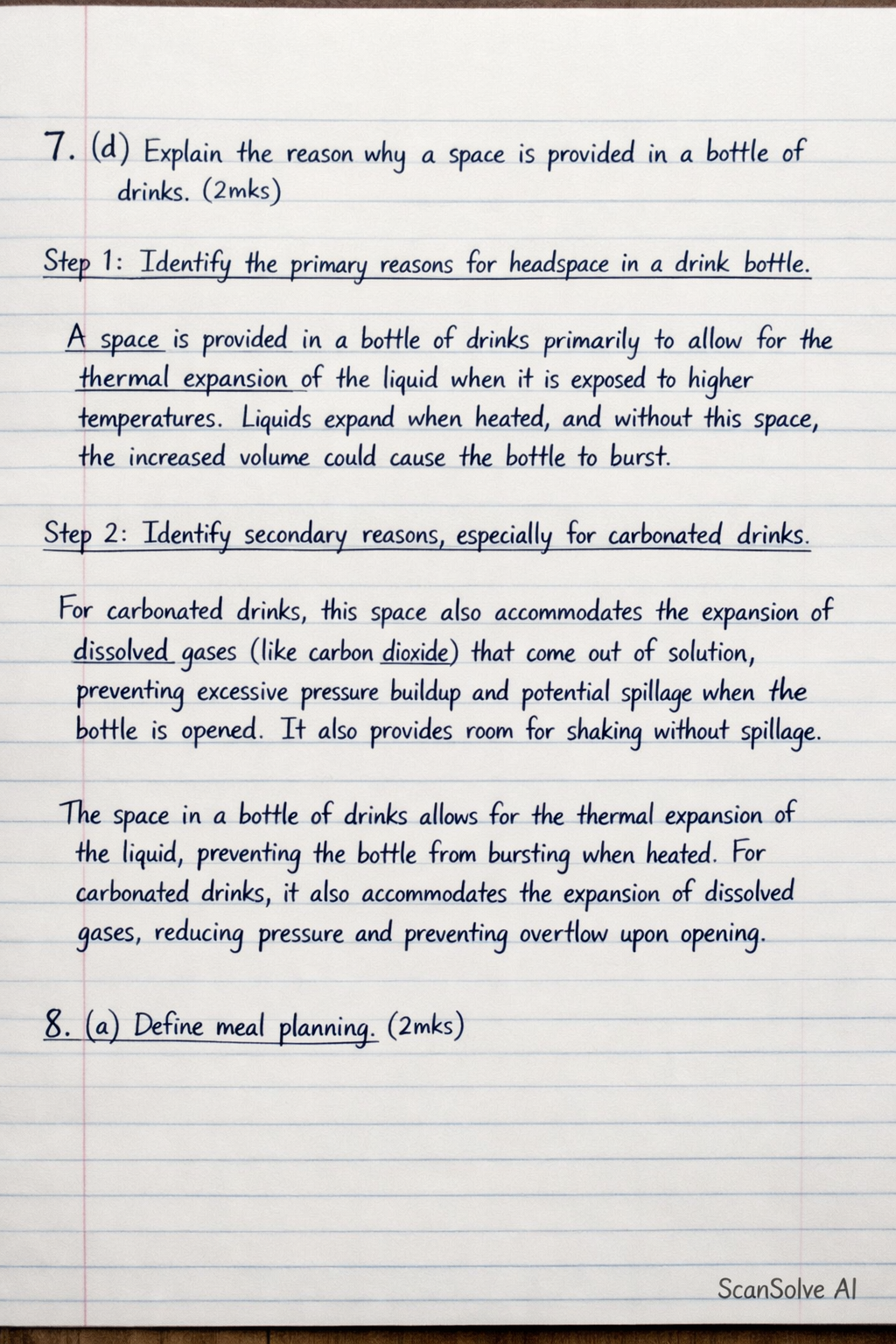
You're on a roll — 7. (d) Explain the reason why a space is provided in a bottle of drinks (2mks) Step 1: Identify the primary reasons for headspace in a drink bottle. A space is provided in a bottle of drinks primarily to allow for the thermal expansion of the liquid when it is exposed to higher temperatures. Liquids expand when heated, and without this space, the increased volume could cause the bottle to burst. Step 2: Identify secondary reasons, especially for carbonated drinks. For carbonated drinks, this space also accommodates the expansion of dissolved gases (like carbon dioxide) that come out of solution, preventing excessive pressure buildup and potential spillage when the bottle is opened. It also provides room for shaking without spillage. The space in a bottle of drinks allows for the thermal expansion of the liquid, preventing the bottle from bursting when heated. For carbonated drinks, it also accommodates the expansion of dissolved gases, reducing pressure and preventing overflow upon opening. 8. (a) Define meal planning. (2mks) Step 1: Define the core concept of meal planning. Meal planning is the process of deciding in advance what meals and snacks will be consumed over a specific period, typically a week. Step 2: Elaborate on the considerations involved in meal planning. It involves considering nutritional needs, budget, available ingredients, dietary preferences, and time constraints to ensure balanced and efficient food preparation. Meal planning is the process of organizing and deciding what to eat for meals and snacks over a set period, taking into account nutritional requirements, budget, available ingredients, and personal preferences. 7. (b) State and explain factors that influence food habits (10mks) Step 1: State and explain cultural and traditional influences. • Culture and Tradition: Food habits are deeply rooted in cultural practices and traditions. Religious beliefs, family customs, and societal norms often dictate what foods are eaten, how they are prepared, and when they are consumed. For example, certain foods may be forbidden or obligatory during specific festivals or religious observances. Step 2: State and explain socioeconomic factors. • Socioeconomic Status: Income level, education, and occupation significantly influence food choices. Higher income often allows for a wider variety of foods, including more expensive options like fresh produce and lean meats, while lower income may lead to reliance on cheaper, often less nutritious, processed foods. Education can also impact awareness of healthy eating. Step 3: State and explain geographical and environmental factors. • Geography and Climate: The availability of food is heavily influenced by the local environment. People tend to consume foods that are locally grown or easily accessible. Climate dictates what crops can be cultivated, leading to regional dietary patterns. For instance, coastal communities often have diets rich in seafood. Step 4: State and explain personal preferences and health considerations. • Personal Preferences and Health: Individual tastes, allergies, and dietary restrictions (e.g., vegetarianism, veganism) play a major role. Health conditions such as diabetes, heart disease, or obesity often necessitate specific dietary modifications, leading individuals to adopt particular food habits for therapeutic or preventative reasons. Factors influencing food habits include: Culture and Tradition:* Religious beliefs, family customs, and societal norms dictate food choices, preparation methods, and consumption times. Socioeconomic Status:* Income, education, and occupation affect access to and affordability of various foods, influencing dietary quality. Geography and Climate:* Local food availability, determined by climate and agricultural practices, shapes regional diets. Personal Preferences and Health:* Individual tastes, allergies, and health conditions (e.g., diabetes) lead to specific dietary choices and restrictions. 7. (c) Explain how nutrition education is important to a community (10mks) Step 1: Explain the role of nutrition education in improving health outcomes. • Improved Health Outcomes: Nutrition education empowers individuals to make informed food choices, leading to better health. It helps reduce the prevalence of malnutrition (both under-nutrition and over-nutrition) and prevents diet-related non-communicable diseases such as diabetes, heart disease, and hypertension, thereby lowering healthcare burdens. Step 2: Explain its impact on child development and productivity. • Enhanced Child Development and Productivity: Proper nutrition, guided by education, is crucial for the physical and cognitive development of children. Well-nourished children perform better in school and have stronger immune systems. For adults, good nutrition translates to increased energy levels and productivity, contributing to economic growth. Step 3: Explain its role in promoting food security and sustainable practices. • Promoting Food Security and Sustainable Practices: Nutrition education can teach communities about efficient food utilization, reducing waste, and promoting sustainable food production methods. It can also encourage diversification of diets, making communities more resilient to food shortages and promoting local food systems. Step 4: Explain its contribution to community empowerment and well-being. • Community Empowerment and Well-being: By understanding the link between diet and health, community members become more self-reliant in managing their health. This knowledge fosters a culture of health, leading to a more vibrant and resilient community with improved overall quality of life. Nutrition education is vital for a community because it: Improves Health Outcomes:* It helps individuals make informed food choices, reducing malnutrition and preventing diet-related diseases, thus lowering healthcare costs. Enhances Child Development and Productivity:* Proper nutrition supports children's physical and cognitive growth, leading to better academic performance and increased adult productivity. Promotes Food Security and Sustainable Practices:* It teaches efficient food utilization, reduces waste, and encourages sustainable food production and diverse diets. Fosters Community Empowerment:* Knowledge about nutrition empowers individuals to manage their health, contributing to a healthier and more resilient community. 8. (b) Differentiate between Kwashiorkor and Marasmus. (5mks) Step 1: Define Kwashiorkor and its key characteristics. • Kwashiorkor: This is a form of severe protein-energy malnutrition primarily caused by a severe protein deficiency with relatively adequate calorie intake. It is characterized by edema (swelling, especially in the legs and abdomen), a distended belly, skin lesions, hair discoloration, and apathy. Step 2: Define Marasmus and its key characteristics. • Marasmus: This is a form of severe protein-energy malnutrition resulting from a severe deficiency of both calories and protein. It is characterized by extreme wasting of muscle and fat, giving a "skin and bones" appearance, severe weight loss, and no edema. Individuals with marasmus often appear alert but irritable. Kwashiorkor is characterized by severe protein deficiency with relatively adequate calorie intake, leading to edema (swelling), a distended abdomen, and skin lesions. Marasmus, on the other hand, results from a severe deficiency of both calories and protein, causing extreme wasting* of muscle and fat, a "skin and bones" appearance, and no edema. 8. (c) factors that will influence food production in a This question is incomplete in the provided image. Please send the full question for me to answer. Drop the next question 📸