
We read your photo as:
Recall Coulomb's Law, which states that the electrostatic force (F) between two charges is inversely proportional to the square of the distance (r) between them: F (1)/(r2).
ScanSolve AI Answer
This answer stops before the end.
It was cut off when it was first written. Ask ScanSolve this question again for the full working.
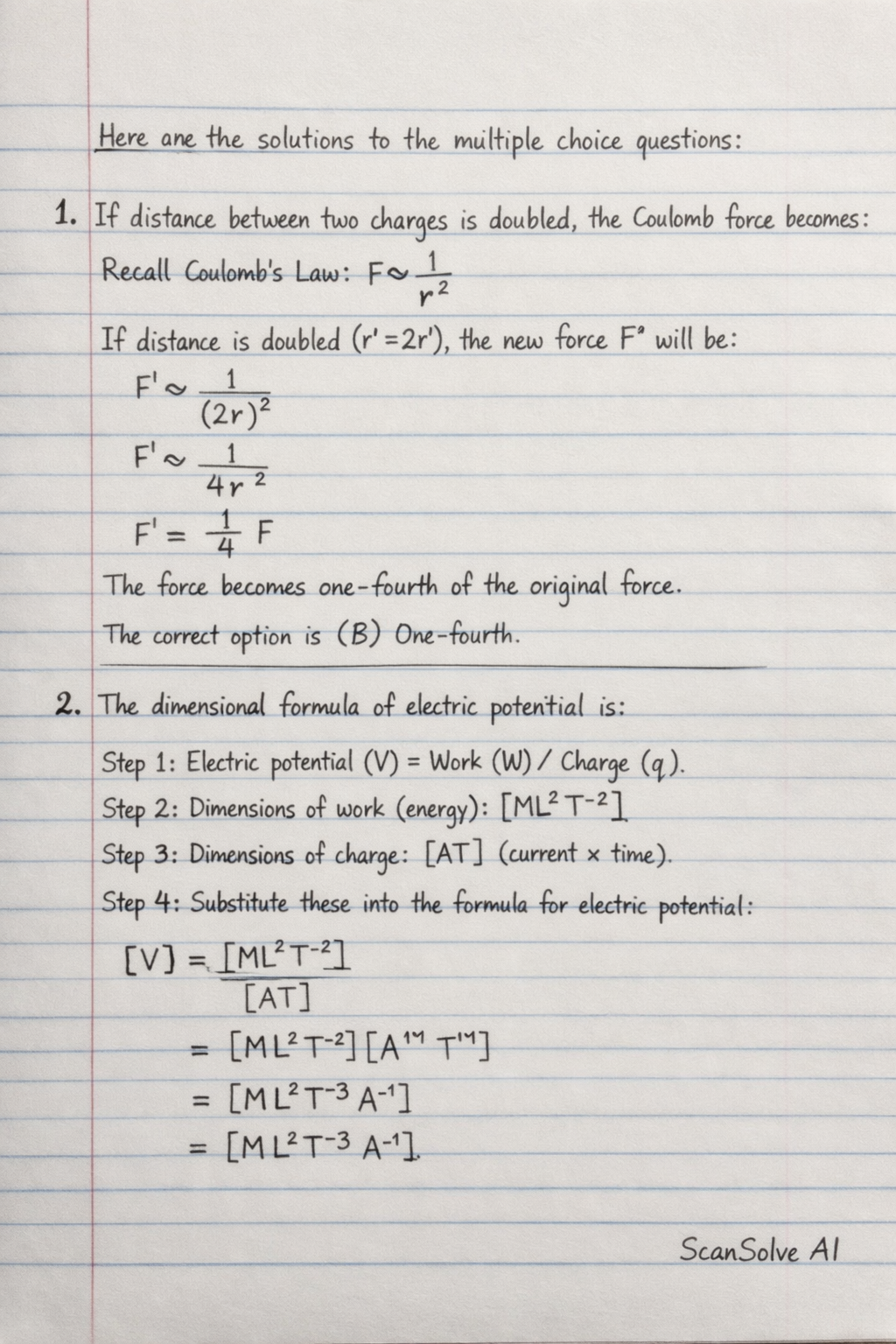
Here are the solutions to the multiple-choice questions:
1. If distance between two charges is doubled, the Coulomb force becomes:
Step 1: Recall Coulomb's Law, which states that the electrostatic force () between two charges is inversely proportional to the square of the distance () between them: .
Step 2: If the distance is doubled (), the new force () will be:
The force becomes one-fourth of the original force.
The correct option is (B) One-fourth.
2. The dimensional formula of electric potential is:
Step 1: Electric potential () is defined as work done () per unit charge (): .
Step 2: The dimensions of work (energy) are .
Step 3: The dimensions of charge are (current time).
Step 4: Substitute these dimensions into the formula for electric potential:
Still stuck on this one?
Ask a follow-up, and the answer starts from this question.
More Physics Questions
Handwritten Step-by-Step Solution
Get this as a handwritten image on WhatsApp — like a tutor wrote it for you.
Try on WhatsApp