
We read your photo as:
Resolve the initial velocity into horizontal and vertical components.
Physics
ScanSolve AI Answer
Step-by-step solution
2 stepsa) Calculate the velocity at which the ball hits the court.
Resolve the initial velocity into horizontal and vertical components.
The initial velocity is at an angle to the horizontal.
The horizontal component () remains constant throughout the flight.
The vertical component () is affected by gravity.Determine the final vertical velocity component ().
We use the kinematic equation .
Taking upward as the positive direction:
The acceleration due to gravity is .
The vertical displacement
Was this helpful?
Still stuck on this one?
Ask a follow-up, and the answer starts from this question.
Got a different question?Ask your own question
More Physics Questions
QIdentify the initial vertical velocity component.QResolve the following forces into their vertical and horizontal components:QResolve each force into its x and y components.QFirst, we resolve each force into its horizontal (x) and vertical (y) components. We will measure…QResolve the first displacement into components.
Browse by topic:Mechanics
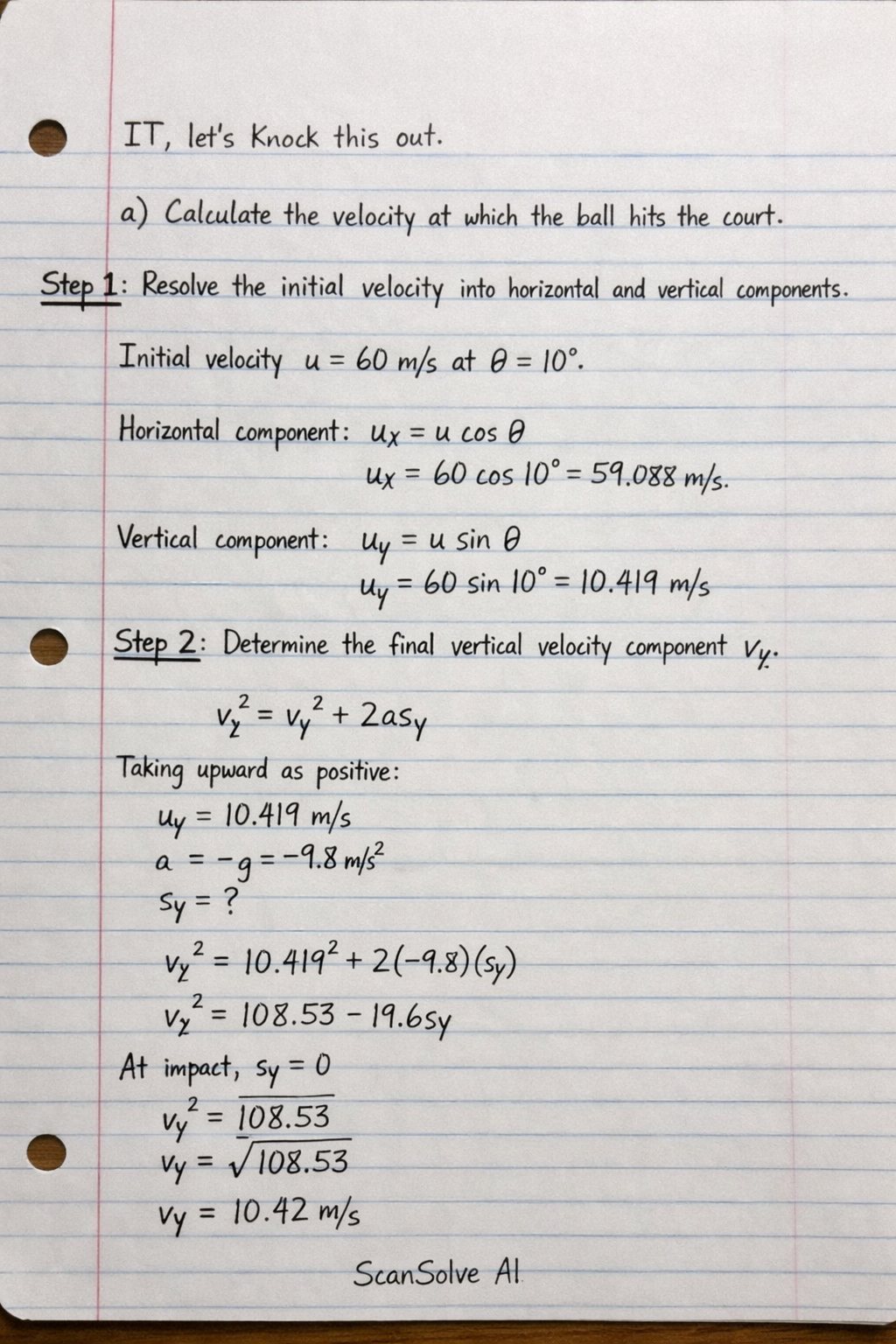
Handwritten Step-by-Step Solution
Get this as a handwritten image on WhatsApp — like a tutor wrote it for you.
Try on WhatsApp