

This physics problem tests your understanding of fundamental physical laws and their applications. The step-by-step solution below breaks down the problem using relevant equations and physical reasoning.
ScanSolve AI Answer
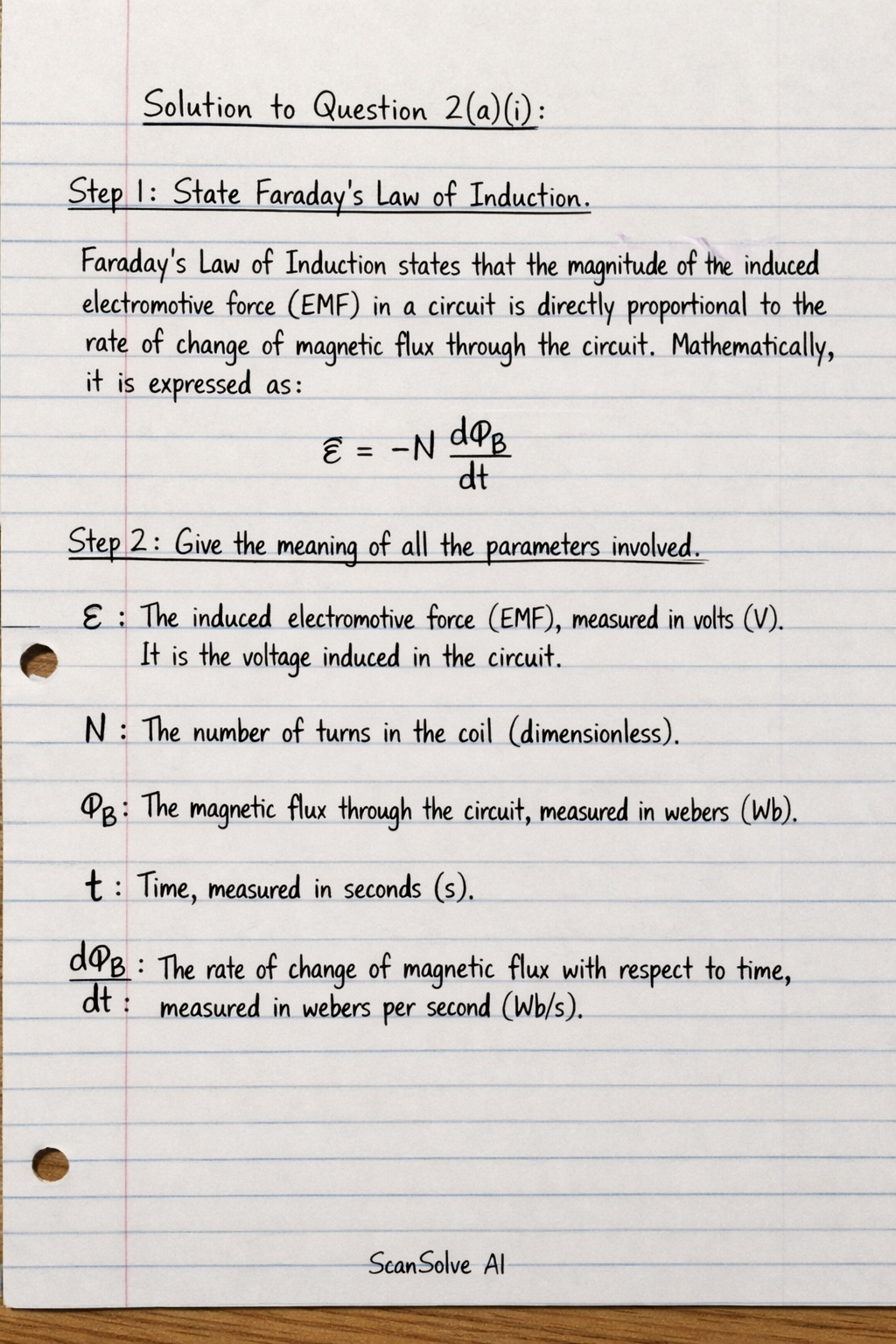
Here's the solution for question 2(a)(i): Step 1: State Faraday's Law of Induction. Faraday's Law of Induction states that the magnitude of the induced electromotive force (EMF) in a circuit is directly proportional to the rate of change of magnetic flux through the circuit. Mathematically, it is expressed as: E = -N (d_B)/(dt) Step 2: Give the meaning of all the parameters involved. • E: This is the induced electromotive force (EMF), measured in volts (V). It represents the voltage generated in the circuit due to the changing magnetic flux. • N: This is the number of turns in the coil. It is a dimensionless quantity. • _B: This is the magnetic flux through the circuit, measured in webers (Wb). It is a measure of the total magnetic field passing through a given area. • t: This is time, measured in seconds (s). • (d_B)/(dt): This represents the rate of change of magnetic flux with respect to time, measured in webers per second (Wb/s). • The negative sign: This indicates the direction of the induced EMF, as described by Lenz's Law. It means that the induced EMF opposes the change in magnetic flux that produced it. Send me the next one 📸