
We read your photo as:
Calculate the spring constant using Hooke's Law and explain impulse using Newton's Second Law.
ScanSolve AI Answer
Answer
Step-by-step solution
4 stepsPart b· 2 steps
Step 1: Identify the given values.
Natural length, .
Extended length, .
Applied force, .
Calculate the extension ().
The extension is the difference between the extended length and the natural length.
Convert the extension to meters:
Apply Hooke's Law to determine the spring constant ().
Hooke's Law states . Rearranging for :
The spring constant is .
Part d· 2 steps
Step 1: Define impulse.
Impulse () is defined as the change in momentum () of an object.
Relate force to momentum using Newton's Second Law.
Newton's Second Law states that the net force () acting on an object is equal to the rate of change of its momentum.
where is the time interval over which the force acts.
Show that impulse can be expressed as .
From Newton's Second Law, we can rearrange the equation to solve for the change in momentum:
Since impulse , we can substitute to show:
This demonstrates that the impulse on an object can be expressed as the product of the force applied and the time interval over which it acts.
Try one yourself
A new problem that tests the same skill.
Still stuck on this one?
Ask a follow-up, and the answer starts from this question.
More Physics Questions
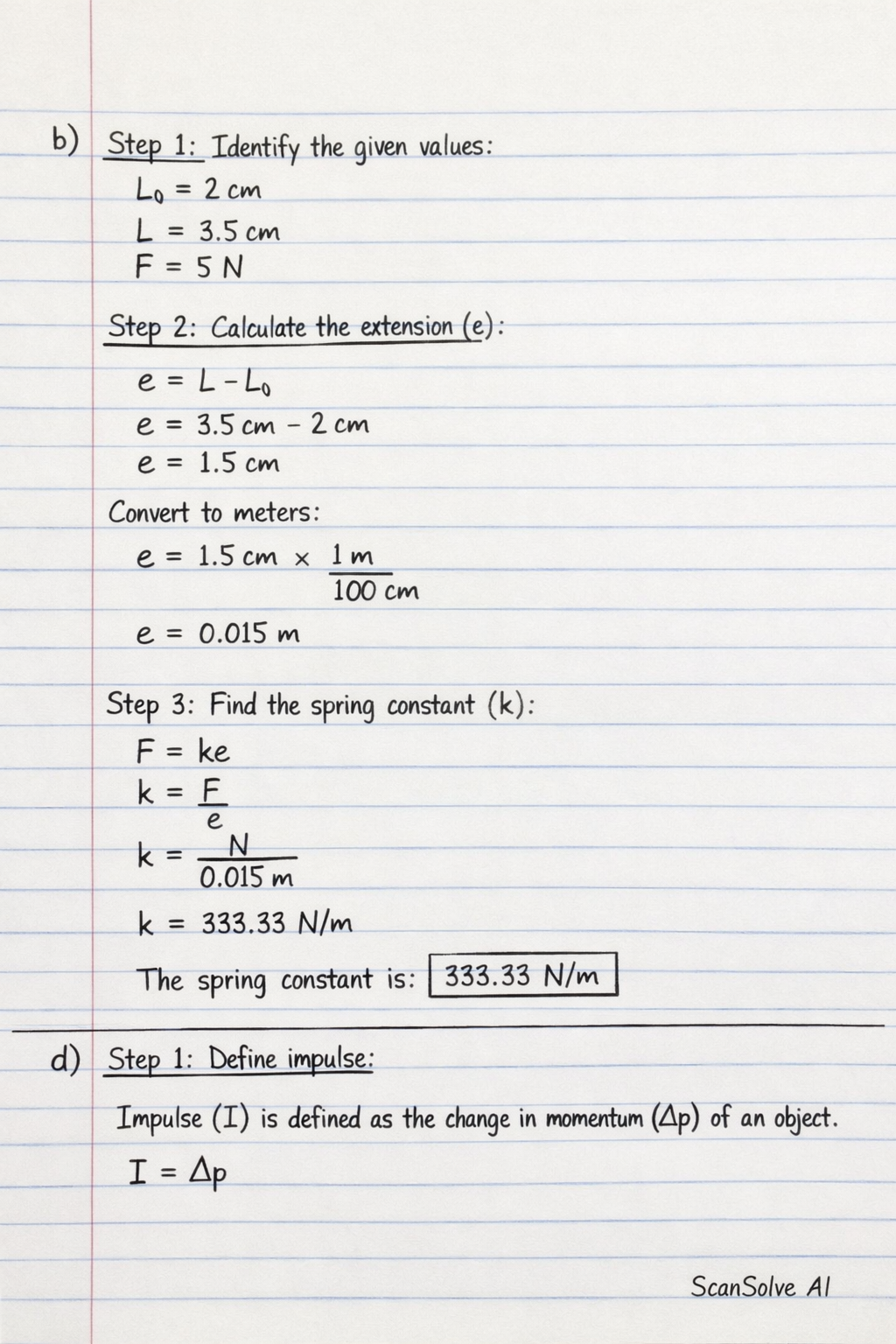
Handwritten Step-by-Step Solution
Get this as a handwritten image on WhatsApp — like a tutor wrote it for you.
Try on WhatsApp