

This physics problem tests your understanding of fundamental physical laws and their applications. The step-by-step solution below breaks down the problem using relevant equations and physical reasoning.
ScanSolve AI Answer
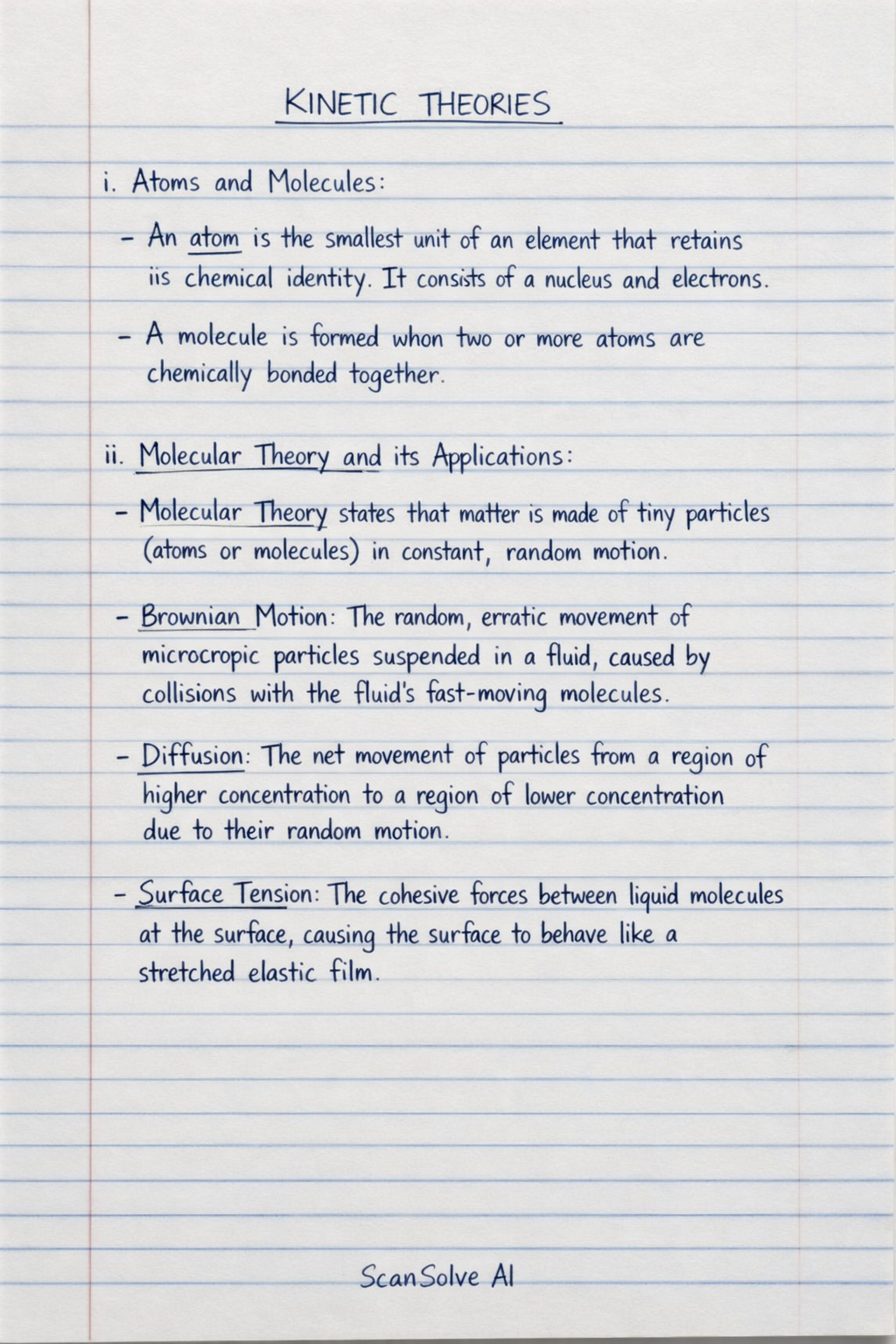
Here are notes based on the provided UTME Physics syllabus objectives: KINETIC THEORIES i. Atoms and Molecules: An atom* is the smallest unit of an element that retains its chemical identity. It consists of a nucleus and electrons. A molecule* is formed when two or more atoms are chemically bonded together. ii. Molecular Theory and its Applications: Molecular Theory states that matter is made of tiny particles (atoms or molecules) in constant, random motion. Brownian Motion: The random, erratic movement of microscopic particles suspended in a fluid, caused by collisions with the fluid's fast-moving molecules. Diffusion: The net movement of particles from a region of higher concentration to a region of lower concentration due to their random motion. Surface Tension: The cohesive forces between liquid molecules at the surface, causing the surface to behave like a stretched elastic film. Capillarity (Capillary Action): The ability of a liquid to flow in narrow spaces against gravity, due to the combined effects of adhesion and cohesion. Adhesion: The attractive force between molecules of different* substances. Cohesion: The attractive force between molecules of the same* substance. Angle of Contact: The angle formed between the tangent to the liquid surface and the solid surface at their point of contact, indicating the balance between adhesive and cohesive forces. iii. Assumptions of Kinetic Theory of Gases: Gases consist of a large number of identical, tiny particles in constant, random motion. The volume of the gas particles themselves is negligible compared to the total volume of the gas. There are no significant intermolecular forces between the particles, except during collisions. Collisions between particles and with the container walls are perfectly elastic. The average kinetic energy of the gas particles is directly proportional to the absolute temperature of the gas. iv. Interpretation of Kinetic Theory and Related Concepts: Pressure Exerted by Gases: Arises from the force exerted by gas particles colliding with the walls of the container. Boyle's Law: For a fixed mass of gas at constant temperature, pressure is inversely proportional to volume. P_1V_1 = P_2V_2 Charles' Law: For a fixed mass of gas at constant pressure, volume is directly proportional to its absolute temperature. (V_1)/(T_1) = (V_2)/(T_2) Melting: The phase change from solid to liquid at a specific temperature (melting point) as particles gain enough energy to overcome fixed lattice forces. Boiling: The phase change from liquid to gas at a specific temperature (boiling point) throughout the liquid when its vapor pressure equals the external pressure. Vaporization: The general process of a substance changing from a liquid to a gas. Change in Temperature: Reflects a change in the average kinetic energy of the particles within a substance. Evaporation: The process where liquid changes to gas at the surface, occurring at temperatures below the boiling point.