We read your photo as:

Terdapat satu dongkrak hidrolik memiliki dua piston dengan luas penampang masing-masing 10 cm² dan 200 cm². Jika gaya sebesar 50 N diberikan pada piston yang lebih kecil, berapakah gaya yang dihasilkan pada piston yang lebih besar?

Physics

ScanSolve AI Answer

Step-by-step solution

10 steps

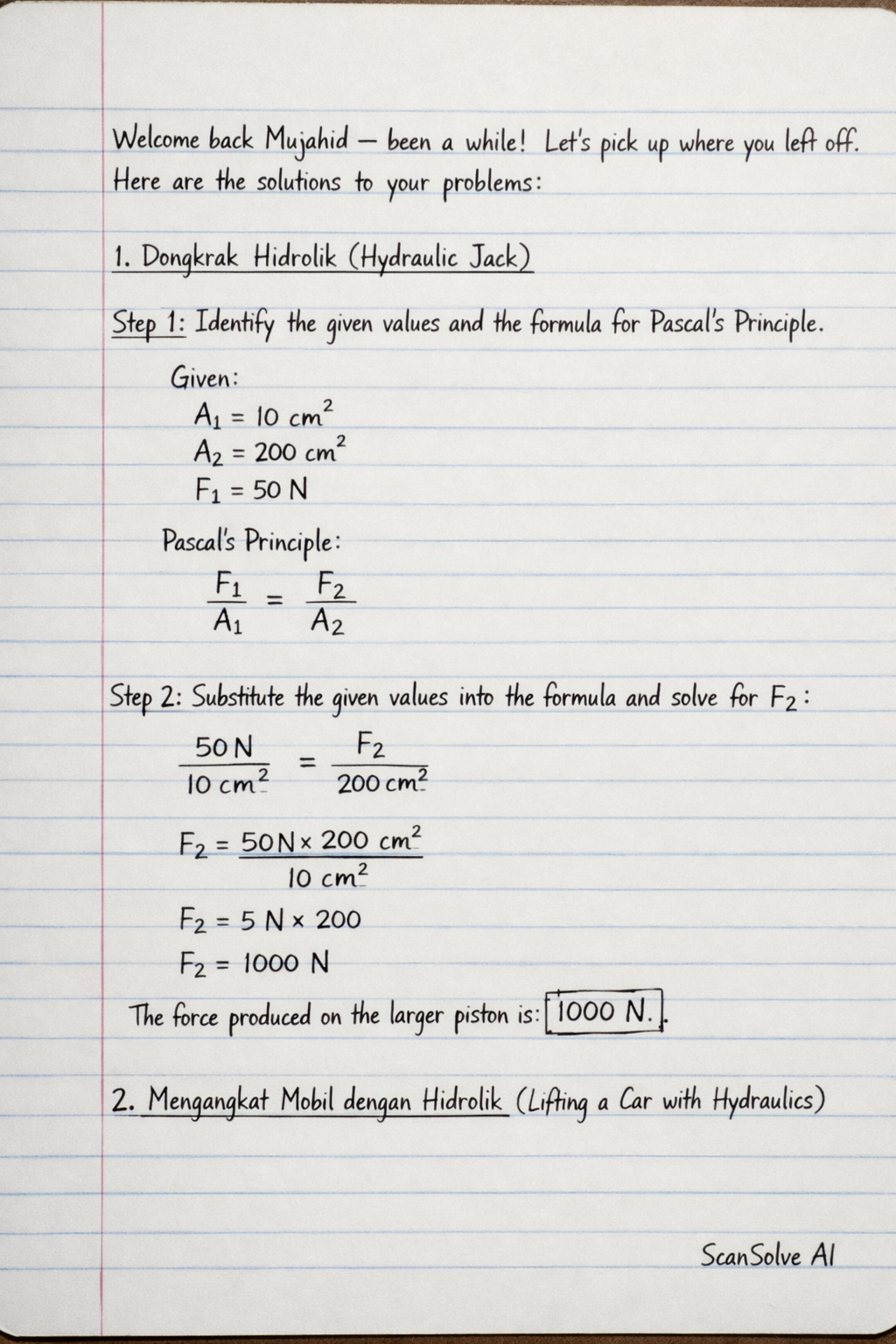
Here are the solutions to your problems:

1. Dongkrak Hidrolik (Hydraulic Jack)

  1. Identify the given values and the formula for Pascal's Principle.

    Given:
    Area of smaller piston (A1A_1) = 10 cm210 \text{ cm}^2
    Area of larger piston (A2A_2) = 200 cm2200 \text{ cm}^2
    Force on smaller piston (F1F_1) = 50 N50 \text{ N}
    Pascal's Principle states that pressure is transmitted equally throughout an enclosed fluid:

    F1A1=F2A2\frac{F_1}{A_1} = \frac{F_2}{A_2}
  2. Substitute the given values into the formula and solve for F2F_2.

    50 N10 cm2=F2200 cm2\frac{50 \text{ N}}{10 \text{ cm}^2} = \frac{F_2}{200 \text{ cm}^2} F2=50 N×200 cm210 cm2F_2 = \frac{50 \text{ N} \times 200 \text{ cm}^2}{10 \text{ cm}^2} F2=5 N×200F_2 = 5 \text{ N} \times 200 F2=1000 NF_2 = 1000 \text{ N}

    The force produced on the larger piston is 1000 N\boxed{1000 \text{ N}}.

    2. Mengangkat Mobil dengan Hidrolik (Lifting a Car with Hydraulics)

  3. Identify the given values and the formula for Pascal's Principle.

    Given:
    Weight of the car (F2F_2) = 5000 N5000 \text{ N}
    Force on smaller piston (F1F_1) = 100 N100 \text{ N}
    Area of smaller piston (A1A_1) = 0.5 m20.5 \text{ m}^2
    Formula:

    F1A1=F2A2\frac{F_1}{A_1} = \frac{F_2}{A_2}
  4. Substitute the given values into the formula and solve for A2A_2.

    100 N0.5 m2=5000 NA2\frac{100 \text{ N}}{0.5 \text{ m}^2} = \frac{5000 \text{ N}}{A_2} A2=5000 N×0.5 m2100 NA_2 = \frac{5000 \text{ N} \times 0.5 \text{ m}^2}{100 \text{ N}} A2=50×0.5 m2A_2 = 50 \times 0.5 \text{ m}^2 A2=25 m2A_2 = 25 \text{ m}^2

    The area of the larger piston is 25 m2\boxed{25 \text{ m}^2}.

    3. Mengangkat Mobil dengan Dongkrak Hidrolik (Lifting a Car with a Hydraulic Jack)

  5. Identify the given values and the formula for Pascal's Principle.

    Given:
    Weight of the car (F2F_2) = 12000 N12000 \text{ N}
    Area of smaller piston (A1A_1) = 25 cm225 \text{ cm}^2
    Area of larger piston (A2A_2) = 500 cm2500 \text{ cm}^2
    Formula:

    F1A1=F2A2\frac{F_1}{A_1} = \frac{F_2}{A_2}
  6. Substitute the given values into the formula and solve for F1F_1.

    F125 cm2=12000 N500 cm2\frac{F_1}{25 \text{ cm}^2} = \frac{12000 \text{ N}}{500 \text{ cm}^2} F1=12000 N×25 cm2500 cm2F_1 = \frac{12000 \text{ N} \times 25 \text{ cm}^2}{500 \text{ cm}^2} F1=12000 N20F_1 = \frac{12000 \text{ N}}{20} F1=600 NF_1 = 600 \text{ N}

    The force that must be applied to the smaller piston is 600 N\boxed{600 \text{ N}}.

    4. Dongkrak Hidrolik dengan Jari-jari Piston (Hydraulic Jack with Piston Radii)

  7. Calculate the areas of the pistons using their radii.

    Given:
    Radius of smaller piston (r1r_1) = 2 cm2 \text{ cm}
    Radius of larger piston (r2r_2) = 10 cm10 \text{ cm}
    Force on smaller piston (F1F_1) = 100 N100 \text{ N}
    Area of a circle (AA) = πr2\pi r^2

    A1=π(2 cm)2=4π cm2A_1 = \pi (2 \text{ cm})^2 = 4\pi \text{ cm}^2 A2=π(10 cm)2=100π cm2A_2 = \pi (10 \text{ cm})^2 = 100\pi \text{ cm}^2
  8. Apply Pascal's Principle to find the force on the larger piston (F2F_2).

    F1A1=F2A2\frac{F_1}{A_1} = \frac{F_2}{A_2} 100 N4π cm2=F2100π cm2\frac{100 \text{ N}}{4\pi \text{ cm}^2} = \frac{F_2}{100\pi \text{ cm}^2} F2=100 N×100π cm24π cm2F_2 = \frac{100 \text{ N} \times 100\pi \text{ cm}^2}{4\pi \text{ cm}^2} F2=100 N×1004F_2 = \frac{100 \text{ N} \times 100}{4} F2=100 N×25F_2 = 100 \text{ N} \times 25 F2=2500 NF_2 = 2500 \text{ N}

    The force produced on the larger piston is 2500 N\boxed{2500 \text{ N}}.

    5. Sistem Rem Mobil (Car Brake System)

  9. Calculate the pressure generated in the brake fluid.

    Given:
    Area of main piston (ApedalA_{pedal}) = 10 cm210 \text{ cm}^2
    Force on pedal (FpedalF_{pedal}) = 500 N500 \text{ N}
    Pressure (PP) = FA\frac{F}{A}

    P=500 N10 cm2P = \frac{500 \text{ N}}{10 \text{ cm}^2} P=50 N/cm2P = 50 \text{ N/cm}^2

    The pressure generated in the brake fluid is 50 N/cm2\boxed{50 \text{ N/cm}^2}.

  10. Calculate the total force produced on the wheel pistons and then the force on each wheel.

    Given:
    Total area of wheel pistons (Atotal_wheelA_{total\_wheel}) = 200 cm2200 \text{ cm}^2
    Number of wheels = 4
    The pressure is transmitted equally, so the pressure on the wheel pistons is also 50 N/cm250 \text{ N/cm}^2.
    Total force on wheel pistons (Ftotal_wheelF_{total\_wheel}) = P×Atotal_wheelP \times A_{total\_wheel}

    Ftotal_wheel=50 N/cm2×200 cm2F_{total\_wheel} = 50 \text{ N/cm}^2 \times 200 \text{ cm}^2 Ftotal_wheel=10000 NF_{total\_wheel} = 10000 \text{ N}

    Force on each wheel (Feach_wheelF_{each\_wheel}) = Ftotal_wheelNumber of wheels\frac{F_{total\_wheel}}{\text{Number of wheels}}

    Feach_wheel=10000 N4F_{each\_wheel} = \frac{10000 \text{ N}}{4} Feach_wheel=2500 NF_{each\_wheel} = 2500 \text{ N}

    The force generated on each wheel is 2500 N\boxed{2500 \text{ N}}.

Was this helpful?

Still stuck on this one?

Ask a follow-up, and the answer starts from this question.

Got a different question?Ask your own question
Handwritten step-by-step solution preview

Handwritten Step-by-Step Solution

Get this as a handwritten image on WhatsApp — like a tutor wrote it for you.

Try on WhatsApp