
![Prove that: i. Cv = [dE/dT]v ii. Cp = [dH/dT]p](/_next/image?url=https%3A%2F%2Fohijasnjvprzodcmxltt.supabase.co%2Fstorage%2Fv1%2Fobject%2Fpublic%2Fwhatsapp-images%2F1782088526951-68dd76d5ea3c1b89.png&w=3840&q=75)
This physics problem tests your understanding of fundamental physical laws and their applications. The step-by-step solution below breaks down the problem using relevant equations and physical reasoning.
ScanSolve AI Answer
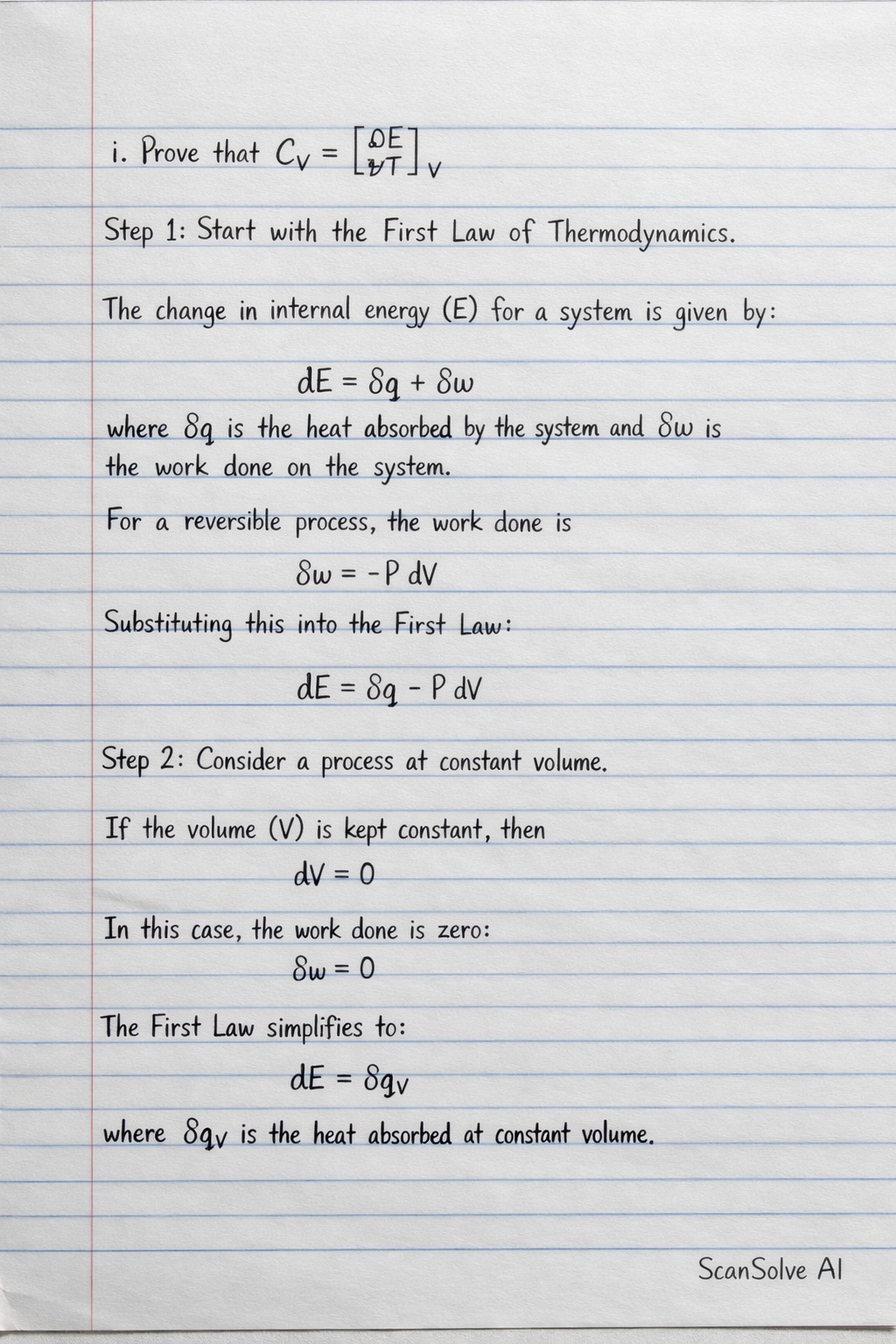
Here's the proof for the definitions of heat capacities at constant volume and constant pressure. i. Prove that C_V = [( E)/( T)]_V Step 1: Start with the First Law of Thermodynamics. The change in internal energy (E) for a system is given by: dE = q + w where q is the heat absorbed by the system and w is the work done on the system. For a reversible process, the work done is w = -P dV. Substituting this into the First Law: dE = q - P dV Step 2: Consider a process at constant volume. If the volume (V) is kept constant, then dV = 0. In this case, the work done is zero ( w = 0). The First Law simplifies to: dE = q_V where q_V is the heat absorbed at constant volume. Step 3: Define heat capacity at constant volume (C_V). Heat capacity at constant volume is defined as the amount of heat required to raise the temperature of a substance by one degree Celsius (or Kelvin) at constant volume: C_V = (( q_V)/( T))_V Step 4: Substitute dE into the definition of C_V. Since dE = q_V at constant volume, we can replace q_V with dE: C_V = (( E)/( T))_V This proves the first relation. C_V = [( E)/( T)]_V ii. Prove that C_P = [( H)/( T)]_P Step 1: Start with the definition of enthalpy (H). Enthalpy is defined as: H = E + PV where E is internal energy, P is pressure, and V is volume. Taking the total differential of H: dH = dE + d(PV) = dE + P dV + V dP Step 2: Substitute dE from the First Law of Thermodynamics. From Step 1 of part (i), we know dE = q - P dV. Substitute this into the expression for dH: dH = ( q - P dV) + P dV + V dP dH = q + V dP Step 3: Consider a process at constant pressure. If the pressure (P) is kept constant, then dP = 0. The expression for dH simplifies to: dH = q_P where q_P is the heat absorbed at constant pressure. Step 4: Define heat capacity at constant pressure (C_P). Heat capacity at constant pressure is defined as the amount of heat required to raise the temperature of a substance by one degree Celsius (or Kelvin) at constant pressure: C_P = (( q_P)/( T))_P Step 5: Substitute dH into the definition of C_P. Since dH = q_P at constant pressure, we can replace q_P with dH: C_P = (( H)/( T))_P This proves the second relation. C_P = [( H)/( T)]_P Send me the next one 📸