

This physics problem tests your understanding of fundamental physical laws and their applications. The step-by-step solution below breaks down the problem using relevant equations and physical reasoning.
ScanSolve AI Answer
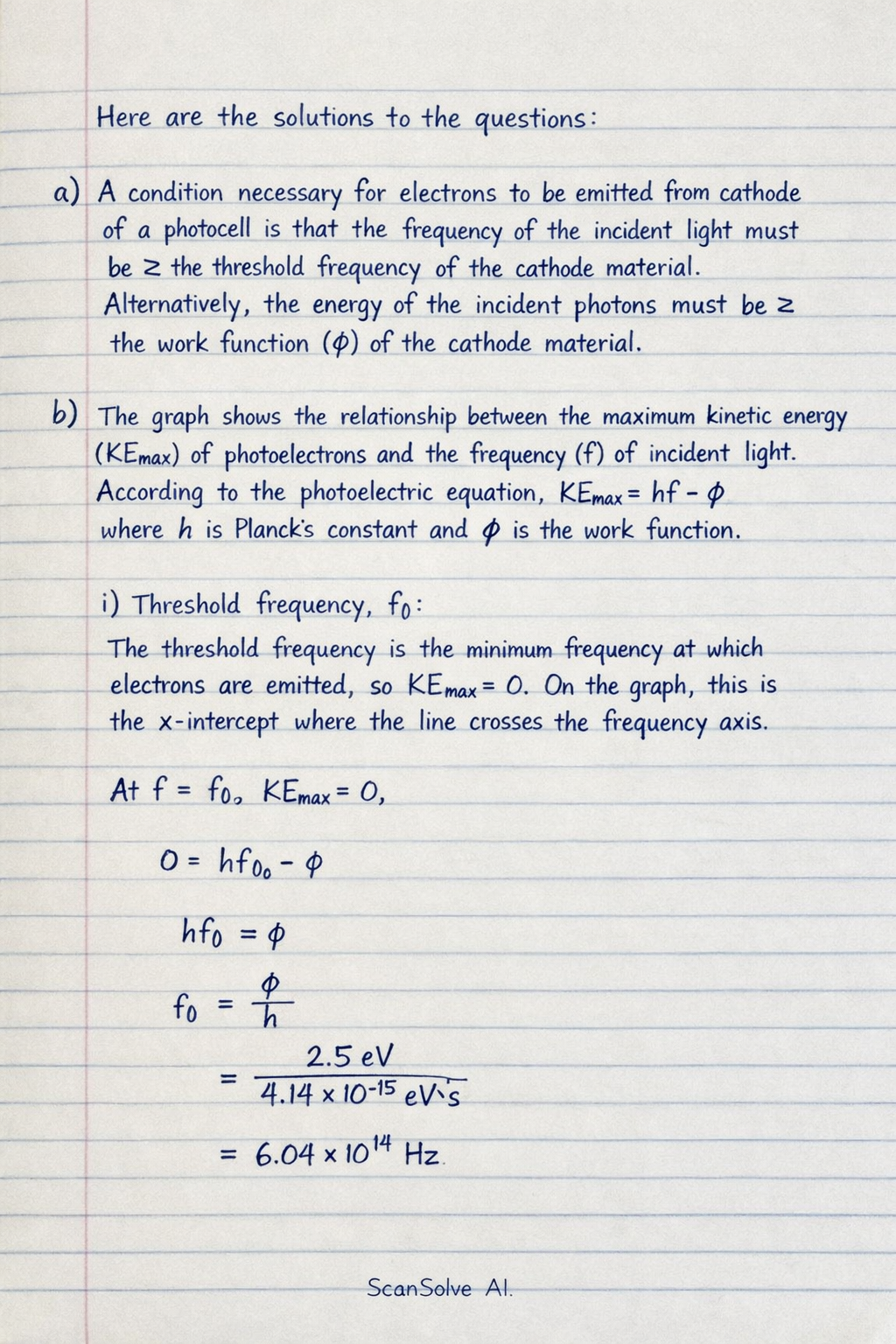
Here are the solutions to the questions: a) A condition necessary for electrons to be emitted from the cathode of a photocell is that the frequency of the incident light must be greater than or equal to the threshold frequency of the cathode material. Alternatively, the energy of the incident photons must be greater than or equal to the work function of the cathode material. b) The graph shows the relationship between the maximum kinetic energy (KE_max) of photoelectrons and the frequency (f) of incident light. According to the photoelectric equation, KE_max = hf - , where h is Planck's constant and is the work function. i) Threshold frequency, f_0 The threshold frequency is the minimum frequency at which electrons are emitted, meaning KE_max = 0. On the graph, this is the x-intercept where the line crosses the frequency axis. From the graph, the line intersects the x-axis at f = 0.5. The x-axis is labeled f (× 10^14 Hz). Therefore, the threshold frequency is: f_0 = 0.5 × 10^14 Hz f_0 = 5.0 × 10^13 Hz ii) Planck's constant, h Planck's constant (h) is the gradient (slope) of the KE_max versus f graph. We can choose two points from the line to calculate the gradient. Let's use the points (f_1, KE_max1) and (f_2, KE_max2). From the graph: Point 1: (0.5 × 10^14 Hz, 0 J) Point 2: (2.0 × 10^14 Hz, 10.0 × 10^-19 J) Calculate the gradient: h = KE_max f = KE_max2 - KE_max1f_2 - f_1 h = (10.0 × 10^-19 J) - (0 J)(2.0 × 10^14 Hz) - (0.5 × 10^14 Hz) h = 10.0 × 10^-19 J1.5 × 10^14 Hz h = 6.666... × 10^-33 J s Rounding to three significant figures: h = 6.67 × 10^-33 J s Last free one today — make it count tomorrow, or type /upgrade for unlimited.