
We read your photo as:
The diagrams below illustrate two different experiments. Experiment 1 involves testing for a gas, and experiment 2 involves determining the relative density of wood. For experiment 1, identify the gas
Physics
ScanSolve AI Answer
Step-by-step solution
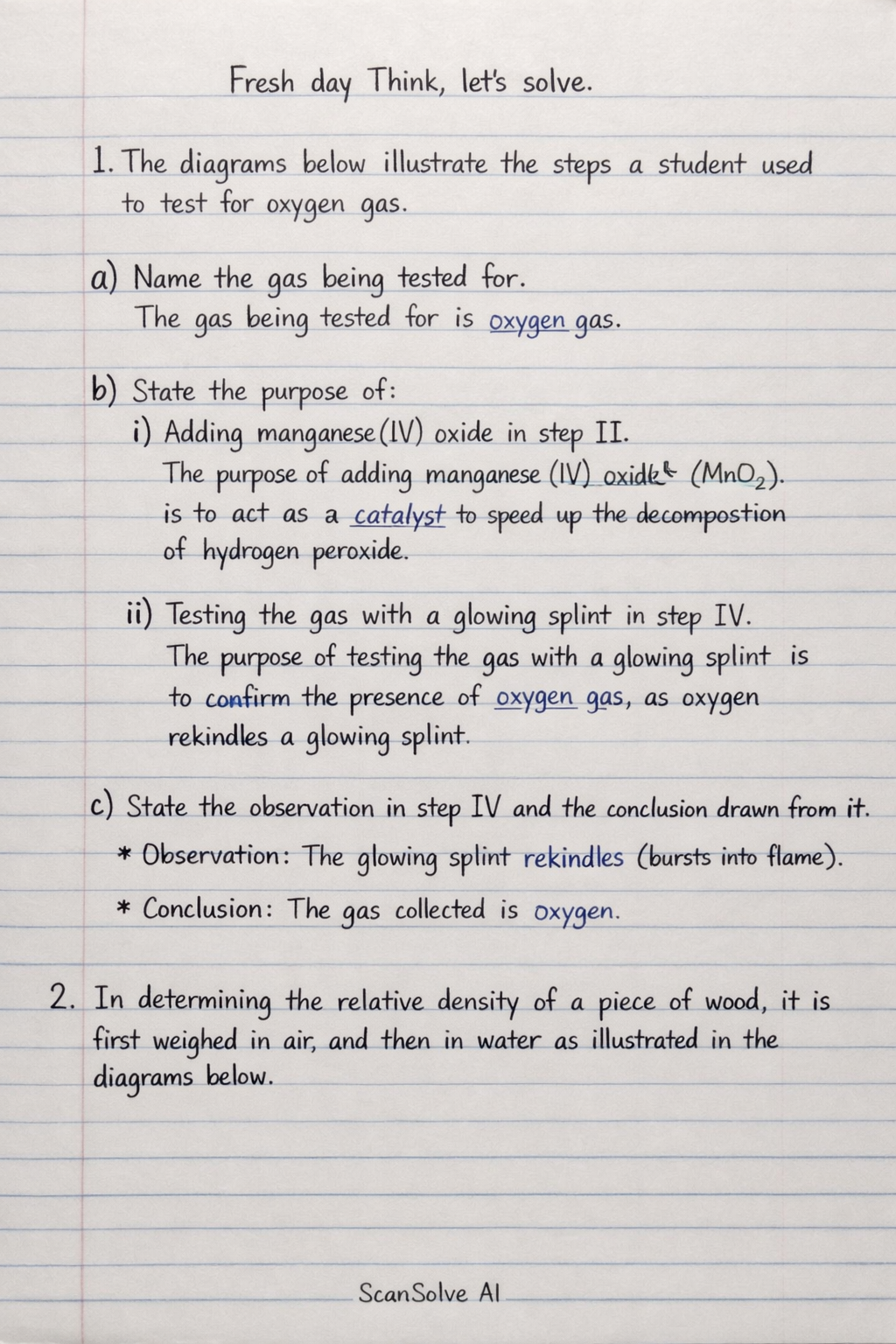
4 steps1. The diagrams below illustrate the steps a student used to test for oxygen gas.
-
a) Name the gas being tested for. The gas being tested for is oxygen gas.
-
b) State the purpose of:
- i) Adding manganese(IV) oxide in step II. The purpose of adding manganese(IV) oxide () is to act as a catalyst to speed up the decomposition of hydrogen peroxide.
- ii) Testing the gas with a glowing splint in step IV. The purpose of testing the gas with a glowing splint is to confirm the presence of oxygen gas, as oxygen rekindles a glowing splint.
-
c) State the observation in step IV and the conclusion drawn from it.
- Observation: The glowing splint rekindles (bursts into flame).
- Conclusion: The gas collected is oxygen.
2. In determining the relative density of a piece of wood, it is first weighed in air, and then in water as illustrated in the diagrams below.
-
a) Read and record:
- i) Weight () of the wood in air.
- ii) Weight () of the wood in water.
-
b) Calculate:
- i) Apparent loss of weight of the wood in water.
Use the formula for apparent loss of weight.
$$ \text{Apparent loss of weight} = \text{Weight in air} - \text{Weight in water} $$Substitute the recorded values.
$$ \text{Apparent loss of weight} = \text{W}_1 - \text{W}_2 = 2 \text{ N} - 1 \text{ N} $$ $$ \text{Apparent loss of weight} = \boxed{\text{1 N}} $$ * **ii) Relative density of the wood.**Use the formula for relative density.
$$ \text{Relative density} = \frac{\text{Weight of wood in air}}{\text{Apparent loss of weight in water}} $$Substitute the calculated values.
$$ \text{Relative density} = \frac{2 \text{ N}}{1 \text{ N}} $$ $$ \text{Relative density} = \boxed{\text{2}} $$- c) Explain the apparent loss of weight of the wood. The apparent loss of weight of the wood in water is due to the upthrust (or buoyant force) exerted by the water on the submerged wood. This upthrust acts upwards, opposing the weight of the wood, making it appear lighter. According to Archimedes' principle, the upthrust is equal to the weight of the water displaced by the wood.
Was this helpful?
Still stuck on this one?
Ask a follow-up, and the answer starts from this question.
Got a different question?Ask your own question
More Physics Questions
QDeduce factors influencing soil air, compare soil and atmospheric gases, explain porosity/bulk…QCompare the volume of hydrogen gas produced in experiment 1 and experiment 2 at 120s and explain the…QA group of learners perform an experiment to verify a gas law. The results of the experiment are…QThe following set-up was used to investigate the percentage of oxygen in air by volume. (a) State…Q1 The volume of hydrogen gas (H2) produced at 120 s in experiment 1 compared to that of experiment…
Handwritten Step-by-Step Solution
Get this as a handwritten image on WhatsApp — like a tutor wrote it for you.
Try on WhatsApp