The mass of a gas per unit time, m, escaping through an opening depends on the area, A, of the opening, the pressure, P of the gas and the density, ho of the gas. Use the method of dimensions to obtai
|Physics
The mass of a gas per unit time, m, escaping through an opening depends on the area, A, of the opening, the pressure, P of the gas and the density, ho of the gas. Use the method of dimensions to obtai
ScanSolve AI Answer
Answer
\text{*m = k A \sqrt{P \rho}*}
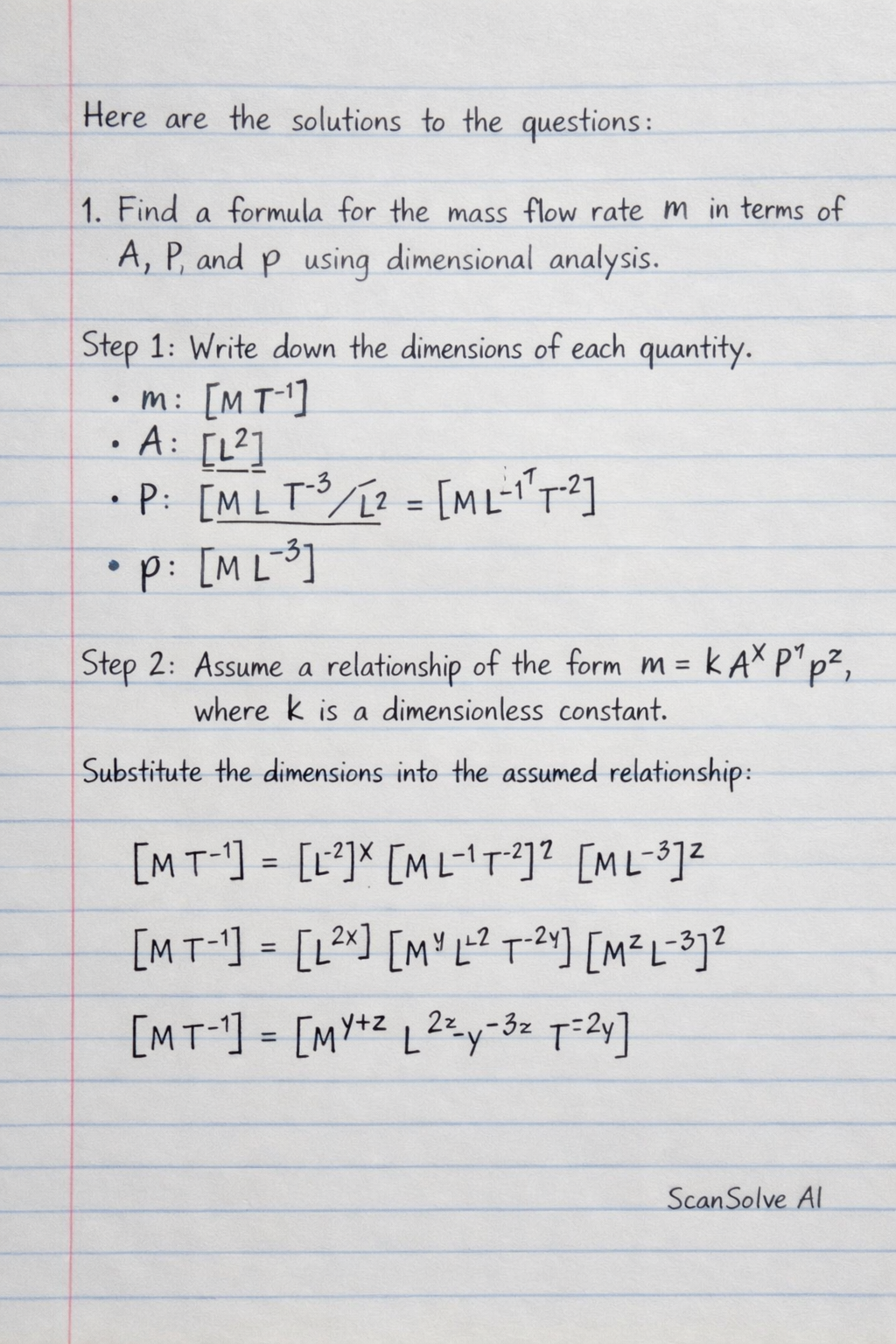
Here are the solutions to the questions:
1. The mass of a gas per unit time, m, escaping through an opening depends on the area, A, of the opening, the pressure, P of the gas and the density, ρ of the gas. Use the method of dimensions to obtain a formula for m in terms of A, P and ρ.
Step 1: Write down the dimensions of each quantity.
Mass per unit time, m: [MT−1]
Area, A: [L2]
Pressure, P (Force/Area = Mass × Acceleration / Area): [MLT−2/L2]=[ML−1T−2]
Density, ρ (Mass/Volume): [ML−3]
Step 2: Assume a relationship of the form m=kAxPyρz, where k is a dimensionless constant.
Substitute the dimensions into the assumed relationship:
[MT−1]=[L2]x[ML−1T−2]y[ML−3]z[MT−1]=[L2x][MyL−yT−2y][MzL−3z][MT−1]=[My+zL2x−y−3zT−2y]
Step 3: Equate the powers of M, L, and T on both sides of the equation.
For M: 1=y+z (Equation 1)
For T: −1=−2y⟹y=21 (Equation 2)
For L: 0=2x−y−3z (Equation 3)
Step 4: Solve the system of equations.
Substitute y=21 into Equation 1:
1=21+z⟹z=1−21=21
Substitute y=21 and z=21 into Equation 3:
0=2x−21−3(21)0=2x−21−230=2x−240=2x−22x=2⟹x=1
Step 5: Substitute the values of x,y,z back into the assumed relationship.
m=kA1P1/2ρ1/2m=kAPρ
The formula for m is ∗m=kAPρ∗
2. a. Define Young modulus.
Young modulus is a measure of the stiffness of an elastic material. It is defined as the ratio of tensile stress (force per unit area) to tensile strain (fractional change in length) within the elastic limit of the material.
2. b. When a force of 50 N is applied to the free end of an elastic cord, an extension of 5 cm is produced. Calculate the work done on the cord.
Given:
Force, F=50 N
Extension, x=5 cm =0.05 m
Step 1: The work done on an elastic cord (or spring) is given by the formula W=21Fx, where F is the applied force and x is the extension.
Step 2: Substitute the given values into the formula.
W=21×50N×0.05 mW=25N×0.05 mW=1.25 J
The work done on the cord is ∗1.25J∗
3. State three materials used for marking optical fibres.
UV-curable inks
Pigmented polymer coatings
Fluorescent dyes
4. a. What is the range of a projectile?
The range of a projectile is the total horizontal distance covered by the projectile from its point of projection to the point where it lands at the same horizontal level.
4. b. An athlete threw a javelin with a velocity of 12 ms−1. If the javelin hits the ground after 1.5 s, calculate its angle of projection. [g = 10 ms−2].
Given:
Initial velocity, u=12ms−1
Time of flight, t=1.5 s
Acceleration due to gravity, g=10ms−2
Step 1: Consider the vertical motion of the projectile. Assuming the javelin is thrown from and lands at the same horizontal level, the net vertical displacement (sy) is 0.
The vertical component of initial velocity is uy=usinθ.
The acceleration in the vertical direction is ay=−g (taking upward as positive).
Using the kinematic equation sy=uyt+21ayt2:
0=(usinθ)t+21(−g)t20=(usinθ)t−21gt2
Step 2: Since t=0 (the javelin is in the air for 1.5 s), we can divide by t:
0=usinθ−21gtusinθ=21gt
Step 3: Solve for sinθ.
sinθ=2ugt
Step 4: Substitute the given values.
sinθ=2×(12ms−1)(10ms−2)×(1.5s)sinθ=2415sinθ=0.625
Step 5: Calculate the angle θ.
θ=arcsin(0.625)θ≈38.68∘
The angle of projection is ∗38.68∘∗
5. a. What does the acronym LASER stand for?
LASER stands for Light Amplification by Stimulated Emission of Radiation.
5. b. What is a laser?
A laser is a device that produces a highly concentrated, monochromatic (single color), coherent (waves in phase), and collimated (traveling in a narrow, parallel beam) light through the process of stimulated emission of electromagnetic radiation.
6. State three differences between sound waves and light waves.
Nature: Sound waves are mechanical waves that require a medium for propagation, whereas light waves are electromagnetic waves that can travel through a vacuum.
Type of wave: Sound waves are longitudinal waves, meaning the particles of the medium oscillate parallel to the direction of wave propagation. Light waves are transverse waves, meaning the electric and magnetic fields oscillate perpendicular to the direction of wave propagation.
Speed: Light waves travel significantly faster than sound waves. For example, in air, light travels at approximately 3×10⁸ m/s, while sound travels at approximately 343 m/s.
7. Explain why conductivity of an elemental semiconductor increases when doped with either a Group III or V element.
Elemental semiconductors like silicon (Group IV) have four valence electrons, forming stable covalent bonds. Their intrinsic conductivity is low.
Doping with a Group V element (e.g., phosphorus): Group V elements have five valence electrons. When a Group V atom replaces a semiconductor atom in the crystal lattice, four of its valence electrons form covalent bonds, leaving one extra
Was this helpful?
Need help with your own homework?
Get instant step-by-step solutions to any question. Free to start.
1. The mass of a gas per unit time, m, escaping through an opening depends on the area, A, of the opening, the pressure, P of the gas and the density, of the gas.
The mass of a gas per unit time, m, escaping through an opening depends on the area, A, of the opening, the pressure, P of the gas and the density, ho of the gas. Use the method of dimensions to obtai
This physics problem tests your understanding of fundamental physical laws and their applications. The step-by-step solution below breaks down the problem using relevant equations and physical reasoning.
ScanSolve AI Answer
Here are the solutions to the questions: 1. The mass of a gas per unit time, m, escaping through an opening depends on the area, A, of the opening, the pressure, P of the gas and the density, of the gas. Use the method of dimensions to obtain a formula for m in terms of A, P and . Step 1: Write down the dimensions of each quantity. Mass per unit time, m: [M T^-1] Area, A: [L^2] Pressure, P (Force/Area = Mass × Acceleration / Area): [M L T^-2 / L^2] = [M L^-1 T^-2] Density, (Mass/Volume): [M L^-3] Step 2: Assume a relationship of the form m = k A^x P^y ^z, where k is a dimensionless constant. Substitute the dimensions into the assumed relationship: [M T^-1] = [L^2]^x [M L^-1 T^-2]^y [M L^-3]^z [M T^-1] = [L^2x] [M^y L^-y T^-2y] [M^z L^-3z] [M T^-1] = [M^y+z L^2x-y-3z T^-2y] Step 3: Equate the powers of M, L, and T on both sides of the equation. For M: 1 = y+z (Equation 1) For T: -1 = -2y y = (1)/(2) (Equation 2) For L: 0 = 2x-y-3z (Equation 3) Step 4: Solve the system of equations. Substitute y = (1)/(2) into Equation 1: 1 = (1)/(2) + z z = 1 - (1)/(2) = (1)/(2) Substitute y = (1)/(2) and z = (1)/(2) into Equation 3: 0 = 2x - (1)/(2) - 3((1)/(2)) 0 = 2x - (1)/(2) - (3)/(2) 0 = 2x - (4)/(2) 0 = 2x - 2 2x = 2 x = 1 Step 5: Substitute the values of x, y, z back into the assumed relationship. m = k A^1 P^1/2 ^1/2 m = k A sqrt(P ) The formula for m is m = k A sqrt(P ) 2. a. Define Young modulus. Young modulus is a measure of the stiffness of an elastic material. It is defined as the ratio of tensile stress (force per unit area) to tensile strain (fractional change in length) within the elastic limit of the material. 2. b. When a force of 50 N is applied to the free end of an elastic cord, an extension of 5 cm is produced. Calculate the work done on the cord. Given: Force, F = 50 N Extension, x = 5 cm = 0.05 m Step 1: The work done on an elastic cord (or spring) is given by the formula W = (1)/(2) Fx, where F is the applied force and x is the extension. Step 2: Substitute the given values into the formula. W = (1)/(2) × 50 N × 0.05 m W = 25 N × 0.05 m W = 1.25 J The work done on the cord is 1.25 J 3. State three materials used for marking optical fibres. UV-curable inks* Pigmented polymer coatings* Fluorescent dyes* 4. a. What is the range of a projectile? The range of a projectile is the total horizontal distance covered by the projectile from its point of projection to the point where it lands at the same horizontal level. 4. b. An athlete threw a javelin with a velocity of 12 ms^-1. If the javelin hits the ground after 1.5 s, calculate its angle of projection. [g = 10 ms^-2]. Given: Initial velocity, u = 12 ms^-1 Time of flight, t = 1.5 s Acceleration due to gravity, g = 10 ms^-2 Step 1: Consider the vertical motion of the projectile. Assuming the javelin is thrown from and lands at the same horizontal level, the net vertical displacement (s_y) is 0. The vertical component of initial velocity is u_y = u . The acceleration in the vertical direction is a_y = -g (taking upward as positive). Using the kinematic equation s_y = u_y t + (1)/(2) a_y t^2: 0 = (u ) t + (1)/(2) (-g) t^2 0 = (u ) t - (1)/(2) g t^2 Step 2: Since t ≠ 0 (the javelin is in the air for 1.5 s), we can divide by t: 0 = u - (1)/(2) g t u = (1)/(2) g t Step 3: Solve for . = (g t)/(2u) Step 4: Substitute the given values. = (10 ms^-2) × (1.5 s)2 × (12 ms^-1) = (15)/(24) = 0.625 Step 5: Calculate the angle . = (0.625) ≈ 38.68^ The angle of projection is 38.68^ 5. a. What does the acronym LASER stand for? LASER stands for Light Amplification by Stimulated Emission of Radiation*. 5. b. What is a laser? A laser is a device that produces a highly concentrated, monochromatic (single color), coherent (waves in phase), and collimated (traveling in a narrow, parallel beam) light through the process of stimulated emission of electromagnetic radiation. 6. State three differences between sound waves and light waves. Nature: Sound waves are mechanical waves that require a medium for propagation, whereas light waves are electromagnetic waves* that can travel through a vacuum. Type of wave: Sound waves are longitudinal waves, meaning the particles of the medium oscillate parallel to the direction of wave propagation. Light waves are transverse waves*, meaning the electric and magnetic fields oscillate perpendicular to the direction of wave propagation. Speed: Light waves travel significantly faster than sound waves. For example, in air, light travels at approximately 3 × 10^8 m/s, while sound travels at approximately 343 m/s. 7. Explain why conductivity of an elemental semiconductor increases when doped with either a Group III or V element. Elemental semiconductors like silicon (Group IV) have four valence electrons, forming stable covalent bonds. Their intrinsic conductivity is low. Doping with a Group V element (e.g., phosphorus): Group V elements have five valence electrons. When a Group V atom replaces a semiconductor atom in the crystal lattice, four of its valence electrons form covalent bonds, leaving one extra