
We read your photo as:
The provided text appears to be a solution set for a physics homework assignment. It contains answers and explanations for questions numbered 60, 61, and 62. Question 60 defines latent heat and asks f
ScanSolve AI Answer
Answer
Change phase without temperature change
Step-by-step solution
9 stepsHere are the solutions to the questions:
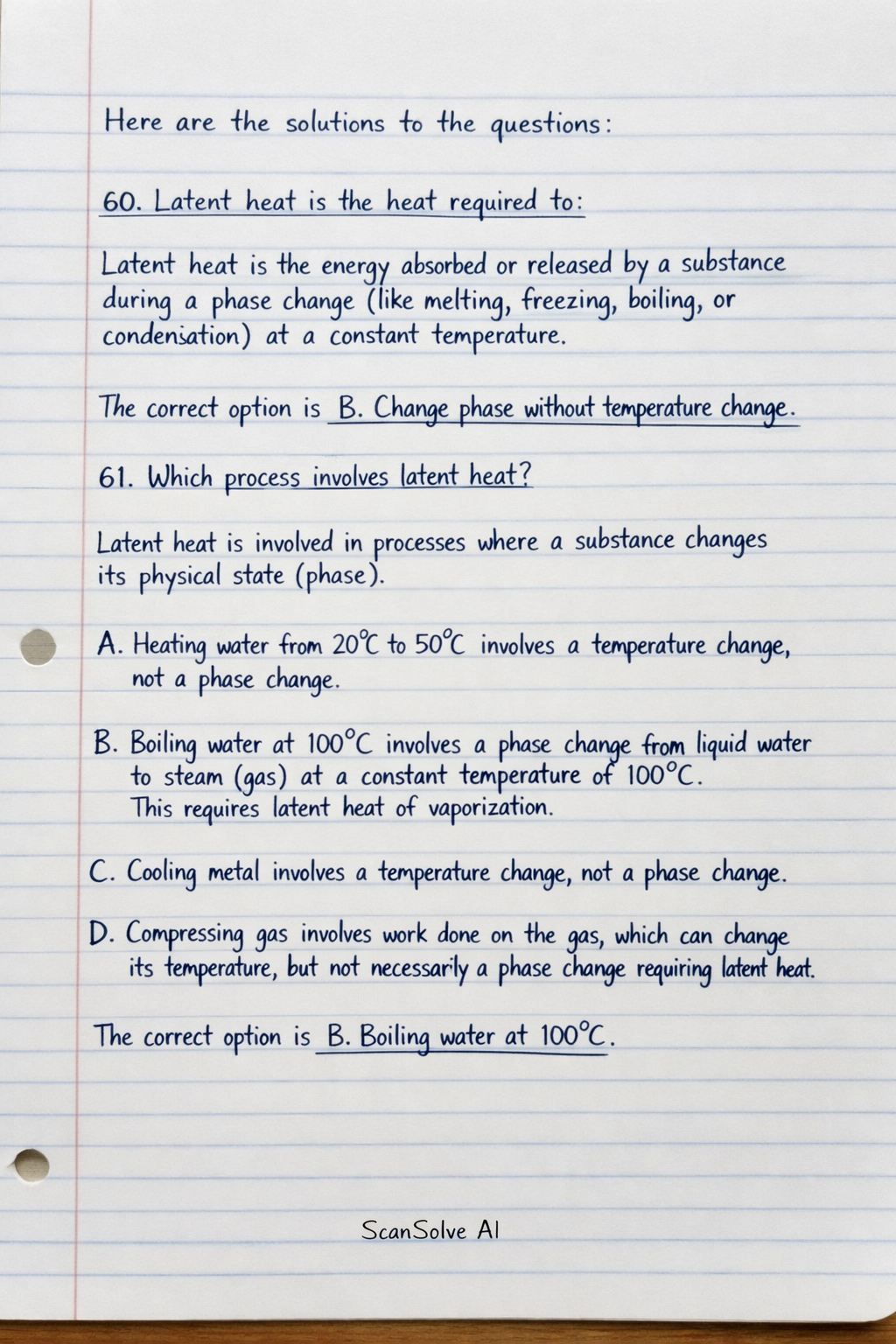
60. Latent heat is the heat required to:
Latent heat is the energy absorbed or released by a substance during a phase change (like melting, freezing, boiling, or condensation) at a constant temperature.
The correct option is B. Change phase without temperature change.
61. Which process involves latent heat?
Latent heat is involved in processes where a substance changes its physical state (phase).
- A. Heating water from to involves a temperature change, not a phase change.
- B. Boiling water at involves a phase change from liquid water to steam (gas) at a constant temperature of . This requires latent heat of vaporization.
- C. Cooling metal involves a temperature change, not a phase change.
- D. Compressing gas involves work done on the gas, which can change its temperature, but not necessarily a phase change requiring latent heat.
The correct option is B. Boiling water at .
62. A 0.5 kg aluminum block (c = 900 J/kg°C) at 200°C is placed in 1 kg of water at 20°C. Final temperature is 40°C. Heat lost by aluminum is:
Identify the given values for the aluminum block.
Mass of aluminum,
Specific heat capacity of aluminum,
Initial temperature of aluminum,
Final temperature of aluminum,Calculate the change in temperature for the aluminum block.
Calculate the heat lost by the aluminum block using the formula .
Since we are looking for heat lost, we take the absolute value.
The correct option is C. 72,000 J.
63. Why is final temperature the same in calorimetry problems?
In calorimetry problems, when objects at different temperatures are brought into contact within an isolated system, heat energy is exchanged between them until they reach a state of thermal equilibrium. At thermal equilibrium, all parts of the system have the same temperature.The correct option is B. Heat flows until thermal equilibrium.
64. How much heat is required to convert 1 kg ice at 0°C to water at 100°C? (c = 4200 J/kg°C, L = 334,000 J/kg)
Calculate the heat required to melt 1 kg of ice at to 1 kg of water at (latent heat of fusion).
Given mass and latent heat of fusion .
Calculate the heat required to raise the temperature of 1 kg of water from to .
Given mass , specific heat capacity of water , and temperature change .
Calculate the total heat required.
The correct option is B. 754,000 J. (Option C, 420,000 + 334,000 J, also represents the correct sum).
65. A steel rod of 2 m expands by 1.2 mm when heated. Find temperature change. ()
Identify the given values and ensure consistent units.
Original length,
Change in length,
Coefficient of linear expansion,Use the formula for linear thermal expansion, , and rearrange to solve for .
Substitute the values and calculate .
The correct option is **B. $50^\circ
Try one yourself
A new problem that tests the same skill.
Still stuck on this one?
Ask a follow-up, and the answer starts from this question.
More Physics Questions
Handwritten Step-by-Step Solution
Get this as a handwritten image on WhatsApp — like a tutor wrote it for you.
Try on WhatsApp