
We read your photo as:
What are the solutions for questions 17 through 21, including the equivalent resistance calculation?
ScanSolve AI Answer
Answer
Step-by-step solution
11 stepsHere are the solutions for questions 17 through 21, and the equivalent resistance calculation.
- Given: Focal length,
Convert the focal length from centimeters to meters.
$$ f = 20 \text{ cm} = 0.20 \text{ m} $$Use the formula for the power of a lens (), which is the reciprocal of the focal length in meters.
For a converging lens, the focal length is positive.
Substitute the value of and calculate the power.
$$ P = \frac{1}{0.20 \text{ m}} $$ $$ P = +5.0 \text{ D} $$ The correct option is **B**. The final answer is $\boxed{+5.0 \text{ D}}$.18. Given: Radius of curvature,
Recall the relationship between the focal length () and the radius of curvature () for a mirror.
$$ f = \frac{R}{2} $$For a convex mirror, the focal length is conventionally negative.
$$ f = -\frac{R}{2} $$Substitute the value of and calculate the focal length.
$$ f = -\frac{2 \text{ m}}{2} $$ $$ f = -1 \text{ m} $$ The correct option is **C**. The final answer is $\boxed{-1 \text{ m}}$.19. Ohm's law states that the voltage () across a conductor is directly proportional to the current () flowing through it, provided all physical conditions and temperature remain constant. The constant of proportionality is the resistance (). The correct expression for Ohm's law is . The correct option is A. The final answer is .
-
The resistance () of a wire is given by the formula , where is the resistivity of the material, is the length of the wire, and is its cross-sectional area. From this formula, resistance is directly proportional to length. Therefore, an increase in length will increase the resistance of the wire. The correct option is D. The final answer is .
-
The SI unit of electric current is the ampere (A). The correct option is B. The final answer is .
For the equivalent resistance calculation shown in the image:
The circuit shows three resistors connected in parallel.-
Use the formula for equivalent resistance () of resistors in parallel.
Substitute the given resistance values.
Add the fractions.
Invert the result to find .
Convert the fraction to a decimal.
The calculation shown in the image for is incorrect in its initial setup (), but the final numerical value of is correct for three resistors in parallel.
Try one yourself
A new problem that tests the same skill.
Still stuck on this one?
Ask a follow-up, and the answer starts from this question.
More Physics Questions
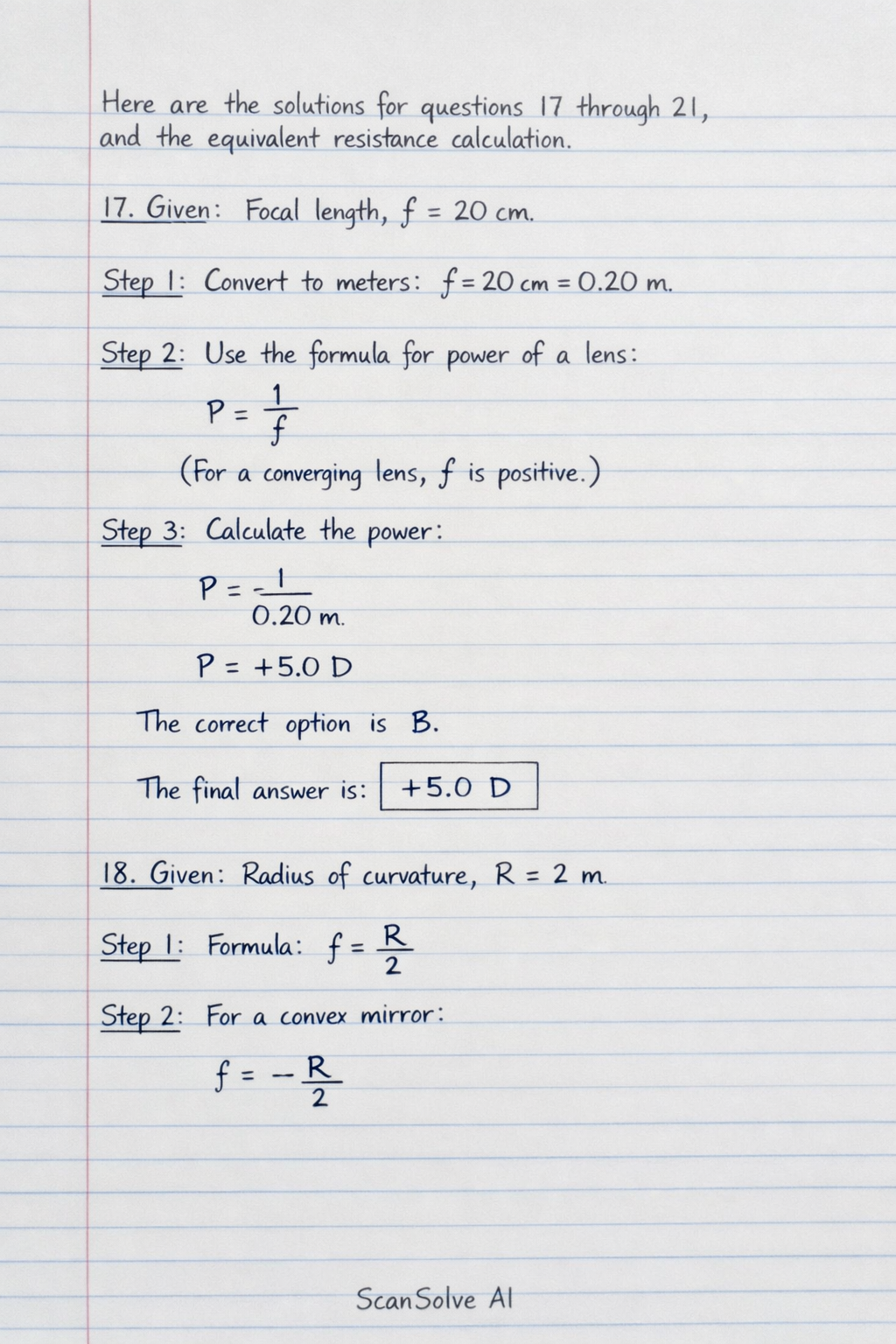
Handwritten Step-by-Step Solution
Get this as a handwritten image on WhatsApp — like a tutor wrote it for you.
Try on WhatsApp