
We read your photo as:
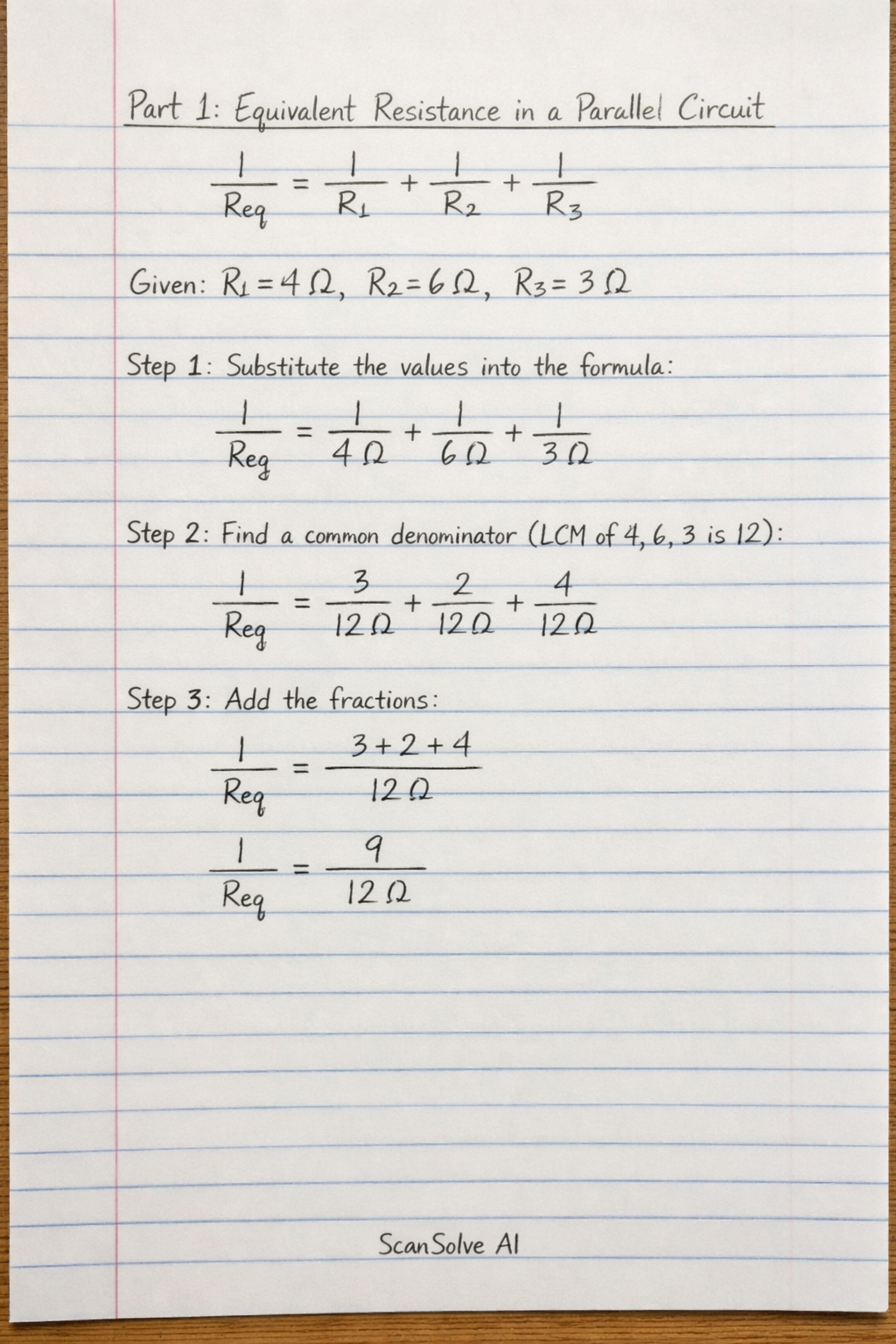
Part 1: Equivalent Resistance in a Parallel Circuit
ScanSolve AI Answer
Answer
Step-by-step solution
4 stepsHere's a step-by-step solution for the problem shown in the image.
Part 1· 4 steps
Equivalent Resistance in a Parallel Circuit
The formula for the equivalent resistance () of resistors connected in parallel is given by:
From the image, the given resistance values are , , and .
Substitute the given resistance values into the formula.
Find a common denominator for the fractions.
The least common multiple (LCM) of 4, 6, and 3 is 12.
Add the fractions.
Simplify the fraction and take the reciprocal to find .
As a decimal, this is approximately:
The student's calculation for the sum of fractions () was incorrect, leading to an incorrect final resistance value.
The correct equivalent resistance is .
Part 2
Voltage in a Parallel Circuit
The image states: and then .
In a parallel circuit, the voltage across each resistor is the same as the total voltage supplied by the source. Therefore, the statement (and also ) is correct.
However, the statement is contradictory. It implies that the total voltage is simultaneously 12 V and 6 V, which is not possible. Without additional context from the original problem, it is not possible to determine the correct total voltage.
Try one yourself
A new problem that tests the same skill.
Still stuck on this one?
Ask a follow-up, and the answer starts from this question.
More Physics Questions
Handwritten Step-by-Step Solution
Get this as a handwritten image on WhatsApp — like a tutor wrote it for you.
Try on WhatsApp