
We read your photo as:
The equivalent resistance of two identical resistors in parallel is 10 Ω. The equivalent resistance of the same resistors in series would be
ScanSolve AI Answer
Answer
Step-by-step solution
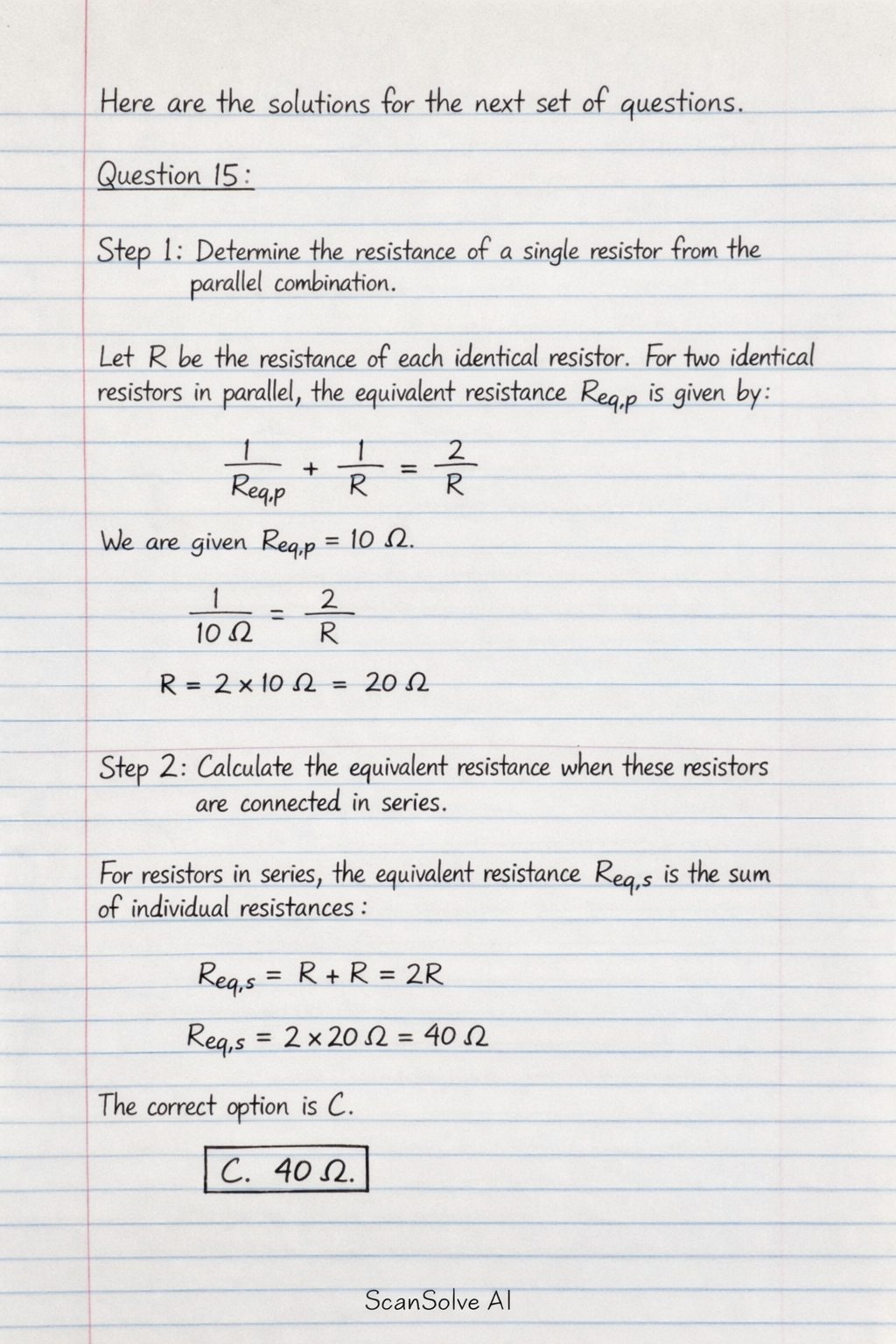
9 stepsHere are the solutions for the next set of questions.
Part 15· 2 steps
Determine the resistance of a single resistor from the parallel combination.
Let be the resistance of each identical resistor. For two identical resistors in parallel, the equivalent resistance is given by:
We are given .
Calculate the equivalent resistance when these resistors are connected in series.
For resistors in series, the equivalent resistance is the sum of individual resistances:
The correct option is C.
Part 16· 3 steps
Identify the given capacitances.
The capacitance in air is .
The capacitance with the dielectric is .Use the formula relating capacitance with and without a dielectric.
The dielectric constant is defined as the ratio of the capacitance with the dielectric to the capacitance in air:
Calculate the dielectric constant.
The correct option is C.
Part 17· 2 steps
Identify the given values and the formula for work done.
We are given the charge and the potential difference .
The work done in moving a charge against a potential difference is given by:Substitute the values and calculate the work done.
The correct option is C.
Part 18· 2 steps
Identify the given values and the formula for power dissipated.
We are given the resistance and the current .
The power dissipated as heat in a resistor is given by:Substitute the values and calculate the power.
The correct option is C.
Part 19
Kirchhoff's first law, also known as Kirchhoff's Current Law (KCL) or the junction rule, states that the algebraic sum of currents entering a junction (or node) is equal to the algebraic sum of currents leaving the junction. This law is a direct consequence of the conservation of charges.
The correct option is D.
Part 20
The amount of work done in bringing a unit positive charge from infinity to a point in an electric field is the definition of Electric potential.
The correct option is A.
Try one yourself
A new problem that tests the same skill.
Still stuck on this one?
Ask a follow-up, and the answer starts from this question.
More Physics Questions
Handwritten Step-by-Step Solution
Get this as a handwritten image on WhatsApp — like a tutor wrote it for you.
Try on WhatsApp