
We read your photo as:
The velocity-time graph for a body moving down a viscous fluid shows the velocity increasing from zero and then leveling off to a constant terminal velocity.
ScanSolve AI Answer
Step-by-step solution
3 steps- a) The velocity-time graph for a body moving down a viscous fluid shows the velocity increasing from zero and then leveling off to a constant terminal velocity.
\begin{tikzpicture}
\begin{axis}[
    axis lines=middle,
    xlabel={Time (s)},
    ylabel={Velocity (m/s)},
    xmin=0, xmax=5,
    ymin=0, ymax=1.2,
    xtick=\empty, ytick=\empty,
    axis line style={-latex},
    xlabel style={at={(axis description cs:1,0)},anchor=north west},
    ylabel style={at={(axis description cs:0,1)},anchor=south east}
]
\addplot[blue, thick, domain=0:4, samples=100] {1 - exp(-x)};
\end{axis}
\end{tikzpicture}
b) The force whose magnitude keeps on changing as the body falls through the liquid is the viscous drag force (or fluid resistance).
-
Observation: The Styrofoam piece will rise out of the test tube. Explanation: When air is blown across the mouth of the test tube, the velocity of the air above the Styrofoam increases. According to Bernoulli's principle, an increase in fluid velocity leads to a decrease in pressure. This creates a pressure difference, with the higher atmospheric pressure inside the test tube pushing the Styrofoam upwards and out.
-
Step 1: Identify the given values and convert units. Elastic constant, Stretch, Mass of stone, Acceleration due to gravity, (standard assumption)
Calculate the elastic potential energy stored in the band.
The elastic potential energy (EPE) is given by the formula:
Substitute the values:
Equate the elastic potential energy to the gravitational potential energy at the maximum height.
Assuming all the elastic potential energy is converted into gravitational potential energy (GPE) at the maximum height :
Substitute the known values:
Solve for .
The maximum height reached by the stone is .
- The surface of a liquid is under tension due to cohesive forces between liquid molecules. Molecules in the bulk of the liquid are attracted equally in all directions by surrounding molecules. However, molecules at the surface experience a net inward attractive force from the molecules below them, as there are fewer or no liquid molecules above. This net inward pull causes the surface to contract and behave like a stretched elastic membrane, resulting in surface tension.
Still stuck on this one?
Ask a follow-up, and the answer starts from this question.
More Physics Questions
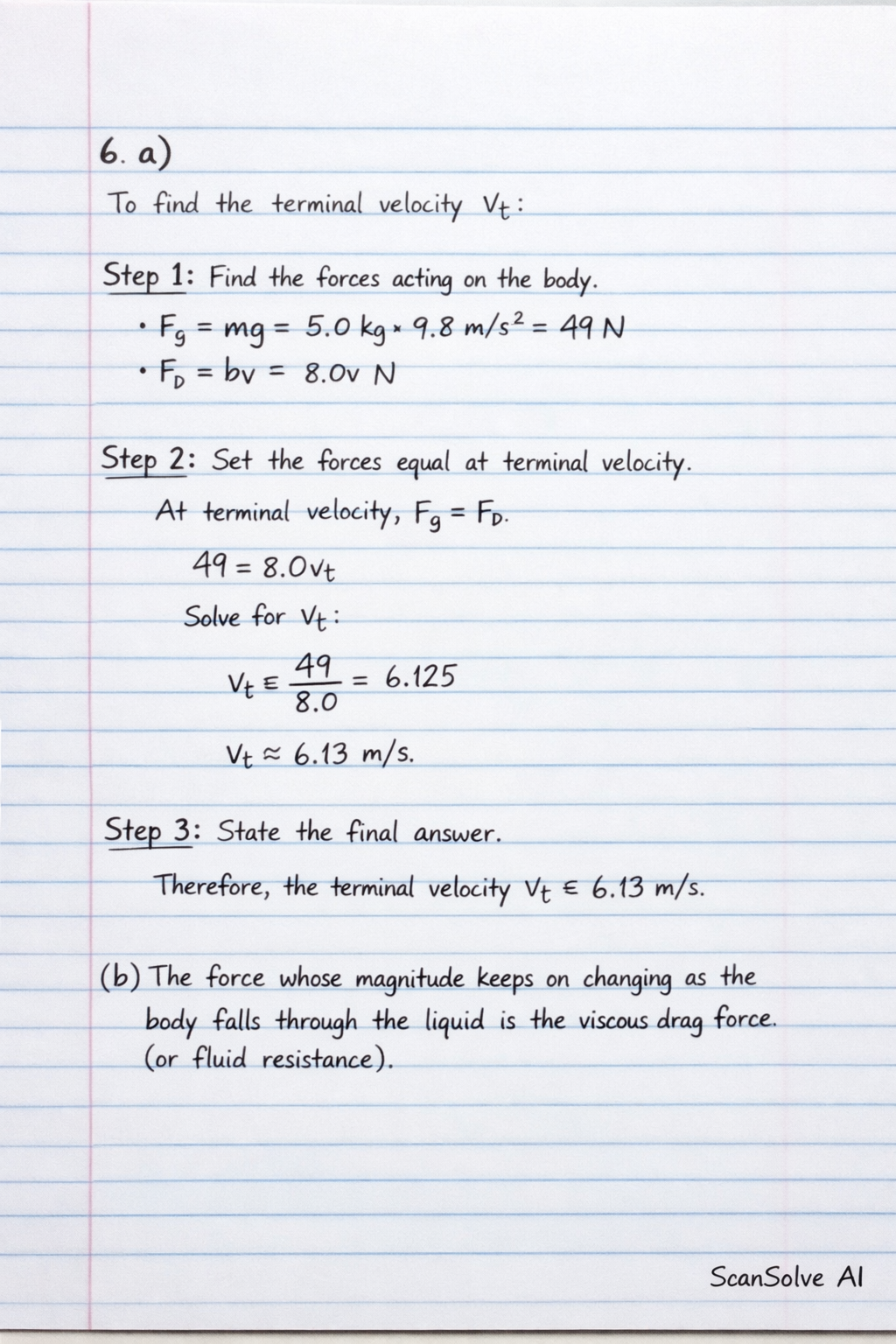
Handwritten Step-by-Step Solution
Get this as a handwritten image on WhatsApp — like a tutor wrote it for you.
Try on WhatsApp