
We read your photo as:
Give three examples of the use of inclined planes in everyday life. 2. A heavy slab weighing 100 N is lifted to a vertical height of 5 m by applying an effort force of 400 N over a distance of 10 m. C
ScanSolve AI Answer
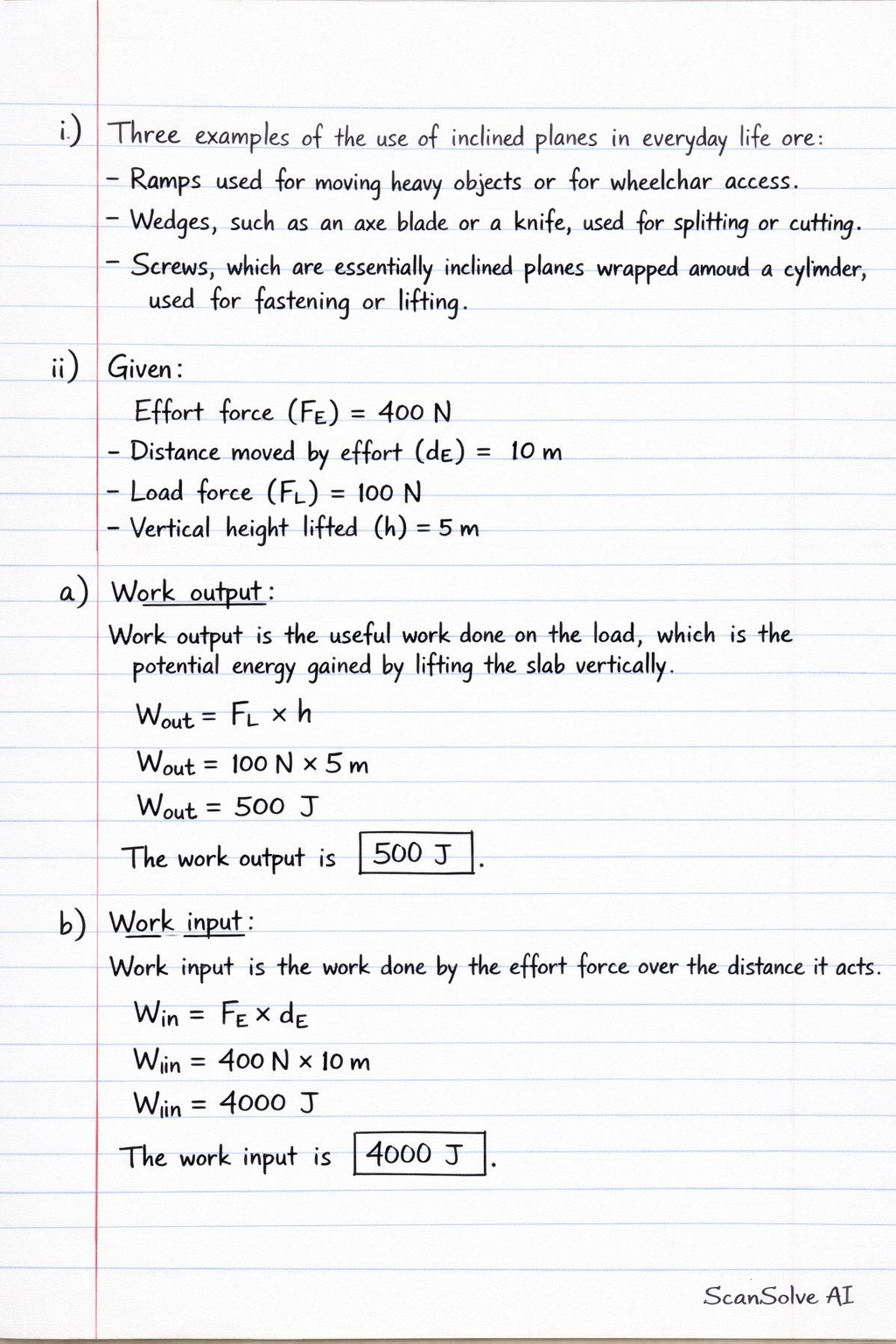
i) Three examples of the use of inclined planes in everyday life are:
- Ramps used for moving heavy objects or for wheelchair access.
- Wedges, such as an axe blade or a knife, used for splitting or cutting.
- Screws, which are essentially inclined planes wrapped around a cylinder, used for fastening or lifting.
ii)
Given:
Effort force () = 400 N
Distance moved by effort () = 10 m
Load force () = 100 N (interpreted as the weight of the slab)
Vertical height lifted () = 5 m
α) Work output
Work output is the useful work done on the load, which is the potential energy gained by lifting the slab vertically.
The work output is .
β) Work input
Work input is the work done by the effort force over the distance it acts.
The work input is .
γ) Efficiency
Efficiency is the ratio of work output to work input, expressed as a percentage.
The efficiency is .
Still stuck on this one?
Ask a follow-up, and the answer starts from this question.
More Physics Questions
Handwritten Step-by-Step Solution
Get this as a handwritten image on WhatsApp — like a tutor wrote it for you.
Try on WhatsApp