
We read your photo as:
To calculate the maximum height of the wall if no tension is allowed, we need to ensure that the resultant normal force acts within the middle third of the base. For a retaining wall, the critical con
Physics
ScanSolve AI Answer
To calculate the maximum height of the wall if no tension is allowed, we need to ensure that the resultant normal force acts within the middle third of the base. For a retaining wall, the critical condition for no tension at the heel (the side with water) is that the resultant force acts at a distance of from the toe (the dry side).
Let's define the parameters:
- Base of the wall, m
- Density of the wall material,
- Density of water,
- Acceleration due to gravity, $g =
Was this helpful?
Still stuck on this one?
Ask a follow-up, and the answer starts from this question.
Got a different question?Ask your own question
More Physics Questions
QTo determine the total resultant force acting on a vertical rectangular gate and the location of its…QThe diagram below shows a plan PQ of length 5m and weight 20N leaning against a vertical wall. The…QWhy is a dam wall wider at the base than at the top?QA 10 m ladder weighing 200 N is placed against a smooth wall at an angle of 60 degrees to the…QCalculate the normal force (N).
Browse by topic:Mechanics
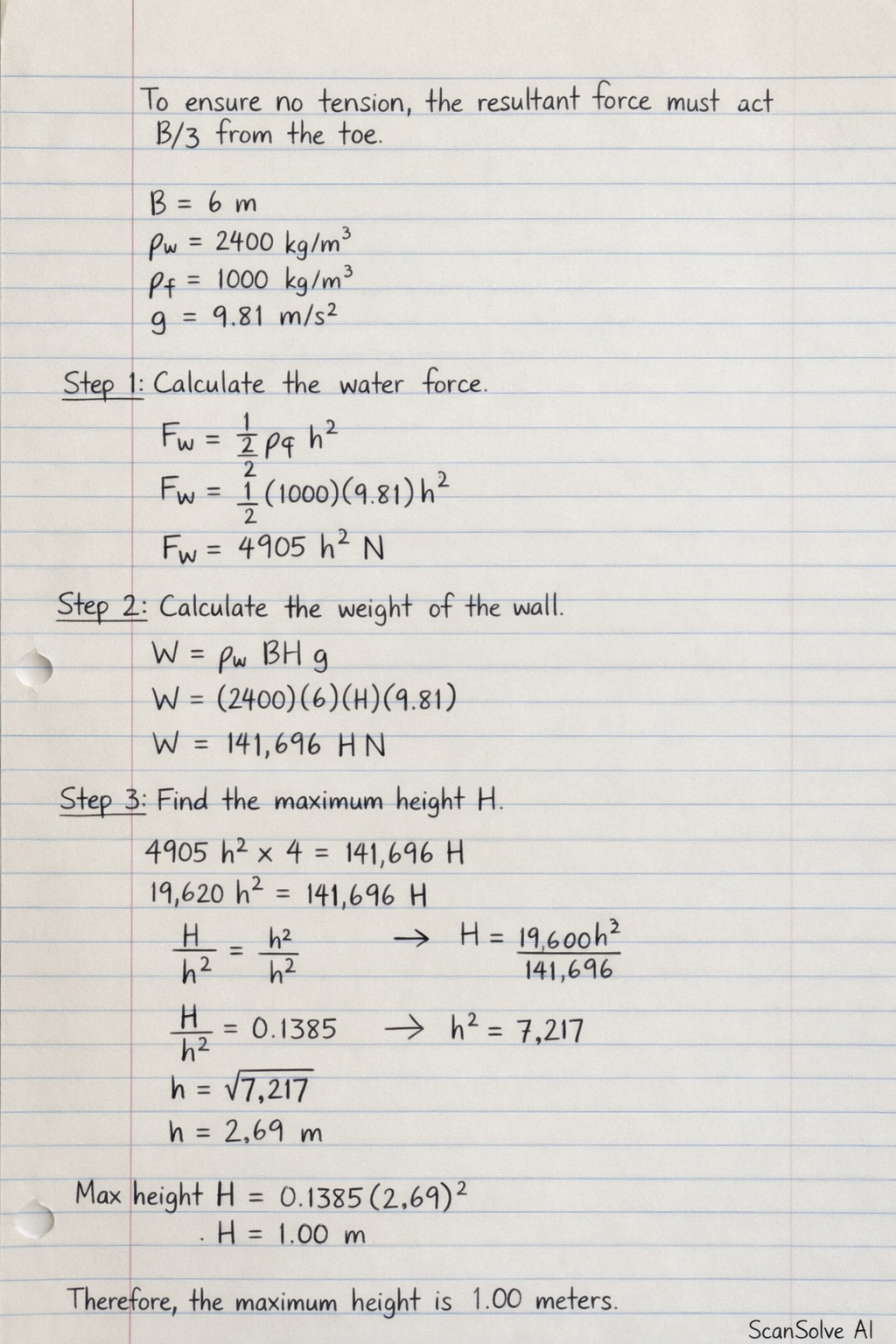
Handwritten Step-by-Step Solution
Get this as a handwritten image on WhatsApp — like a tutor wrote it for you.
Try on WhatsApp