We read your photo as:

Two forces are applied to an object. One force is horizontal with a magnitude of 8 N, and the second force has a magnitude of 5 N and is directed at 45 degrees above the horizontal. What is the result

Physics

ScanSolve AI Answer

Answer

12.07 N12.07 \text{ N}

17.03∘ above the horizontal17.03^\circ \text{ above the horizontal}

Step-by-step solution

4 steps

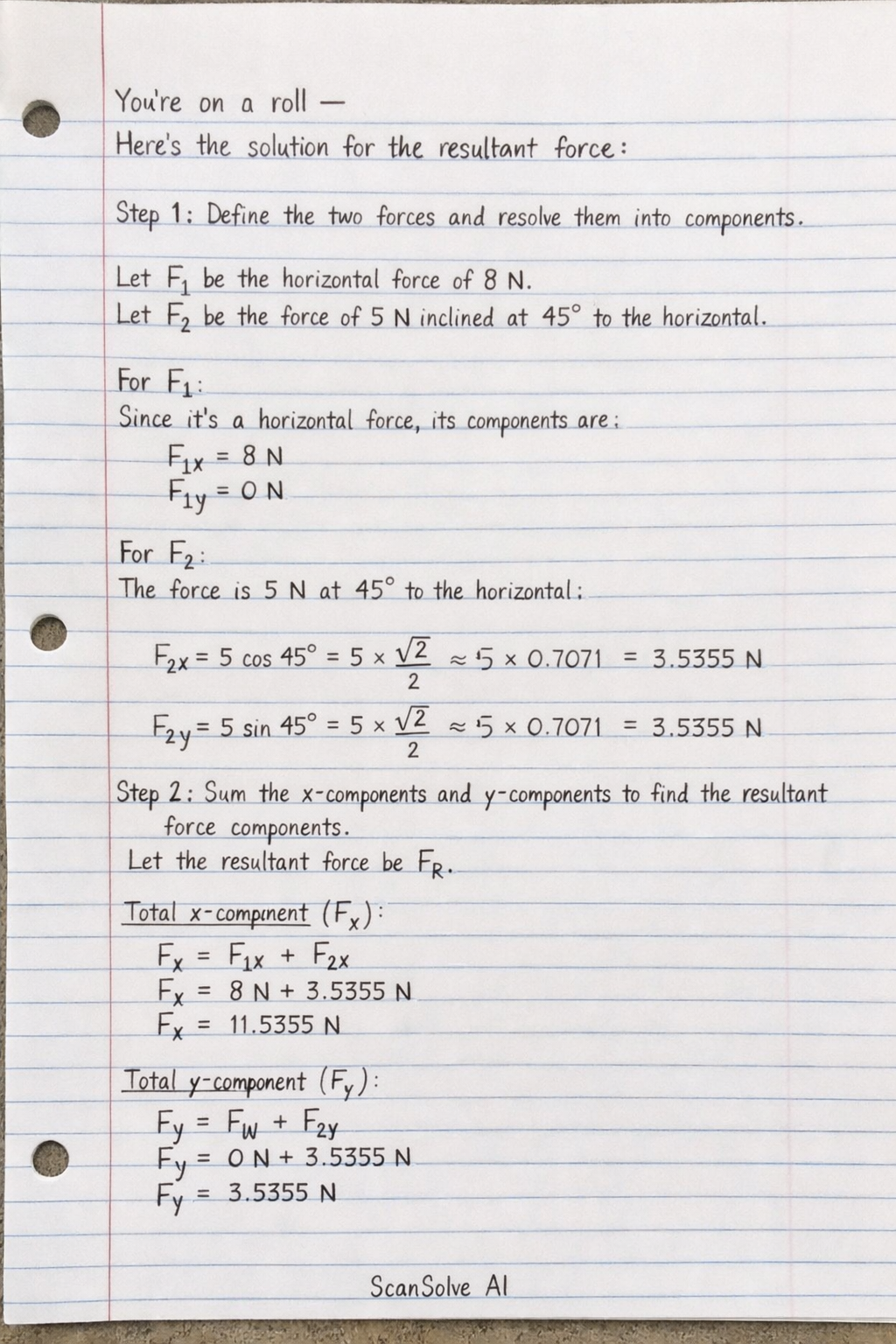
Here's the solution for the resultant force:

  1. Define the two forces and resolve them into components.

    Let F1\mathbf{F_1} be the horizontal force of 8 N.
    Let F2\mathbf{F_2} be the force of 5 N inclined at 45∘45^\circ to the horizontal.

    For F1\mathbf{F_1}:
    Since it's a horizontal force, its components are:

    F1x=8 NF_{1x} = 8 \text{ N} F1y=0 NF_{1y} = 0 \text{ N}

    For F2\mathbf{F_2}:
    The force is 5 N at 45∘45^\circ to the horizontal.

    F2x=5cos⁡(45∘)=5×22≈5×0.7071=3.5355 NF_{2x} = 5 \cos(45^\circ) = 5 \times \frac{\sqrt{2}}{2} \approx 5 \times 0.7071 = 3.5355 \text{ N} F2y=5sin⁡(45∘)=5×22≈5×0.7071=3.5355 NF_{2y} = 5 \sin(45^\circ) = 5 \times \frac{\sqrt{2}}{2} \approx 5 \times 0.7071 = 3.5355 \text{ N}
  2. Sum the x-components and y-components to find the resultant force components.

    Let the resultant force be FR\mathbf{F_R}.
    Total x-component (FxF_x):

    Fx=F1x+F2x=8 N+3.5355 N=11.5355 NF_x = F_{1x} + F_{2x} = 8 \text{ N} + 3.5355 \text{ N} = 11.5355 \text{ N}

    Total y-component (FyF_y):

    Fy=F1y+F2y=0 N+3.5355 N=3.5355 NF_y = F_{1y} + F_{2y} = 0 \text{ N} + 3.5355 \text{ N} = 3.5355 \text{ N}
  3. Calculate the magnitude of the resultant force.

    The magnitude of the resultant force, ∣FR∣|\mathbf{F_R}|, is found using the Pythagorean theorem:

    ∣FR∣=Fx2+Fy2|\mathbf{F_R}| = \sqrt{F_x^2 + F_y^2} ∣FR∣=(11.5355 N)2+(3.5355 N)2|\mathbf{F_R}| = \sqrt{(11.5355 \text{ N})^2 + (3.5355 \text{ N})^2} ∣FR∣=133.067+12.500|\mathbf{F_R}| = \sqrt{133.067 + 12.500} ∣FR∣=145.567|\mathbf{F_R}| = \sqrt{145.567} ∣FR∣≈12.065 N|\mathbf{F_R}| \approx 12.065 \text{ N}
  4. Calculate the direction of the resultant force.

    The direction θ\theta is found using the arctangent function, measured from the horizontal axis:

    θ=arctan⁡(FyFx)\theta = \arctan\left(\frac{F_y}{F_x}\right) θ=arctan⁡(3.5355 N11.5355 N)\theta = \arctan\left(\frac{3.5355 \text{ N}}{11.5355 \text{ N}}\right) θ=arctan⁡(0.3065)\theta = \arctan(0.3065) θ≈17.03∘\theta \approx 17.03^\circ

    Since both FxF_x and FyF_y are positive, the direction is 17.03∘17.03^\circ above the horizontal.

    The magnitude of the resultant force is 12.07 N\boxed{12.07 \text{ N}} and its direction is 17.03∘ above the horizontal\boxed{17.03^\circ \text{ above the horizontal}}.

Was this helpful?

Try one yourself

A new problem that tests the same skill.

Still stuck on this one?

Ask a follow-up, and the answer starts from this question.

Got a different question?Ask your own question
Handwritten step-by-step solution preview

Handwritten Step-by-Step Solution

Get this as a handwritten image on WhatsApp — like a tutor wrote it for you.

Try on WhatsApp