
We read your photo as:
Using the data in Table 1, calculate the extension e of the spring when L = 5.00 N. Plot a graph of L (N) against e (cm).
ScanSolve AI Answer
Answer
Step-by-step solution
7 stepsHere are the solutions for the problem:
Part b· 3 steps
Calculate the extension e of the spring using the equation when N. Record this value of e in Table 1.
Identify the original length () of the spring.
From Table 1, when the load N, the length cm.
So, the original length cm.Identify the length () when the load N.
From Table 1, when N, the length cm.
Calculate the extension () using the formula .
The extension when N is .
The completed Table 1 with this value is:
L/N l/cm e/cm 0.00 2.1 0.0 1.00 6.0 3.9 2.00 10.6 8.5 3.00 14.9 12.8 4.00 19.3 17.2 5.00 23.7 21.6
Part c· 4 steps
Plot a graph of (N) (y-axis) against (cm) (x-axis). Start both axes at the origin (0, 0). Draw the best-fit line.
To plot the graph, use the following data points (e/cm, L/N):
(0.0, 0.0)
(3.9, 1.0)
(8.5, 2.0)
(12.8, 3.0)
(17.2, 4.0)
(21.6, 5.0)
Choose appropriate scales for the axes.
- For the x-axis (extension in cm): Let 1 large square (5 small squares) represent 2.5 cm. This means 1 small square represents 0.5 cm.
- For the y-axis (load in N): Let 1 large square (5 small squares) represent 0.5 N. This means 1 small square represents 0.1 N.
Label the axes clearly with their quantities and units (/cm on the x-axis and /N on the y-axis).
Mark the origin (0,0).
Plot each data point on the graph paper using the chosen scales.
For example:
- (0.0, 0.0) is at the origin.
- (3.9 cm, 1.0 N) will be at small squares along the x-axis and small squares along the y-axis.
- (8.5 cm, 2.0 N) will be at small squares along the x-axis and small squares along the y-axis.
- (12.8 cm, 3.0 N) will be at small squares along the x-axis and small squares along the y-axis.
- (17.2 cm, 4.0 N) will be at small squares along the x-axis and small squares along the y-axis.
- (21.6 cm, 5.0 N) will be at small squares along the x-axis and small squares along the y-axis.
Draw the best-fit line.
This should be a straight line passing through the origin (0,0) and as close as possible to all the plotted points.
Try one yourself
A new problem that tests the same skill.
Still stuck on this one?
Ask a follow-up, and the answer starts from this question.
More Physics Questions
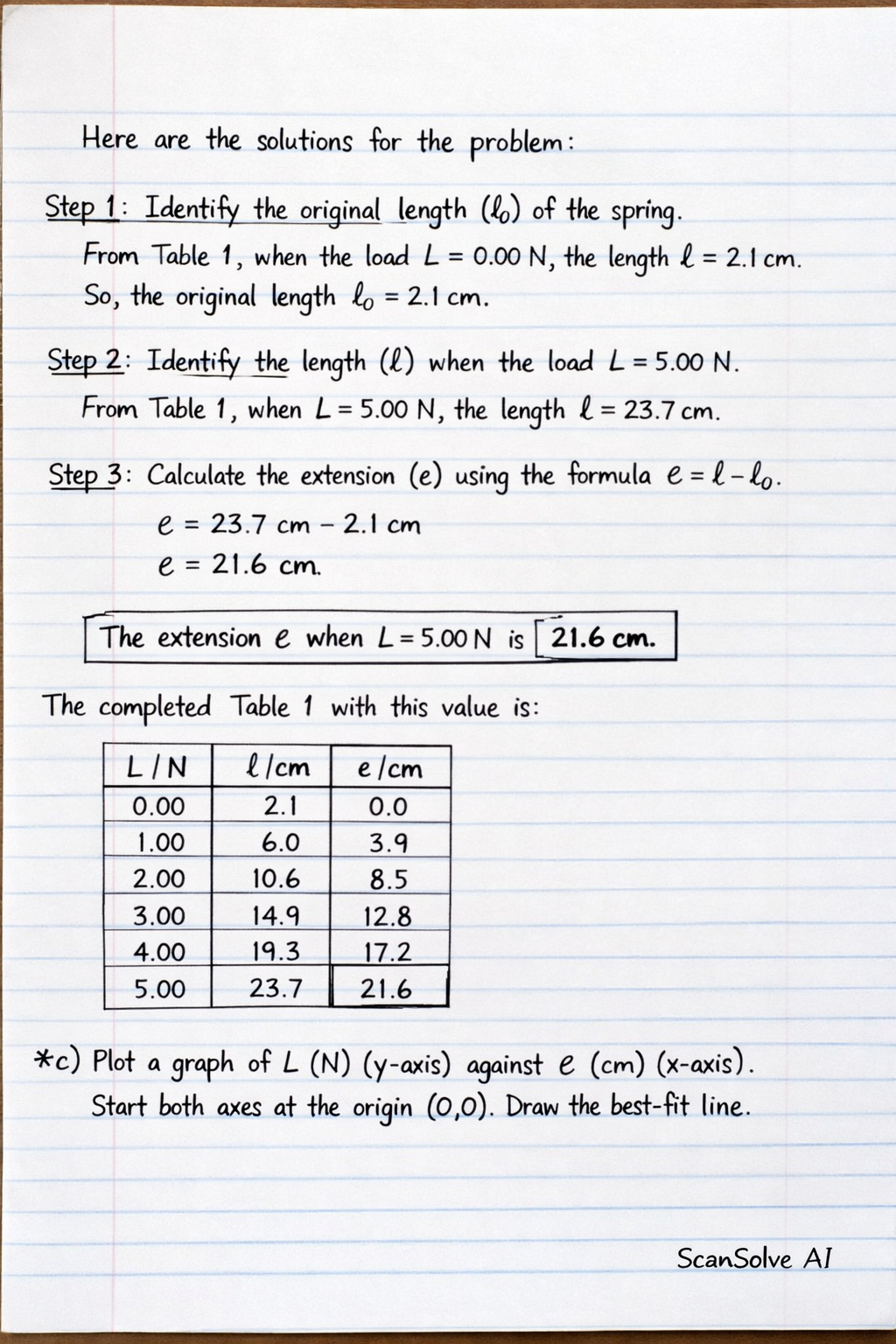
Handwritten Step-by-Step Solution
Get this as a handwritten image on WhatsApp — like a tutor wrote it for you.
Try on WhatsApp