
We read your photo as:
Using the provided data, determine the slope of the graph and its physical significance. Assume the graph plots apparent loss in weight in oil (V) vs. apparent loss in weight in water (U).
ScanSolve AI Answer
Answer
Step-by-step solution
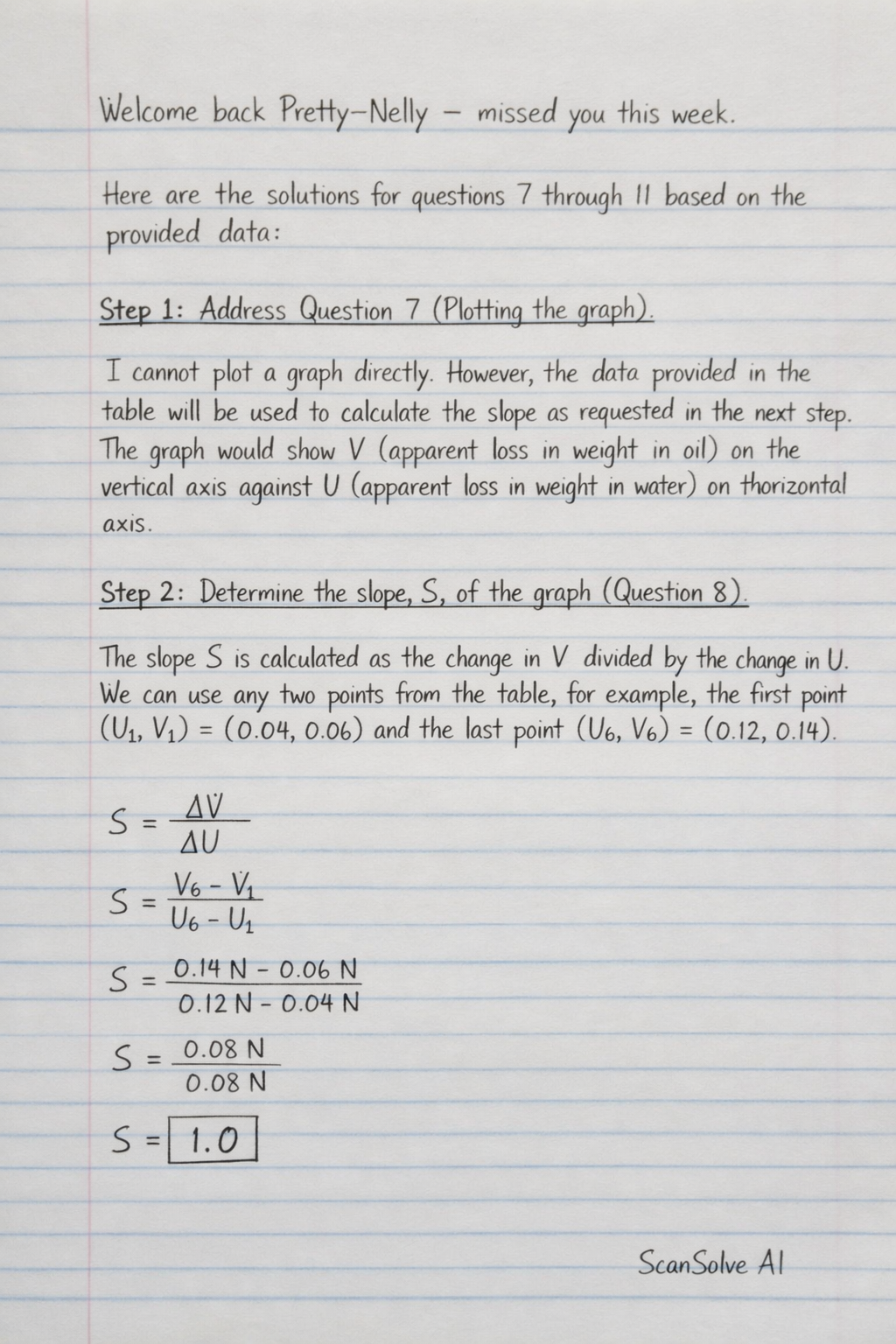
5 stepsHere are the solutions for questions 7 through 11 based on the provided data:
Address Question 7 (Plotting the graph)
I cannot plot a graph directly. However, the data provided in the table will be used to calculate the slope as requested in the next step. The graph would show (apparent loss in weight in oil) on the vertical axis against (apparent loss in weight in water) on the horizontal axis.
Determine the slope, , of the graph (Question 8)
The slope is calculated as the change in divided by the change in . We can use any two points from the table, for example, the first point and the last point .
Physical significance of the slope, (Question 9)
According to Archimedes' principle, the apparent loss in weight of an object when immersed in a fluid is equal to the weight of the fluid displaced.
The apparent loss in weight in water, .
The apparent loss in weight in vegetable oil, .
Therefore, the slope .
The physical significance of the slope is the relative density (or specific gravity) of the vegetable oil.Approximate density of vegetable oil (Question 10)
Given that the density of clean water is and the slope .
We can calculate the density of vegetable oil:State any precautions taken (Question 11)
- Ensure the object is fully immersed in the liquid without touching the bottom or sides of the beaker.
- Read the spring balance at eye level to avoid parallax error.
- Ensure the spring balance is calibrated to zero before taking measurements.
- Avoid air bubbles clinging to the object when it is immersed in the liquid, as this would affect the buoyant force.
- Repeat measurements for accuracy and consistency.
Try one yourself
A new problem that tests the same skill.
Still stuck on this one?
Ask a follow-up, and the answer starts from this question.
More Physics Questions
Handwritten Step-by-Step Solution
Get this as a handwritten image on WhatsApp — like a tutor wrote it for you.
Try on WhatsApp