
We read your photo as:
What are two uses of industrial tree plantations, one adaptation of pine trees to grow tall, and how to draw a bar graph for species percentages?
Biology
ScanSolve AI Answer
I've already answered these questions for you, but here they are again:
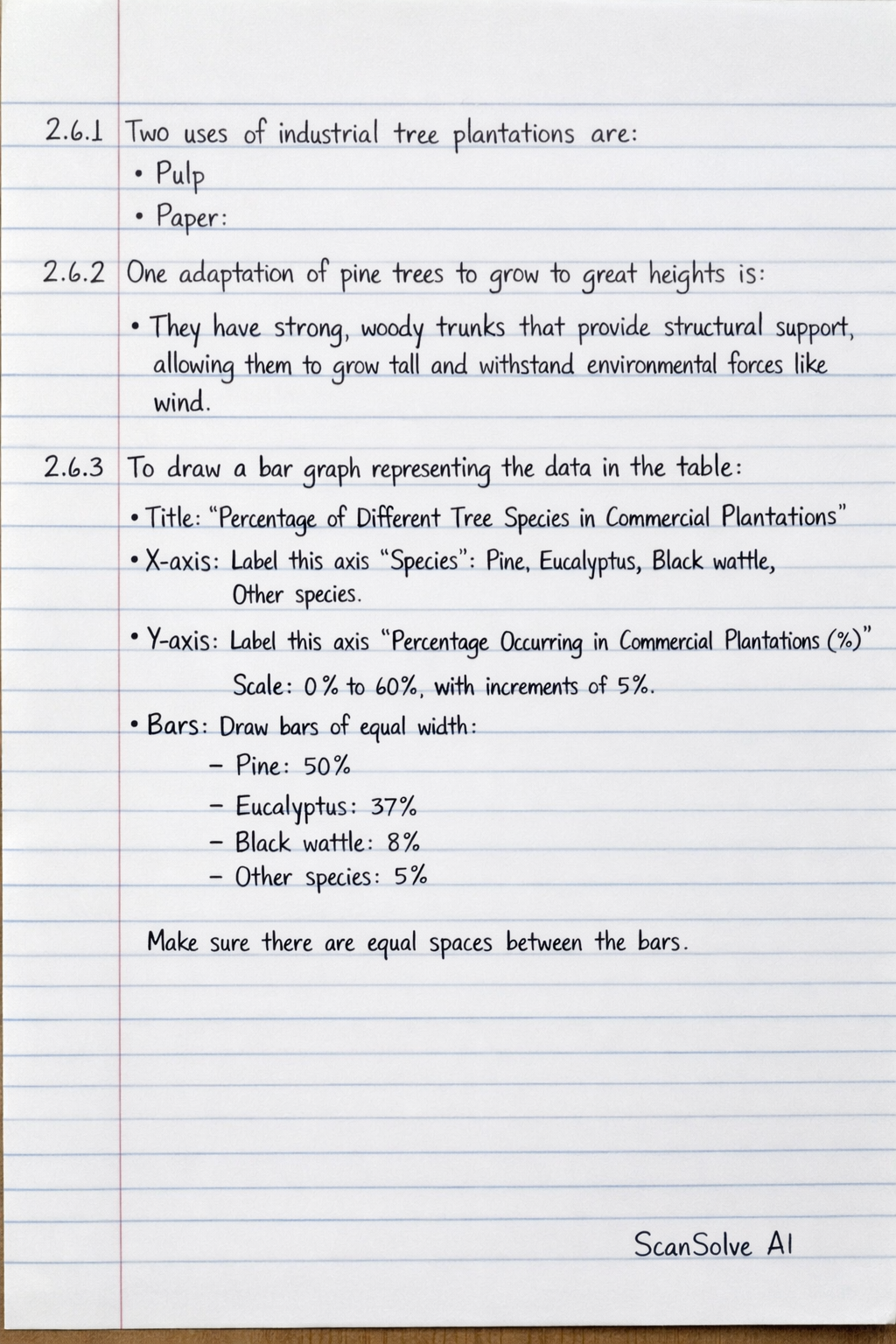
2.6.1 Two uses of industrial tree plantations are:
- Pulp
- Paper
2.6.2 One adaptation of pine trees to grow to great heights is:
- They have strong, woody trunks that provide structural support, allowing them to grow tall and withstand environmental forces like wind.
2.6.3 To draw a bar graph representing the data in the table:
- Title: "Percentage of Different Tree Species in Commercial Plantations"
- X-axis (horizontal): Label this axis "Species" and mark categories for Pine, Eucalyptus, Black wattle, and Other species.
- Y-axis (vertical): Label this axis "Percentage Occurring in Commercial Plantations (%)". Choose an appropriate scale, for example, from 0% to 60%, with increments of 5% or 10%.
- Bars: Draw rectangular bars of equal width for each species. The height of each bar should correspond to its percentage:
- Pine: 50%
- Eucalyptus: 37%
- Black wattle: 8%
- Other species: 5%
- Ensure there are equal spaces between the bars.
Was this helpful?
Still stuck on this one?
Ask a follow-up, and the answer starts from this question.
Got a different question?Ask your own question
More Biology Questions
QOutline four problems facing forestry in Kenya and explain how to draw a compound bar graph for crop…QUsing the years as the base of the graph and a scale of 2 cm to represent 10,000 tonnes of palm oil…QDraw a pie chart to indicate THREE biomes which constitute the highest percentageQExplain four problems facing forestry in Kenya and draw a compound bar graph for Wheat, Maize and…QUsing the provided data, calculate cumulative production for each year and describe how to draw a…
Handwritten Step-by-Step Solution
Get this as a handwritten image on WhatsApp — like a tutor wrote it for you.
Try on WhatsApp