We read your photo as:

Complete the following reactions: a) CH3CH2C=CCH2CH3 + HCN b) CH3CH2CH2CH2C=CH + HCN

Chemistry

ScanSolve AI Answer

Answers

2 parts
a

CH3CH2C(OH)(CN)CH2CH3\text{CH}_3\text{CH}_2\text{C(OH)(CN)CH}_2\text{CH}_3

b

CH3CH2CH2CH2CH(OH)CN\text{CH}_3\text{CH}_2\text{CH}_2\text{CH}_2\text{CH(OH)CN}

Step-by-step solution

4 steps

Part a· 2 steps

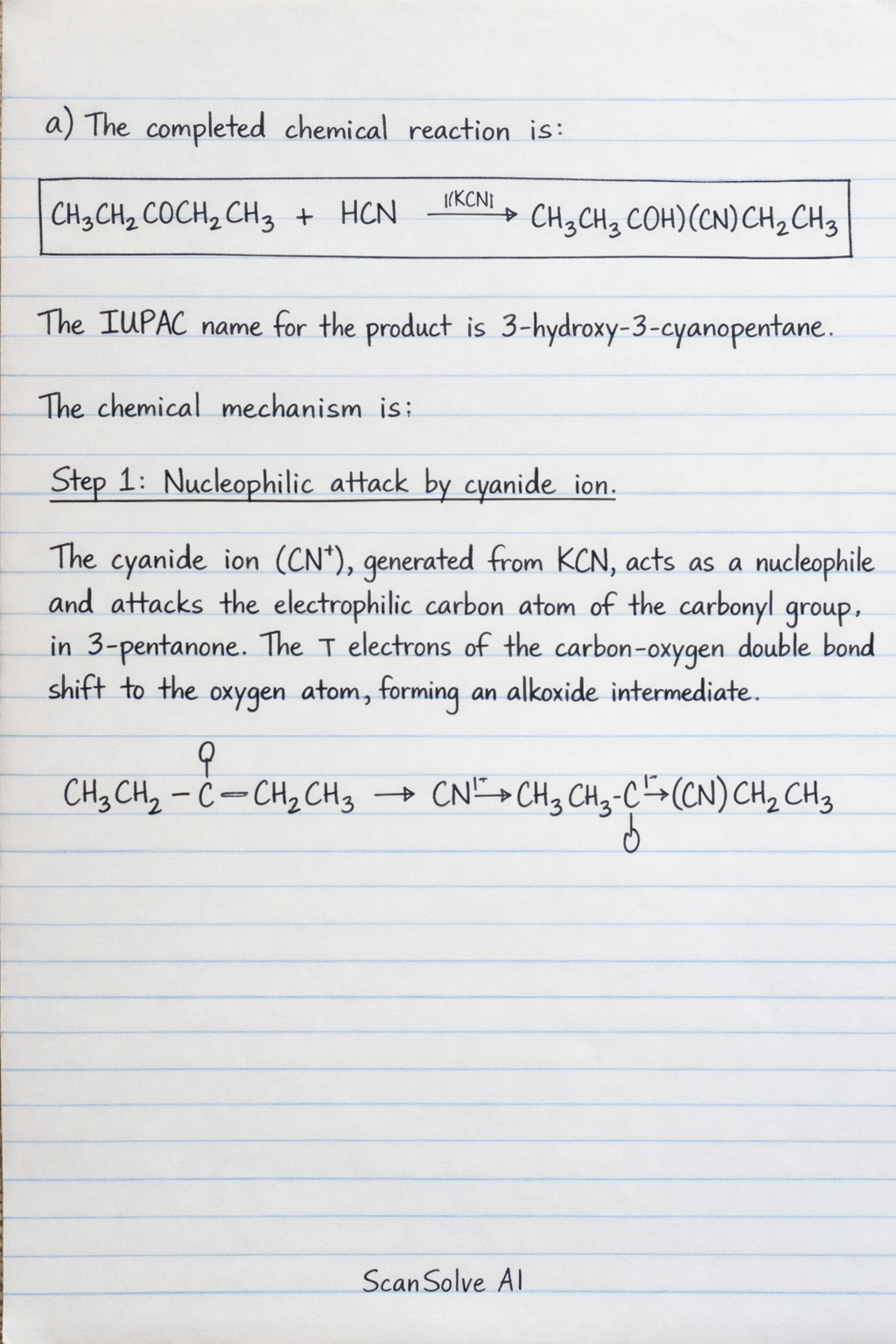
The completed chemical reaction is:

CH3CH2COCH2CH3+HCN→KCNCH3CH2C(OH)(CN)CH2CH3\text{CH}_3\text{CH}_2\text{COCH}_2\text{CH}_3 + \text{HCN} \xrightarrow{\text{KCN}} \boxed{\text{CH}_3\text{CH}_2\text{C(OH)(CN)CH}_2\text{CH}_3}

The IUPAC name for the product is 3-hydroxy-3-cyanopentane.

The chemical mechanism is:

  1. Nucleophilic attack by cyanide ion.

    The cyanide ion (CN−\text{CN}^-), generated from KCN, acts as a nucleophile and attacks the electrophilic carbon atom of the carbonyl group in 3-pentanone. The π\pi electrons of the carbon-oxygen double bond shift to the oxygen atom, forming an alkoxide intermediate.

    CH3CH2C(=O)CH2CH3+CN−⟶CH3CH2C(O−)(CN)CH2CH3\text{CH}_3\text{CH}_2\text{C}(=\text{O})\text{CH}_2\text{CH}_3 + \text{CN}^- \longrightarrow \text{CH}_3\text{CH}_2\text{C}(\text{O}^-)(\text{CN})\text{CH}_2\text{CH}_3
  2. Protonation of the alkoxide.

    The alkoxide intermediate is then protonated by hydrogen cyanide (HCN) to form the stable cyanohydrin product. The cyanide ion is regenerated in this step.

    CH3CH2C(O−)(CN)CH2CH3+HCN⟶CH3CH2C(OH)(CN)CH2CH3+CN−\text{CH}_3\text{CH}_2\text{C}(\text{O}^-)(\text{CN})\text{CH}_2\text{CH}_3 + \text{HCN} \longrightarrow \text{CH}_3\text{CH}_2\text{C}(\text{OH})(\text{CN})\text{CH}_2\text{CH}_3 + \text{CN}^-

Part b

CH3CH2CH2CH2CH(OH)CN\text{CH}_3\text{CH}_2\text{CH}_2\text{CH}_2\text{CH(OH)CN}

The completed chemical reaction is:

CH3CH2CH2CH2CHO+HCN→NaCNCH3CH2CH2CH2CH(OH)CN\text{CH}_3\text{CH}_2\text{CH}_2\text{CH}_2\text{CHO} + \text{HCN} \xrightarrow{\text{NaCN}} \boxed{\text{CH}_3\text{CH}_2\text{CH}_2\text{CH}_2\text{CH(OH)CN}}

The IUPAC name for the product is 2-hydroxypentanenitrile.

The chemical mechanism is:

  1. Nucleophilic attack by cyanide ion.

    The cyanide ion (CN−\text{CN}^-), generated from NaCN, acts as a nucleophile and attacks the electrophilic carbon atom of the carbonyl group in pentanal. The π\pi electrons of the carbon-oxygen double bond shift to the oxygen atom, forming an alkoxide intermediate.

    CH3CH2CH2CH2CHO+CN−⟶CH3CH2CH2CH2CH(O−)CN\text{CH}_3\text{CH}_2\text{CH}_2\text{CH}_2\text{CHO} + \text{CN}^- \longrightarrow \text{CH}_3\text{CH}_2\text{CH}_2\text{CH}_2\text{CH}(\text{O}^-)\text{CN}
  2. Protonation of the alkoxide.

    The alkoxide intermediate is then protonated by hydrogen cyanide (HCN) to form the stable cyanohydrin product. The cyanide ion is regenerated in this step.

    CH3CH2CH2CH2CH(O−)CN+HCN⟶CH3CH2CH2CH2CH(OH)CN+CN−\text{CH}_3\text{CH}_2\text{CH}_2\text{CH}_2\text{CH}(\text{O}^-)\text{CN} + \text{HCN} \longrightarrow \text{CH}_3\text{CH}_2\text{CH}_2\text{CH}_2\text{CH}(\text{OH})\text{CN} + \text{CN}^-
Was this helpful?

Try one yourself

A new problem that tests the same skill.

Still stuck on this one?

Ask a follow-up, and the answer starts from this question.

Got a different question?Ask your own question
Handwritten step-by-step solution preview

Handwritten Step-by-Step Solution

Get this as a handwritten image on WhatsApp — like a tutor wrote it for you.

Try on WhatsApp