
We read your photo as:
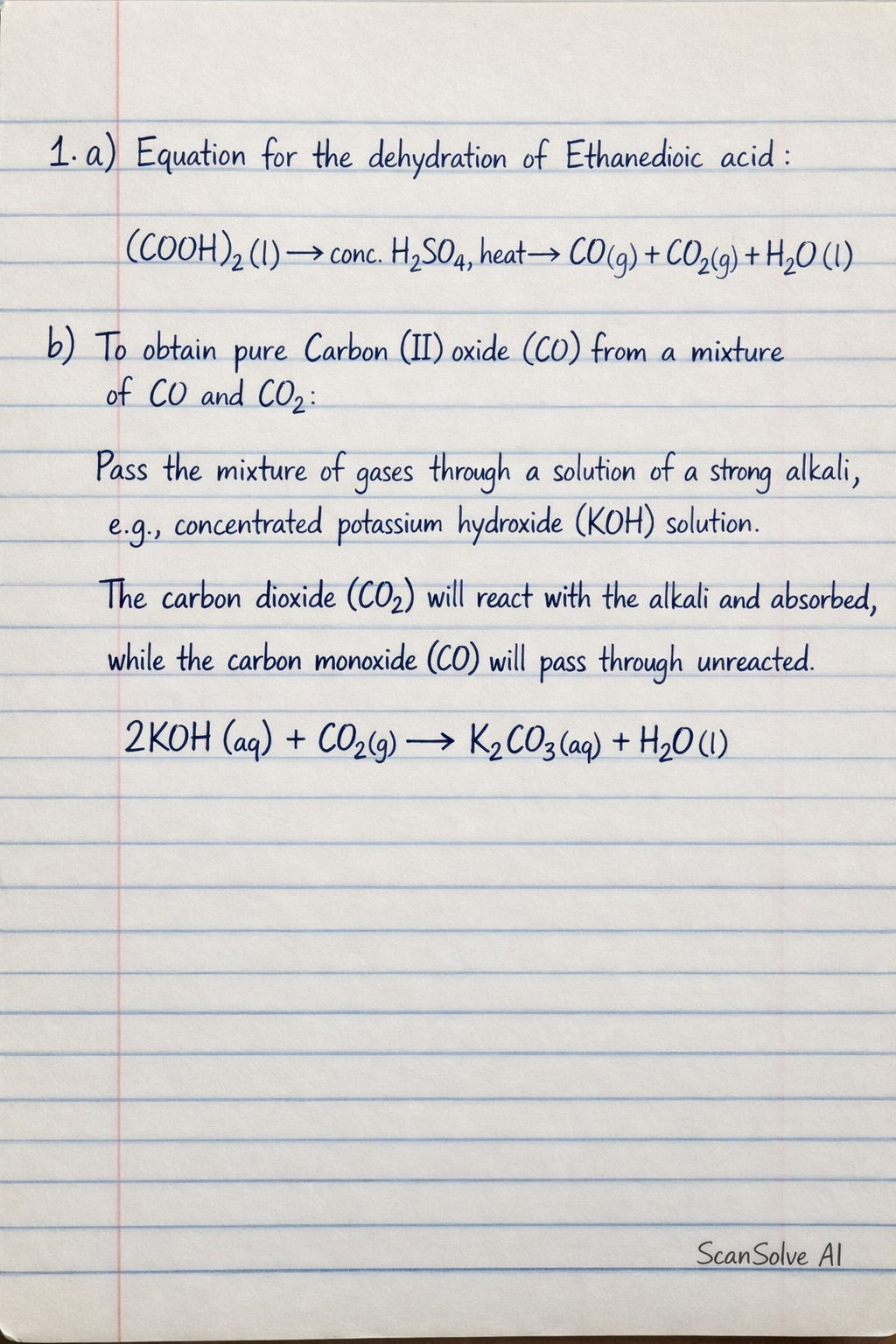
Describe the dehydration of ethanedioic acid and the purification of CO. Explain why graphite is slippery and diamond is used for cutting glass.
Chemistry
ScanSolve AI Answer
Step-by-step solution
5 stepsAnswer Question 4.
- a) Equation for the dehydration of Ethanedioic acid:
- b) To obtain pure Carbon (II) oxide () from a mixture of and : Pass the mixture of gases through a solution of a strong alkali, such as concentrated potassium hydroxide () solution. The carbon (IV) oxide () will react with the alkali and be absorbed, while the carbon (II) oxide () will pass through unreacted.
Answer Question 5.
- i) Graphite is slippery because it has a layered structure. Within each layer, carbon atoms are strongly bonded, but the forces between the layers are weak van der Waals forces. These weak forces allow the layers to slide easily over each other, making graphite slippery.
- ii) Diamond is used in cutting glass because it has a giant covalent structure where each carbon atom is tetrahedrally bonded to four other carbon atoms. This forms a very strong, rigid three-dimensional lattice, making diamond the hardest known natural substance.
Answer Question 6.
- i) Carbon (IV) oxide () neither burns nor supports combustion because it is already a fully oxidized compound and is very stable. However, burning magnesium continues to burn in because magnesium is a highly reactive metal that can reduce carbon (IV) oxide to carbon, taking the oxygen to form magnesium oxide. This reaction is exothermic and sustains the burning of magnesium.
- ii) Two properties of Carbon (IV) oxide that make it suitable for putting off petrol fires:
- It is denser than air, so it forms a blanket over the fire, cutting off the supply of oxygen.
- It is non-flammable and does not support combustion.
Answer Question 7.
- Graphite is a poor conductor of electricity at high temperatures because, although it has delocalized electrons, at high temperatures the carbon atoms (ions) in the lattice vibrate more vigorously. This increased vibration leads to more frequent collisions between the delocalized electrons and the vibrating atoms, hindering the flow of electrons and thus increasing electrical resistance.
Answer Question 8.
- i) The conditions necessary for the reaction to occur are heat and concentrated sulfuric acid () as a dehydrating agent.
- ii) Z is a drying agent (e.g., concentrated sulfuric acid or anhydrous calcium chloride). Its role is to remove water vapor from the gaseous products ( and ).
- iii) The equation for the reaction is:
- iv) Carbon (II) oxide () is collected over water because it is insoluble or sparingly soluble in water.
- v) Carbon (II) oxide is not collected by upward delivery because upward delivery (downward displacement of air) is used for gases that are denser than air. Carbon (II) oxide has a molar mass of approximately , which is slightly less dense than air (average molar mass approximately ). Therefore, it cannot be effectively collected by upward delivery.
Was this helpful?
Still stuck on this one?
Ask a follow-up, and the answer starts from this question.
Got a different question?Ask your own question
More Chemistry Questions
QIdentify the shapes of H3O+ and CO2. Explain why graphite is a lubricant and identify two allotropes…QGraphite conducts electricity whereas diamond does not. (ii)Diamond has a very high melting point…QDescribe the preparation of dry carbon (IV) oxide and state Graham's law of diffusion.QIdentify the products of fermentation and dehydration of ethanol, and describe the conditions for…QWhy diamond is a non-conductor while graphite is a conductor?
Handwritten Step-by-Step Solution
Get this as a handwritten image on WhatsApp — like a tutor wrote it for you.
Try on WhatsApp