
We read your photo as:
Define epimers, describe the Kiliani-Fischer synthesis, and give examples of storage polysaccharides.
ScanSolve AI Answer
Here are the answers to the questions:
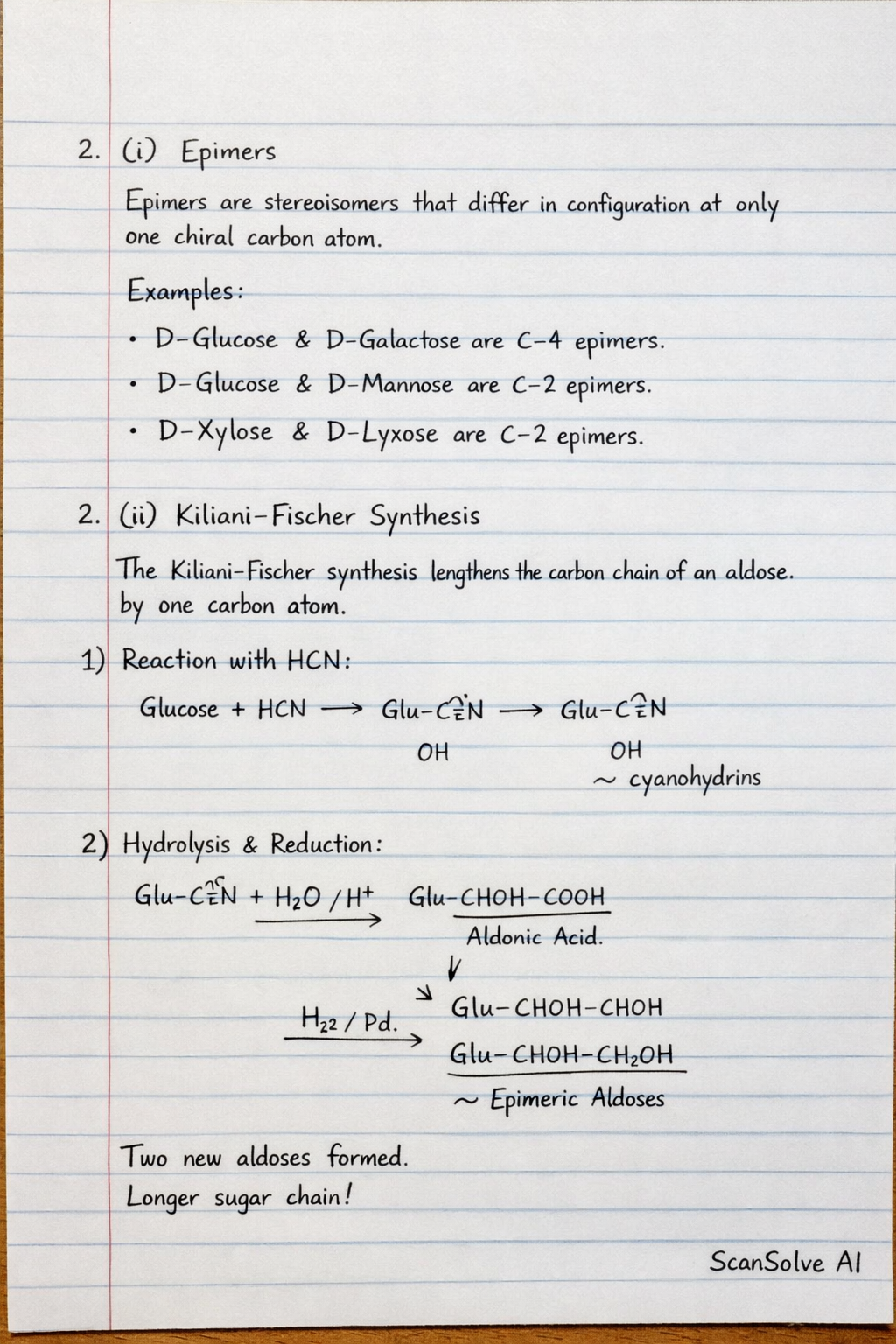
2. (i) Epimers
Epimers are stereoisomers that differ in configuration at only one chiral carbon atom (excluding the anomeric carbon in cyclic sugars). They are a type of diastereomer.
Examples:
- D-Glucose and D-Galactose are C-4 epimers.
- D-Glucose and D-Mannose are C-2 epimers.
- D-Xylose and D-Lyxose are C-2 epimers.
2. (ii) Kiliani-Fischer synthesis
The Kiliani-Fischer synthesis is a method used to lengthen the carbon chain of an aldose by one carbon atom, thereby converting an aldose into a new aldose with one more carbon. The process involves two main steps:
- Reaction of the aldose with hydrogen cyanide (HCN) to form a pair of cyanohydrins. This step creates a new chiral center.
- Hydrolysis of the cyanohydrins to form aldonic acids, followed by reduction (e.g., with hydrogen and a catalyst) to yield two new epimeric aldoses. This synthesis is important for synthesizing higher sugars from lower ones.
2. (iii) Storage polysaccharides
Storage polysaccharides are complex carbohydrates that serve as a form of energy storage in living organisms. They are typically large polymers of monosaccharide units linked by glycosidic bonds.
Examples:
- Starch: The primary energy storage polysaccharide in plants. It is a mixture of amylose (linear) and amylopectin (branched) glucose polymers.
- Glycogen: The main energy storage polysaccharide in animals and fungi. It is a highly branched polymer of glucose units, primarily stored in the liver and muscles.
2. (iv) Enantiomers
Enantiomers are stereoisomers that are non-superimposable mirror images of each other. They possess identical physical properties (e.g., melting point, boiling point, solubility) in an achiral environment but differ in their interaction with plane-polarized light (rotating it in opposite directions) and in their reactions with other chiral molecules. Each chiral molecule has one enantiomer.
Example: D-glucose and L-glucose are enantiomers.
Still stuck on this one?
Ask a follow-up, and the answer starts from this question.
More Chemistry Questions
Handwritten Step-by-Step Solution
Get this as a handwritten image on WhatsApp — like a tutor wrote it for you.
Try on WhatsApp