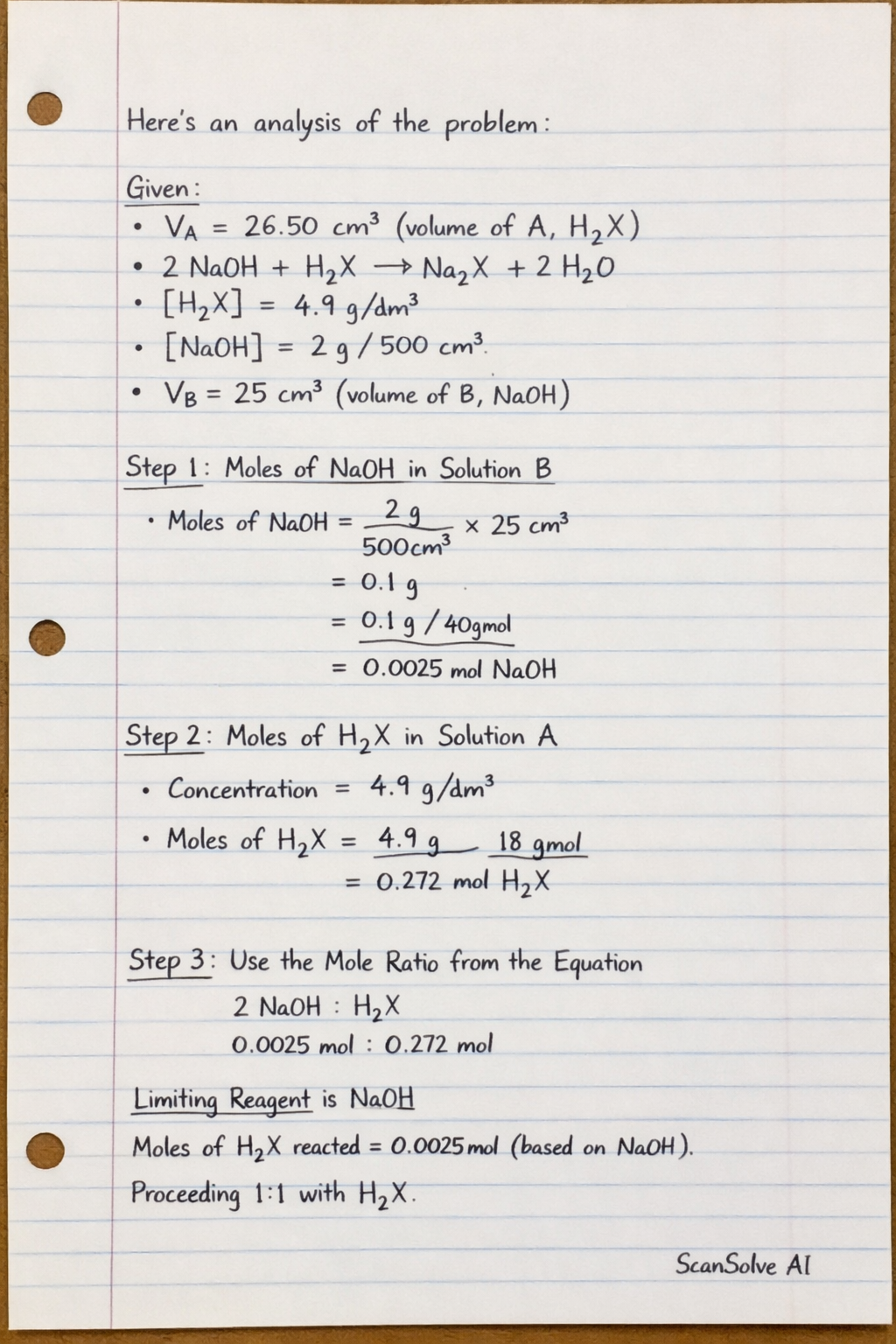
We read your photo as:

From your results and information given, calculate: (i) the Concentration of A in mol/dm3 (ii) the molar mass of H2x (iii) the atomic mass of x (iv) the percentage of x in H2x [Na=23, H=1, O=6]

Chemistry

ScanSolve AI Answer

Answers

4 parts
i

0.04717 mol/dm30.04717 \text{ mol/dm}^3

ii

103.9 g/mol103.9 \text{ g/mol}

iii

101.9 g/mol101.9 \text{ g/mol}

iv

98.07%98.07\%

Step-by-step solution

3 steps

Here's a step-by-step solution to your chemistry problem.

First, let's clarify the given atomic masses. We are given Na=23\text{Na} = 23, H=1\text{H} = 1, and O=b\text{O} = \text{b}. Assuming 'b' is a handwritten '16', we will use O=16\text{O} = 16.

Given information:

  • Average volume of A (H2X\text{H}_2\text{X}) used (VAV_A) = 26.50 cm326.50 \text{ cm}^3
  • Equation: 2NaOH+H2X→Na2X+2H2O2\text{NaOH} + \text{H}_2\text{X} \rightarrow \text{Na}_2\text{X} + 2\text{H}_2\text{O}
  • Mass concentration of H2X\text{H}_2\text{X} (acid A) = 4.9 g/dm34.9 \text{ g/dm}^3
  • Solution B (NaOH\text{NaOH}) contains 2 g2 \text{ g} of NaOH\text{NaOH} per 500 cm3500 \text{ cm}^3
  • Volume of B (NaOH\text{NaOH}) used (VBV_B) = 25 cm325 \text{ cm}^3
  • Atomic masses: Na=23\text{Na} = 23, H=1\text{H} = 1, O=16\text{O} = 16 (assumed)

Step 1: Calculate the molar concentration of NaOH\text{NaOH} (solution B).
First, find the molar mass of NaOH\text{NaOH}:

M(NaOH)=Na+O+H=23+16+1=40 g/molM(\text{NaOH}) = \text{Na} + \text{O} + \text{H} = 23 + 16 + 1 = 40 \text{ g/mol}

Next, calculate the mass of NaOH\text{NaOH} in 1 dm31 \text{ dm}^3:

Mass concentration of NaOH=2 g500 cm3×1000 cm31 dm3=4 g/dm3\text{Mass concentration of NaOH} = \frac{2 \text{ g}}{500 \text{ cm}^3} \times \frac{1000 \text{ cm}^3}{1 \text{ dm}^3} = 4 \text{ g/dm}^3

Now, calculate the molar concentration of NaOH\text{NaOH} (CBC_B):

CB=Mass concentrationMolar mass=4 g/dm340 g/mol=0.1 mol/dm3C_B = \frac{\text{Mass concentration}}{\text{Molar mass}} = \frac{4 \text{ g/dm}^3}{40 \text{ g/mol}} = 0.1 \text{ mol/dm}^3

Step 2: Calculate the molar concentration of H2X\text{H}_2\text{X} (solution A).
From the balanced chemical equation, the mole ratio of H2X\text{H}_2\text{X} to NaOH\text{NaOH} is 1:21:2. So, nA=1n_A = 1 and nB=2n_B = 2.
We use the titration formula:

CAVAnA=CBVBnB\frac{C_A V_A}{n_A} = \frac{C_B V_B}{n_B}

Rearrange to solve for CAC_A:

CA=CBVBnAVAnBC_A = \frac{C_B V_B n_A}{V_A n_B}

Substitute the known values:

CA=(0.1 mol/dm3)×(25 cm3)×1(26.50 cm3)×2C_A = \frac{(0.1 \text{ mol/dm}^3) \times (25 \text{ cm}^3) \times 1}{(26.50 \text{ cm}^3) \times 2} CA=2.553=5106 mol/dm3C_A = \frac{2.5}{53} = \frac{5}{106} \text{ mol/dm}^3 CA≈0.0471698 mol/dm3C_A \approx 0.0471698 \text{ mol/dm}^3

Rounding to four significant figures:

Part i· 1 step

The Concentration of A in mol/dm3^3

CA=0.04717 mol/dm3C_A = \boxed{0.04717 \text{ mol/dm}^3}
  1. Calculate the molar mass of H2X\text{H}_2\text{X}.

    We are given the mass concentration of H2X\text{H}_2\text{X} as 4.9 g/dm34.9 \text{ g/dm}^3. We calculated its molar concentration (CAC_A) in Step 2.

    Molar mass of H2X=Mass concentrationMolar concentration\text{Molar mass of H}_2\text{X} = \frac{\text{Mass concentration}}{\text{Molar concentration}} Molar mass of H2X=4.9 g/dm35/106 mol/dm3\text{Molar mass of H}_2\text{X} = \frac{4.9 \text{ g/dm}^3}{5/106 \text{ mol/dm}^3} Molar mass of H2X=4.9×1065=519.45=103.88 g/mol\text{Molar mass of H}_2\text{X} = \frac{4.9 \times 106}{5} = \frac{519.4}{5} = 103.88 \text{ g/mol}

    Rounding to four significant figures:

Part ii

103.9 g/mol103.9 \text{ g/mol}

The molar mass of H2X\text{H}_2\text{X}

Molar mass of H2X=103.9 g/mol\text{Molar mass of H}_2\text{X} = \boxed{103.9 \text{ g/mol}}
  1. Calculate the atomic mass of X\text{X}.

    The molar mass of H2X\text{H}_2\text{X} is the sum of the atomic masses of its constituent atoms:

    Molar mass of H2X=(2×Atomic mass of H)+Atomic mass of X\text{Molar mass of H}_2\text{X} = (2 \times \text{Atomic mass of H}) + \text{Atomic mass of X} 103.88 g/mol=(2×1 g/mol)+Atomic mass of X103.88 \text{ g/mol} = (2 \times 1 \text{ g/mol}) + \text{Atomic mass of X} Atomic mass of X=103.88−2=101.88 g/mol\text{Atomic mass of X} = 103.88 - 2 = 101.88 \text{ g/mol}

    Rounding to four significant figures:

Part iii

101.9 g/mol101.9 \text{ g/mol}

The atomic mass of X

Atomic mass of X=101.9 g/mol\text{Atomic mass of X} = \boxed{101.9 \text{ g/mol}}
  1. Calculate the percentage of X\text{X} in H2X\text{H}_2\text{X}.

    Percentage of X=Atomic mass of XMolar mass of H2X×100%\text{Percentage of X} = \frac{\text{Atomic mass of X}}{\text{Molar mass of H}_2\text{X}} \times 100\% Percentage of X=101.88 g/mol103.88 g/mol×100%\text{Percentage of X} = \frac{101.88 \text{ g/mol}}{103.88 \text{ g/mol}} \times 100\% Percentage of X≈0.980747×100%\text{Percentage of X} \approx 0.980747 \times 100\%

    Rounding to four significant figures:

Part iv

98.07%98.07\%

The percentage of X in H2X\text{H}_2\text{X}

Percentage of X=98.07%\text{Percentage of X} = \boxed{98.07\%}
Was this helpful?

Try one yourself

A new problem that tests the same skill.

Still stuck on this one?

Ask a follow-up, and the answer starts from this question.

Got a different question?Ask your own question
Handwritten step-by-step solution preview

Handwritten Step-by-Step Solution

Get this as a handwritten image on WhatsApp — like a tutor wrote it for you.

Try on WhatsApp