
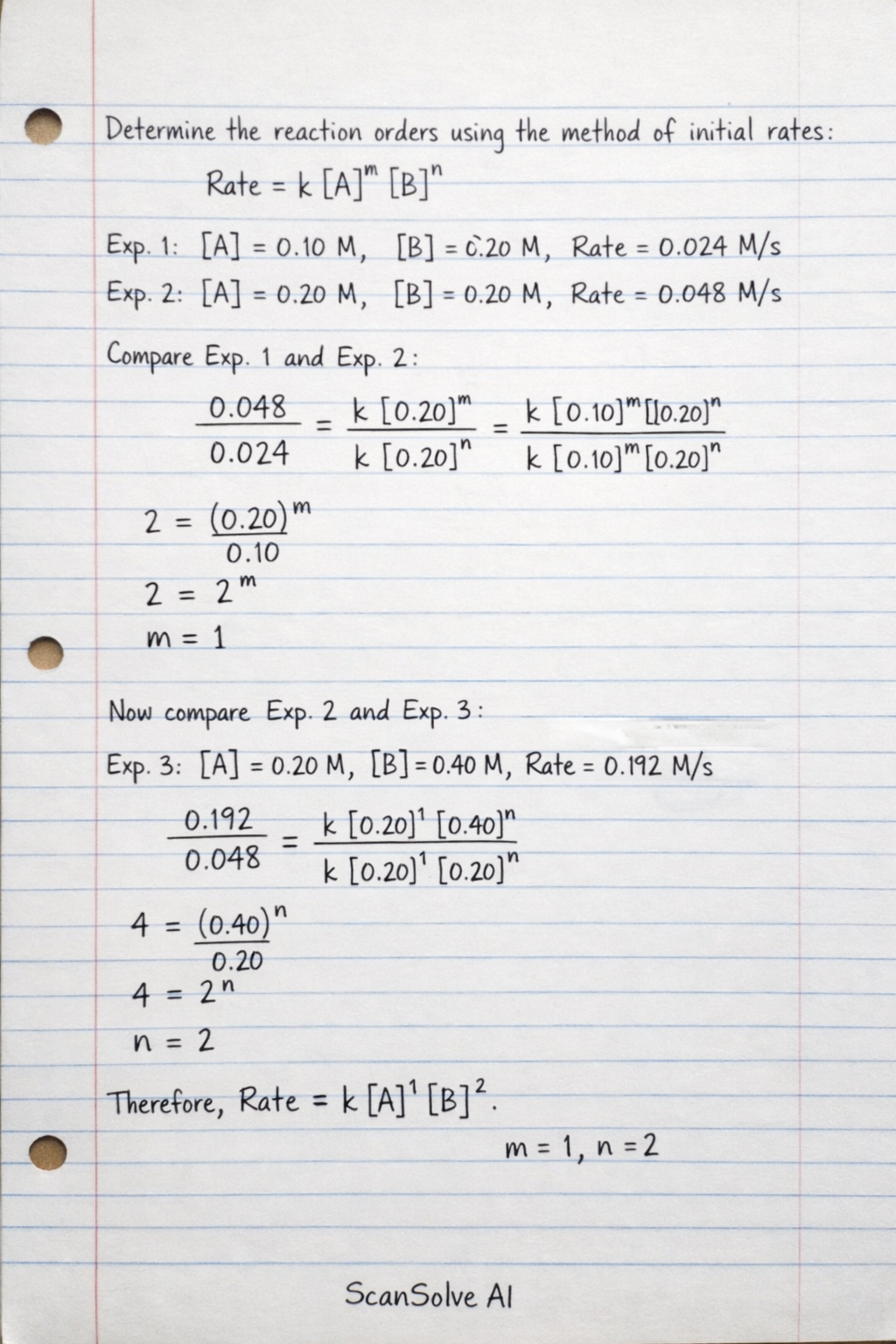
This chemistry question involves key chemical concepts and calculations. The detailed solution below walks through each step, from identifying the reaction type to computing the final answer.
ScanSolve AI Answer
The powers (exponents) in a rate law are determined experimentally. They are found by analyzing how the reaction rate changes when the initial concentrations of reactants are varied (e.g., using the method of initial rates) or by observing how reactant concentrations change over time. These powers, known as reaction orders, are generally not related to the stoichiometric coefficients of the balanced chemical equation, unless the reaction occurs in a single elementary step. Last free one today — make it count tomorrow, or type /upgrade for unlimited.