
We read your photo as:
Describe the preparation of dry carbon (IV) oxide and state Graham's law of diffusion.
Chemistry
ScanSolve AI Answer
Here are the answers to your questions:
-
To prepare and collect dry carbon (IV) oxide (CO), the setup typically involves:
- A conical flask containing marble chips (calcium carbonate) and a thistle funnel through which dilute hydrochloric acid is added.
- A delivery tube leads the produced gas from the conical flask into a wash bottle containing concentrated sulfuric acid to dry the CO.
- Another delivery tube then carries the dry CO into a gas jar or test tube, where it is collected by downward delivery (upward displacement of air) because CO is denser than air.
The reaction is:
-
a) Graham's law of diffusion states that the rate of diffusion of a gas is inversely proportional to the square root of its molar mass (or density), provided the temperature and pressure are constant. Mathematically, for two gases A and B:
where and are the molar masses of gases A and B, respectively.
Was this helpful?
Still stuck on this one?
Ask a follow-up, and the answer starts from this question.
Got a different question?Ask your own question
More Chemistry Questions
QWhat is the laboratory preparation of carbon iv oxideQCalculate the molar mass of an unknown gas using Graham's Law, given its diffusion rate and the…QDry Carbon (II) Oxide gas reacts with heated Lead (II) as shown in the equation below. PbO(s)…QIdentify liquid P, write the equation for the reaction, and state one industrial use of carbon(IV)…QI. Draw a labelled diagram to illustrate the laboratory preparation of carbon (IV) oxide from…
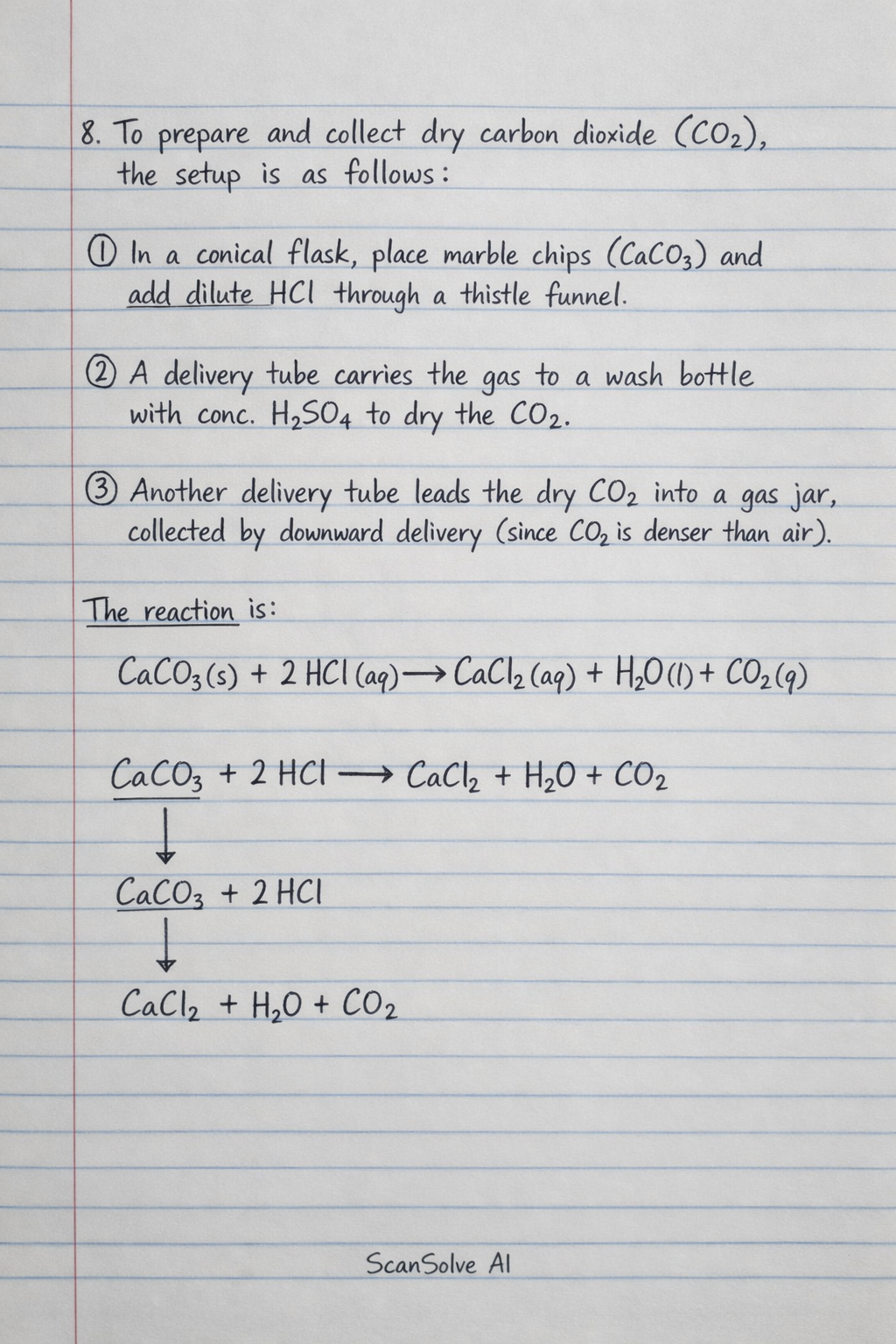
Handwritten Step-by-Step Solution
Get this as a handwritten image on WhatsApp — like a tutor wrote it for you.
Try on WhatsApp