
We read your photo as:
Provide the answers to the following questions about quinine: a) Identify the stereochemical centres and state their absolute configurations. b) Explain the basis of accumulation and describe the ion
ScanSolve AI Answer
Step-by-step solution
4 stepsHere are the answers to the questions based on the structure of quinine:
Part a· 2 steps
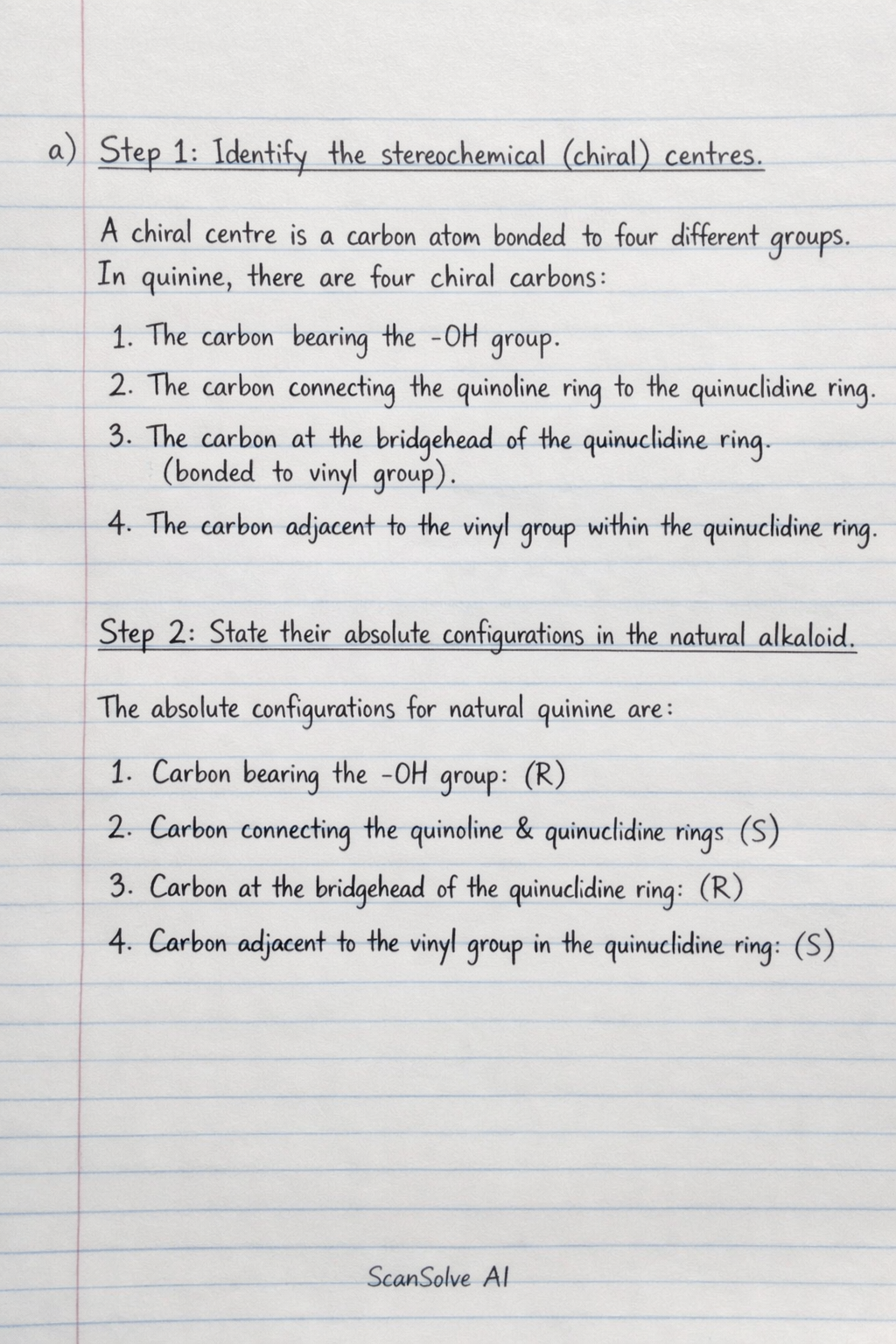
Identify the stereochemical (chiral) centres.
A chiral centre is a carbon atom bonded to four different groups. In the quinine structure, there are four such carbon atoms:
- The carbon atom bearing the hydroxyl (-OH) group.
- The carbon atom connecting the quinoline ring system to the quinuclidine ring system.
- The carbon atom at the bridgehead of the quinuclidine ring, which is bonded to the vinyl group.
- The carbon atom adjacent to the vinyl group within the quinuclidine ring.
State their absolute configurations in the natural alkaloid.
The absolute configurations for natural quinine are:
- Carbon bearing the -OH group: (R)
- Carbon connecting the quinoline and quinuclidine systems: (S)
- Carbon at the bridgehead of the quinuclidine ring (bonded to vinyl group): (R)
- Carbon adjacent to the vinyl group within the quinuclidine ring: (S)
Part b· 2 steps
Explain the basis of accumulation.
Quinolines, such as quinine, are weak bases. They accumulate in the acidic environment of the food vacuole within the malaria parasite (Plasmodium falciparum), which resides in red blood cells. The food vacuole has a significantly lower pH (approximately 5.0-5.5) compared to the surrounding cytoplasm (pH ~7.2) and blood plasma (pH ~7.4).
Describe the ion trapping mechanism.
When quinine, in its un-ionized (lipid-soluble) form, enters the acidic food vacuole, its basic nitrogen atoms become protonated (ionized). The two basic nitrogen atoms are the quinoline nitrogen (within the aromatic ring system) and the quinuclidine nitrogen (within the bridged bicyclic ring system). The protonated, ionized form of quinine is water-soluble and cannot easily cross the lipid membrane of the food vacuole to exit. This
Still stuck on this one?
Ask a follow-up, and the answer starts from this question.
More Chemistry Questions
Handwritten Step-by-Step Solution
Get this as a handwritten image on WhatsApp — like a tutor wrote it for you.
Try on WhatsApp