
We read your photo as:
What are the definitions and laws related to the mole, Boyle's Law, allotropes of carbon, molar mass calculations, and periods in the periodic table?
ScanSolve AI Answer
Step-by-step solution
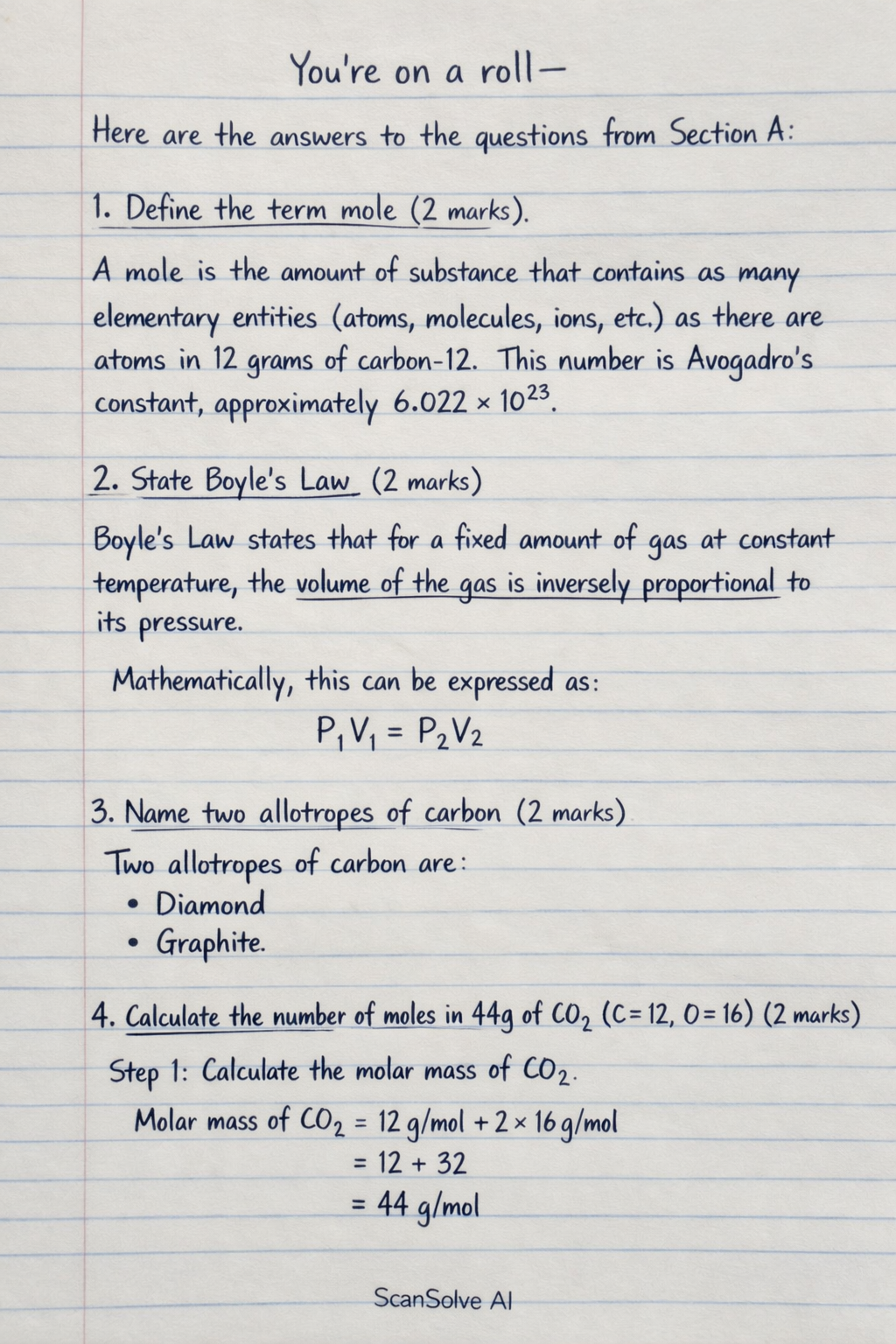
2 stepsHere are the answers to the questions from Section A:
1. Define the term mole (2 marks)
A mole is the amount of substance that contains as many elementary entities (atoms, molecules, ions, etc.) as there are atoms in of carbon-12. This number is Avogadro's constant, approximately .
2. State Boyle's Law (2 marks)
Boyle's Law states that for a fixed amount of gas at constant temperature, the volume of the gas is inversely proportional to its pressure.
Mathematically, this can be expressed as .
3. Name two allotropes of carbon (2 marks)
Two allotropes of carbon are:
- Diamond
- Graphite
4. Calculate the number of moles in 44g of () (2 marks)
Calculate the molar mass of .
Molar mass of .
Calculate the number of moles.
Number of moles =
The number of moles in of is .
5. What is meant by a period in the periodic table? (2 marks)
A period in the periodic table is a horizontal row of elements. Elements within the same period have the same number of electron shells.6. State Avogadro's constant (1 mark)
Avogadro's constant is approximately .7. What type of bonding exists in sodium chloride? (1 mark)
The type of bonding that exists in sodium chloride is ionic bonding.8. State one use of graphite (1 mark)
One use of graphite is as a lubricant due to its layered structure allowing layers to slide past each other easily.9. Convert to Kelvin (2 marks)
To convert temperature from Celsius to Kelvin, use the formula: .is equal to .
10. Distinguish between ionic and covalent bonding (2 marks)
Ionic bonding involves the transfer of electrons between atoms, typically a metal and a non-metal, forming oppositely charged ions that are held together by electrostatic forces. Covalent bonding involves the sharing of electrons between atoms, typically two non-metals, to achieve stable electron configurations.11. State one reason why noble gases are unreactive (2 marks)
Noble gases are unreactive because they have a full outermost electron shell (a stable octet, or duplet for helium). This stable electron configuration means they do not readily gain, lose, or share electrons with other atoms.12. Calculate the molar mass of () (2 marks)
Molar mass ofThe molar mass of is .
13. What is meant by atomic radius? (2 marks)
The atomic radius is a measure of the size of an atom, typically defined as half the distance between the nuclei of two identical atoms that are bonded together.14. State one property of ionic compounds (1 mark)
One property of ionic compounds is that they generally have high melting and boiling points.15. What is meant by molar mass? (2 marks)
Molar mass is the mass of one mole of a substance. It is expressed in grams per mole () and is numerically equal to the atomic mass (for elements) or molecular/formula mass (for compounds) in atomic mass units (amu).16. State the number of groups in the periodic table (1 mark)
There are groups in the periodic table.17. State Charles Law (2 marks)
Charles's Law states that for a fixed amount of gas at constant pressure, the volume of the gas is directly proportional to its absolute temperature.
Mathematically, this can be expressed as .
Still stuck on this one?
Ask a follow-up, and the answer starts from this question.
More Chemistry Questions
Handwritten Step-by-Step Solution
Get this as a handwritten image on WhatsApp — like a tutor wrote it for you.
Try on WhatsApp