
We read your photo as:
What do the following solutions have in common: a) 100 cm³ of 1 M solution b) 10 cm³ of 10 M solution c) 50 cm³ of 2 M solution?
Chemistry
ScanSolve AI Answer
Answer
Step-by-step solution
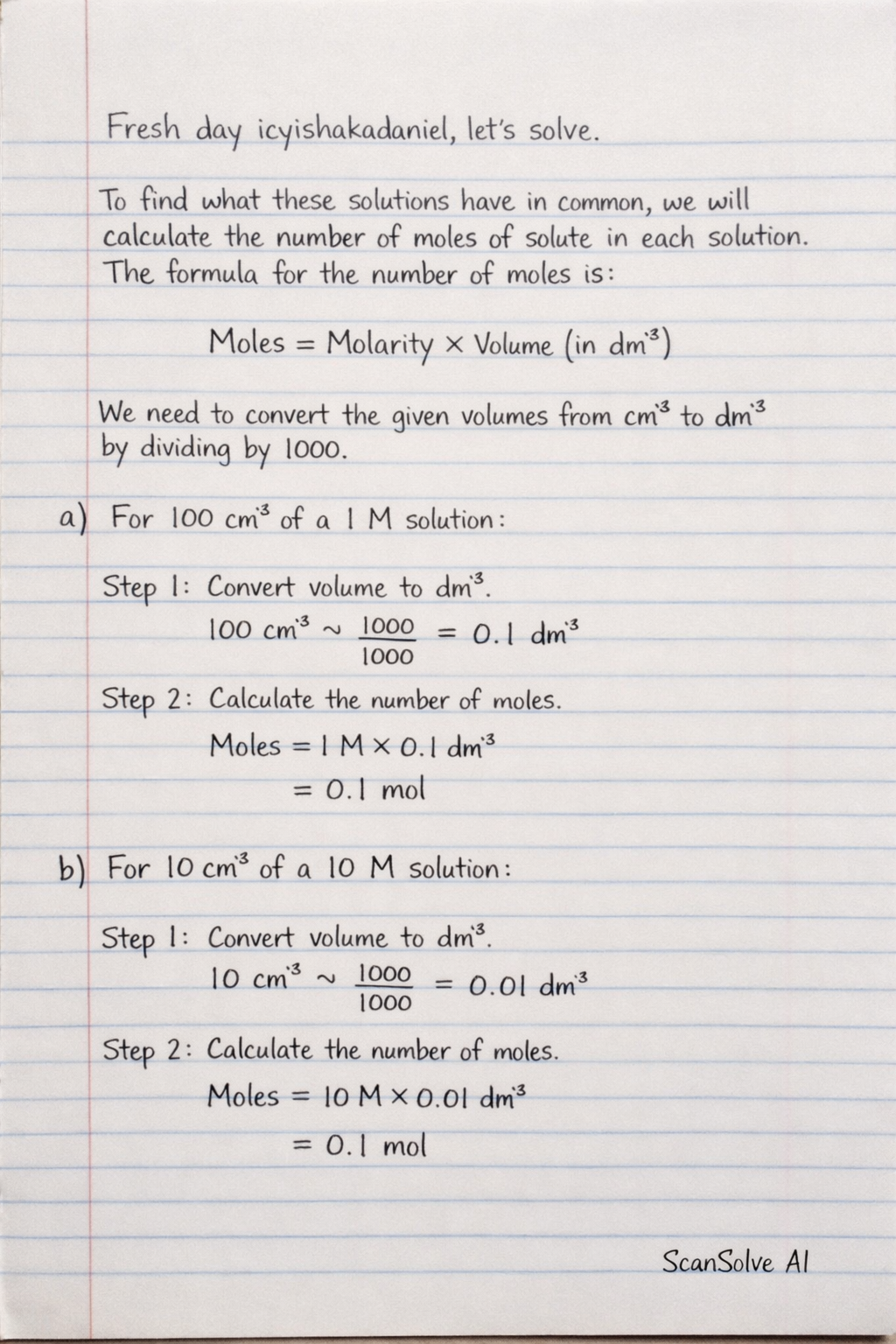
6 stepsTo find what these solutions have in common, we will calculate the number of moles of solute in each solution. The formula for the number of moles is:
We need to convert the given volumes from to by dividing by 1000.
Part a· 2 steps
For of a solution
Convert volume to .
Calculate the number of moles.
Part b· 2 steps
For of a solution
Convert volume to .
Calculate the number of moles.
Part c
For of a solution
Convert volume to .
Calculate the number of moles.
All three solutions contain the same number of moles of solute.
The commonality is that they all contain .
Was this helpful?
Try one yourself
A new problem that tests the same skill.
Still stuck on this one?
Ask a follow-up, and the answer starts from this question.
Got a different question?Ask your own question
More Chemistry Questions
QA student prepares a solution by taking 5.0 cm³ of 0.1 M NaOH and diluting it with distilled water…QWhat is a standard solution? What mass of sodium carbonate is needed to prepare 500 cm 3 of 0.2…QA solution has an initial concentration of 1.00 mol dm-3. (i) What is its concentration if it is…QIn an experiment to determine the molar concentration of a standard solution in the laboratory…QWhat's the volume of solution B in calculating its molarity.!!!
Handwritten Step-by-Step Solution
Get this as a handwritten image on WhatsApp — like a tutor wrote it for you.
Try on WhatsApp