
We read your photo as:
Calculate the volume of 0.6M sulphuric (VI) acid solution needed to neutralize 30cm³ of 0.2M potassium hydroxide.
ScanSolve AI Answer
Step-by-step solution
2 steps7.
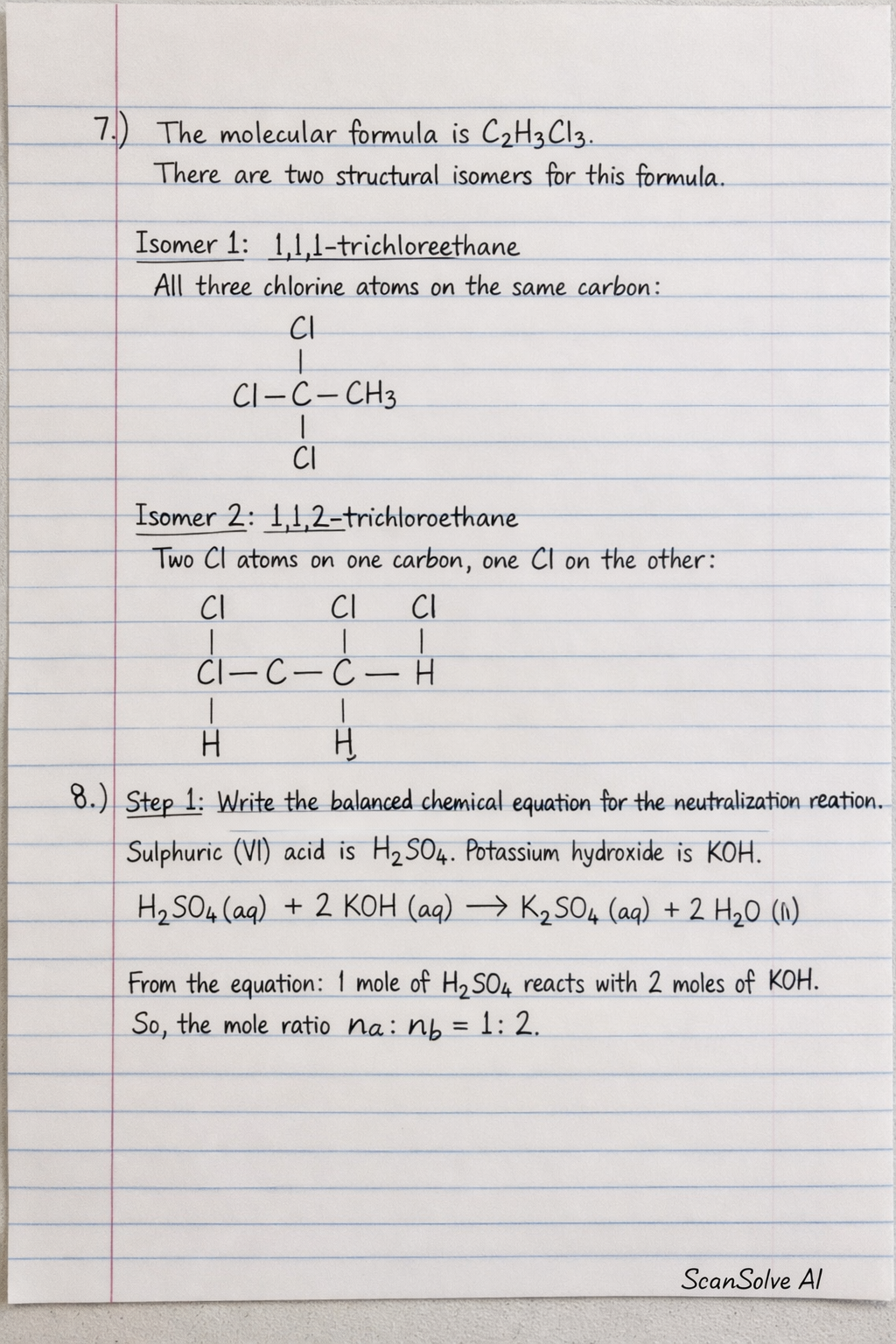
The molecular formula is . There are two structural isomers for this formula.
-
Isomer 1: 1,1,1-trichloroethane All three chlorine atoms are attached to the same carbon atom.
-
Isomer 2: 1,1,2-trichloroethane Two chlorine atoms are on one carbon, and one chlorine atom is on the other carbon.
8.
Write the balanced chemical equation for the neutralization reaction.
Sulphuric (VI) acid is . Potassium hydroxide is KOH.
From the equation, 1 mole of reacts with 2 moles of KOH. So, the mole ratio .
Use the titration formula to calculate the unknown volume.
The formula for neutralization is .
Given:
()
(KOH)
Substitute the values into the formula:
The volume of 0.6M sulphuric (VI) acid solution needed is .
9.
a) (Ammonia)
Nitrogen has 5 valence electrons (represented by dots). Each Hydrogen has 1 valence electron (represented by crosses). Nitrogen forms three single covalent bonds with three hydrogen atoms and has one lone pair of electrons.b) (Ammonium ion)
The ammonium ion is formed when a hydrogen ion () accepts the lone pair of electrons from the nitrogen in ammonia, forming a dative (coordinate) covalent bond. All four N-H bonds are equivalent once formed. The overall charge is +1.
Still stuck on this one?
Ask a follow-up, and the answer starts from this question.
More Chemistry Questions
Handwritten Step-by-Step Solution
Get this as a handwritten image on WhatsApp — like a tutor wrote it for you.
Try on WhatsApp