
We read your photo as:
1 Give a reason why TS ewline extyen NP. 4.2 Determine the equation of the line passing through N and P in the form y=mx+c.
ScanSolve AI Answer
Answers
5 partsStep-by-step solution
15 stepsHere are the solutions to the problems:
Part 4.1· 2 steps
Give a reason why .
Identify the given information.
The problem states that is the center of the circle. The line through and intersects the circle at . It is also given that .
Apply the relevant geometric theorem.
is a chord of the circle. is the midpoint of the chord because . The line segment connects the center of the circle () to the midpoint of the chord (). A line from the center of a circle to the midpoint of a chord is perpendicular to the chord.
Reason: The line segment from the center of a circle to the midpoint of a chord is perpendicular to the chord.
Therefore, .
Part 4.2
Determine the equation of the line passing through N and P in the form .
Calculate the gradient of .
Given points and .
Determine the gradient of .
From question 4.1, we know that . For perpendicular lines, the product of their gradients is .
Find the equation of the line .
The line passes through and has a gradient . Using the point-slope form :
The equation of the line passing through and is .
Part 4.3
Determine the equations of the tangents to the circle that are parallel to the x-axis.
Find the coordinates of point .
Point is where the circle cuts the y-axis, and it lies on the line . For a point on the y-axis, .
Substitute into the equation of line :So, .
Calculate the radius of the circle.
The center of the circle is and is a point on the circle. The radius is the distance .
Determine the equations of the horizontal tangents.
Tangents parallel to the x-axis are horizontal lines of the form . These tangents occur at the highest and lowest points of the circle.
The y-coordinate of the center is . The radius is .
The highest point is .
The lowest point is .
The equations of the tangents are .
Part 4.4
Determine the length of MT.
Find the coordinates of point .
Point is where the line intersects the x-axis. For a point on the x-axis, .
Substitute into the equation of line ():So, .
Calculate the distance .
Given points and .
The length of is .
Part 4.5
Another circle is drawn through the points S, T and M. Determine, with reasons, the equation of this circle STM in the form .
Identify the points and a key geometric property.
The points are , , and .
From question 4.1, we established that . Since lies on the line , it means .
Therefore, .Determine the diameter of the circle STM.
If an angle inscribed in a circle is , then the chord subtending that angle is the diameter of the circle. Since , the segment is the diameter of the circle passing through .
Find the center of the circle STM.
The center of the circle is the midpoint of its diameter .
Let the center be .The center of the circle is .
Calculate the radius squared () of the circle STM.
The diameter is . From question 4.4, .
The radius is half the diameter: .Write the equation of the circle STM.
The equation of a circle is .
Substituting the center and :The equation of the circle STM is .
Try one yourself
A new problem that tests the same skill.
Still stuck on this one?
Ask a follow-up, and the answer starts from this question.
More Mathematics Questions
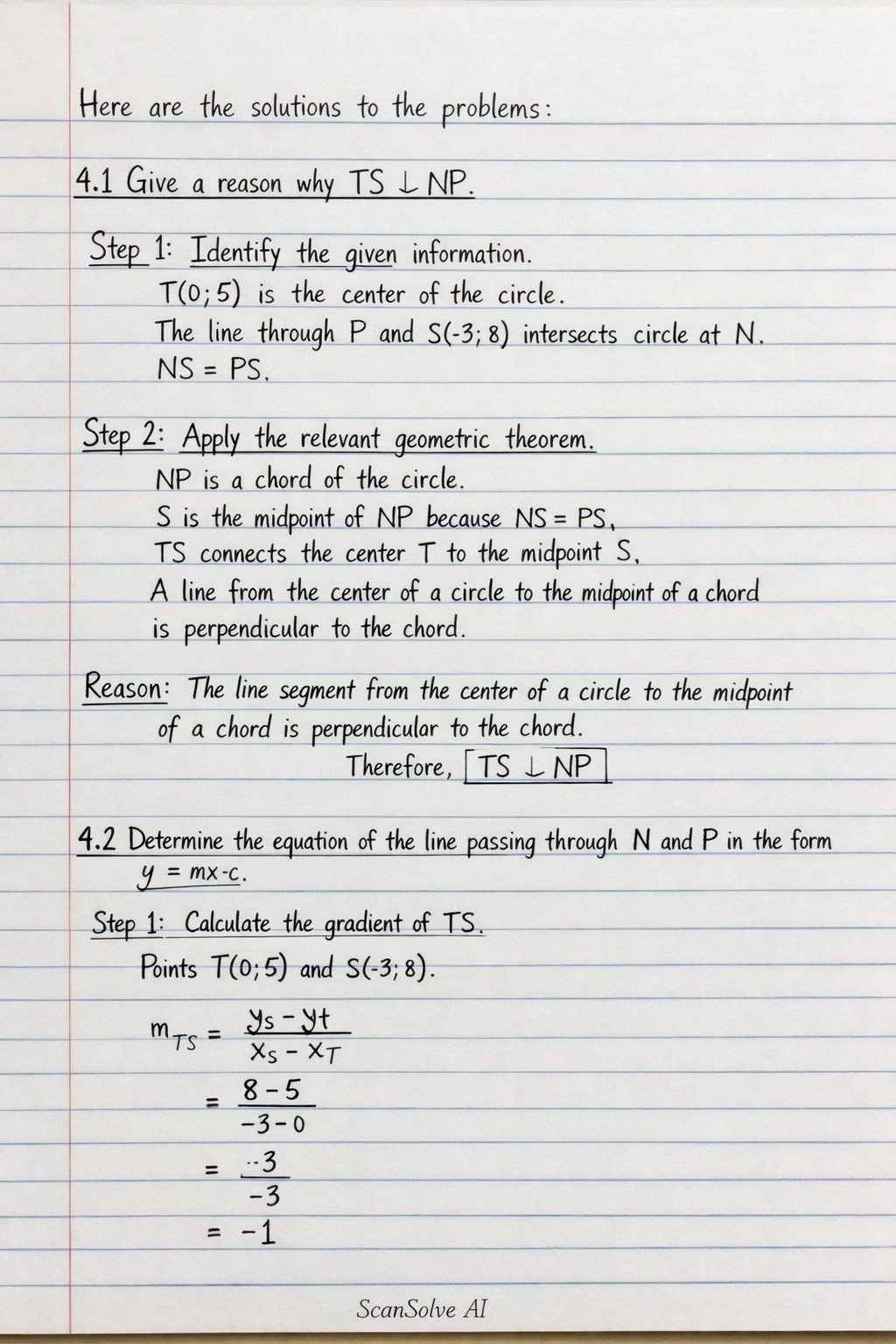
Handwritten Step-by-Step Solution
Get this as a handwritten image on WhatsApp — like a tutor wrote it for you.
Try on WhatsApp