We read your photo as:

Find the coordinates of M where lines L1 and L2 intersect, and the equation of line L3 perpendicular to L2 at M.

Mathematics

ScanSolve AI Answer

Answers

3 parts
a
(2, 6)
b

y=3xy = 3x

c
(0, 4.5)
(-3, 0)

Step-by-step solution

9 steps

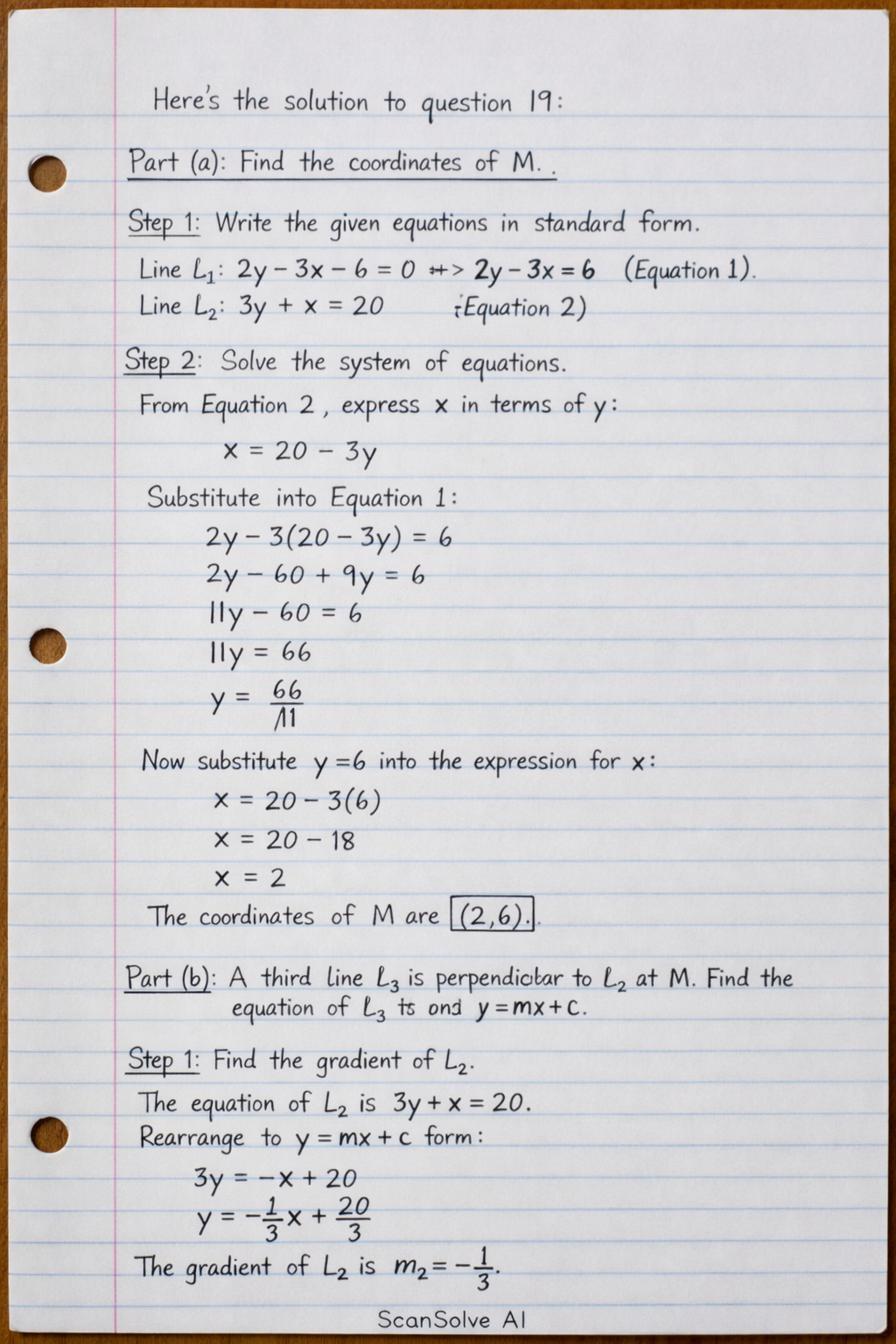
Here's the solution to question 19:

Part a· 2 steps

Find the coordinates of M.

  1. Write the given equations in a standard form.

    Line L1:2y−3x−6=0  ⟹  2y−3x=6L_1: 2y - 3x - 6 = 0 \implies 2y - 3x = 6 (Equation 1)
    Line L2:3y+x=20L_2: 3y + x = 20 (Equation 2)

  2. Solve the system of equations.

    From Equation 2, express xx in terms of yy:

    x=20−3yx = 20 - 3y

    Substitute this expression for xx into Equation 1:

    2y−3(20−3y)=62y - 3(20 - 3y) = 6 2y−60+9y=62y - 60 + 9y = 6 11y−60=611y - 60 = 6 11y=6611y = 66 y=6611y = \frac{66}{11} y=6y = 6

    Now substitute y=6y=6 back into the expression for xx:

    x=20−3(6)x = 20 - 3(6) x=20−18x = 20 - 18 x=2x = 2

    The coordinates of M are (2,6)\boxed{(2, 6)}.

Part b

y=3xy = 3x

A third line L3L_3 is perpendicular to L2L_2 at M. Find the equation of L3L_3 in the form y=mx+cy = mx + c.

  1. Find the gradient of L2L_2.

    The equation of L2L_2 is 3y+x=203y + x = 20.
    Rearrange to y=mx+cy = mx + c form:

    3y=−x+203y = -x + 20 y=−13x+203y = -\frac{1}{3}x + \frac{20}{3}

    The gradient of L2L_2 is m2=−13m_2 = -\frac{1}{3}.

  2. Find the gradient of L3L_3.

    Since L3L_3 is perpendicular to L2L_2, the product of their gradients is −1-1:

    m3×m2=−1m_3 \times m_2 = -1 m3×(−13)=−1m_3 \times \left(-\frac{1}{3}\right) = -1 m3=3m_3 = 3
  3. Use the point M (2,6)(2, 6) and the gradient m3=3m_3 = 3 to find the equation of L3L_3.

    Using the point-slope form y−y1=m(x−x1)y - y_1 = m(x - x_1):

    y−6=3(x−2)y - 6 = 3(x - 2) y−6=3x−6y - 6 = 3x - 6 y=3x−6+6y = 3x - 6 + 6 y=3xy = 3x

    The equation of L3L_3 is y=3x\boxed{y = 3x}.

Part c(0, 4.5)

Another line L4L_4 is parallel to L1L_1 and passes through (−1,3)(-1, 3). Determine the x and y intercepts of L4L_4.

  1. Find the gradient of L1L_1.

    The equation of L1L_1 is 2y−3x−6=02y - 3x - 6 = 0.
    Rearrange to y=mx+cy = mx + c form:

    2y=3x+62y = 3x + 6 y=32x+62y = \frac{3}{2}x + \frac{6}{2} y=32x+3y = \frac{3}{2}x + 3

    The gradient of L1L_1 is m1=32m_1 = \frac{3}{2}.

  2. Find the gradient of L4L_4.

    Since L4L_4 is parallel to L1L_1, their gradients are equal:

    m4=m1=32m_4 = m_1 = \frac{3}{2}
  3. Use the point (−1,3)(-1, 3) and the gradient m4=32m_4 = \frac{3}{2} to find the equation of L4L_4.

    Using the point-slope form y−y1=m(x−x1)y - y_1 = m(x - x_1):

    y−3=32(x−(−1))y - 3 = \frac{3}{2}(x - (-1)) y−3=32(x+1)y - 3 = \frac{3}{2}(x + 1)

    Multiply the entire equation by 2 to eliminate the fraction:

    2(y−3)=3(x+1)2(y - 3) = 3(x + 1) 2y−6=3x+32y - 6 = 3x + 3 2y=3x+92y = 3x + 9 y=32x+92y = \frac{3}{2}x + \frac{9}{2}
  4. Determine the x and y intercepts of L4L_4.

    For the y-intercept, set x=0x = 0:

    y=32(0)+92y = \frac{3}{2}(0) + \frac{9}{2} y=92y = \frac{9}{2} y=4.5y = 4.5

    The y-intercept is (0,4.5)\boxed{(0, 4.5)}.

    For the x-intercept, set y=0y = 0:

    0=32x+920 = \frac{3}{2}x + \frac{9}{2}

    Multiply the entire equation by 2:

    0=3x+90 = 3x + 9 −3x=9-3x = 9 x=9−3x = \frac{9}{-3} x=−3x = -3

    The x-intercept is (−3,0)\boxed{(-3, 0)}.

Was this helpful?

Try one yourself

A new problem that tests the same skill.

Still stuck on this one?

Ask a follow-up, and the answer starts from this question.

Got a different question?Ask your own question
Handwritten step-by-step solution preview

Handwritten Step-by-Step Solution

Get this as a handwritten image on WhatsApp — like a tutor wrote it for you.

Try on WhatsApp