

This mathematics problem involves applying core mathematical principles and formulas. Below you will find a complete step-by-step solution with detailed explanations for each step, helping you understand not just the answer but the method behind it.
ScanSolve AI Answer
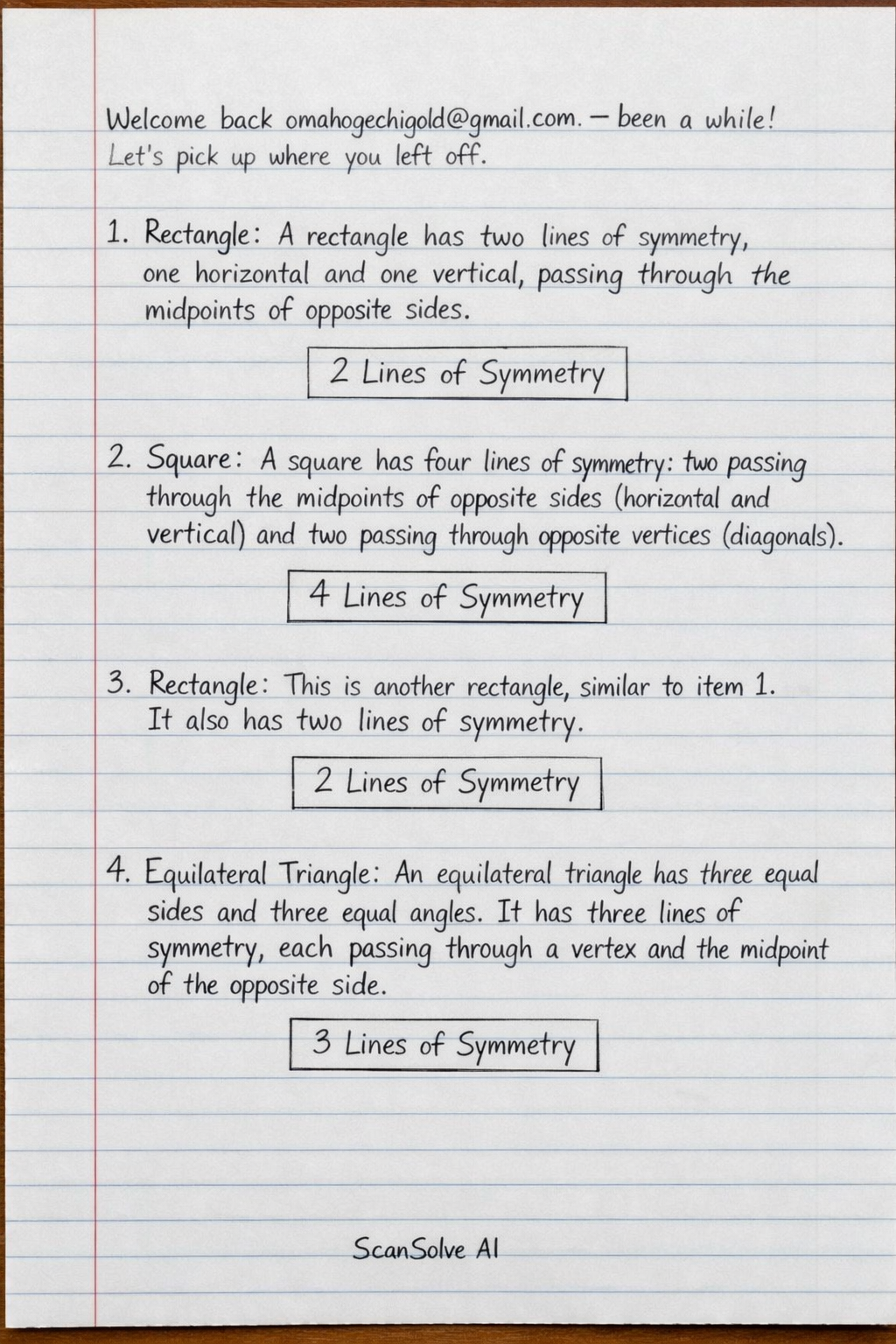
Here are the lines of symmetry for each shape: 1. Rectangle: A rectangle has two lines of symmetry, one horizontal and one vertical, passing through the midpoints of opposite sides. 2 Lines of Symmetry 2. Square: A square has four lines of symmetry: two passing through the midpoints of opposite sides (horizontal and vertical) and two passing through opposite vertices (diagonals). 4 Lines of Symmetry 3. Rectangle: This is another rectangle, similar to item 1. It also has two lines of symmetry. 2 Lines of Symmetry 4. Equilateral Triangle: An equilateral triangle has three equal sides and three equal angles. It has three lines of symmetry, each passing through a vertex and the midpoint of the opposite side. 3 Lines of Symmetry 5. Isosceles Triangle: An isosceles triangle has two equal sides and two equal angles. It has one line of symmetry, which passes through the vertex between the two equal sides and the midpoint of the base. 1 Line of Symmetry 6. Scalene Triangle: This triangle has side lengths 3 cm, 4 cm, and 6 cm. Since all side lengths are different, it is a scalene triangle. A scalene triangle has no lines of symmetry. 0 Lines of Symmetry 7. Parallelogram: A parallelogram has opposite sides parallel and equal in length. Unless it is a rhombus or a rectangle, a general parallelogram has no lines of symmetry. 0 Lines of Symmetry Send me the next one 📸