
We read your photo as:
To determine if a sample is representative, we need to compare the proportion of its characteristics to the proportion of those characteristics in the overall population.
Mathematics
ScanSolve AI Answer
Answer
Step-by-step solution
4 stepsTo determine if a sample is representative, we need to compare the proportion of its characteristics to the proportion of those characteristics in the overall population.
Analyze the Hypothetical Population.
The population consists of circles (•) and triangles (▲).
- Number of circles: 6
- Number of triangles: 6
- Total population size: 12
- Proportion of circles: (50%)
- Proportion of triangles: (50%) A representative sample should ideally reflect this 1:1 ratio or 50% for each shape.
Analyze Sample 1.
- Number of circles: 3
- Number of triangles: 3
- Total sample size: 6
- Proportion of circles: (50%)
- Proportion of triangles: (50%) The proportions in Sample 1 match the population proportions. Representative?
Analyze Sample 2.
- Number of circles: 4
- Number of triangles: 2
- Total sample size: 6
- Proportion of circles: (67%)
- Proportion of triangles: (33%) The proportions in Sample 2 (67% circles, 33% triangles) do not match the population proportions (50% circles, 50% triangles). Representative?
Analyze Sample 3.
- Number of circles: 3
- Number of triangles: 3
- Total sample size: 6
- Proportion of circles: (50%)
- Proportion of triangles: (50%) The proportions in Sample 3 match the population proportions. Representative?
Was this helpful?
Try one yourself
A new problem that tests the same skill.
Still stuck on this one?
Ask a follow-up, and the answer starts from this question.
Got a different question?Ask your own question
More Mathematics Questions
QDifferentiate between population and sample in Statistics?QCalculate the sample proportion (p).QI. What is a sample? How does a sample differ from the accessible population? ii. Why should a…QPerform a one-sample proportion test with continuity correction for the data, given the null…QCalculate the Representative Fraction (RF).
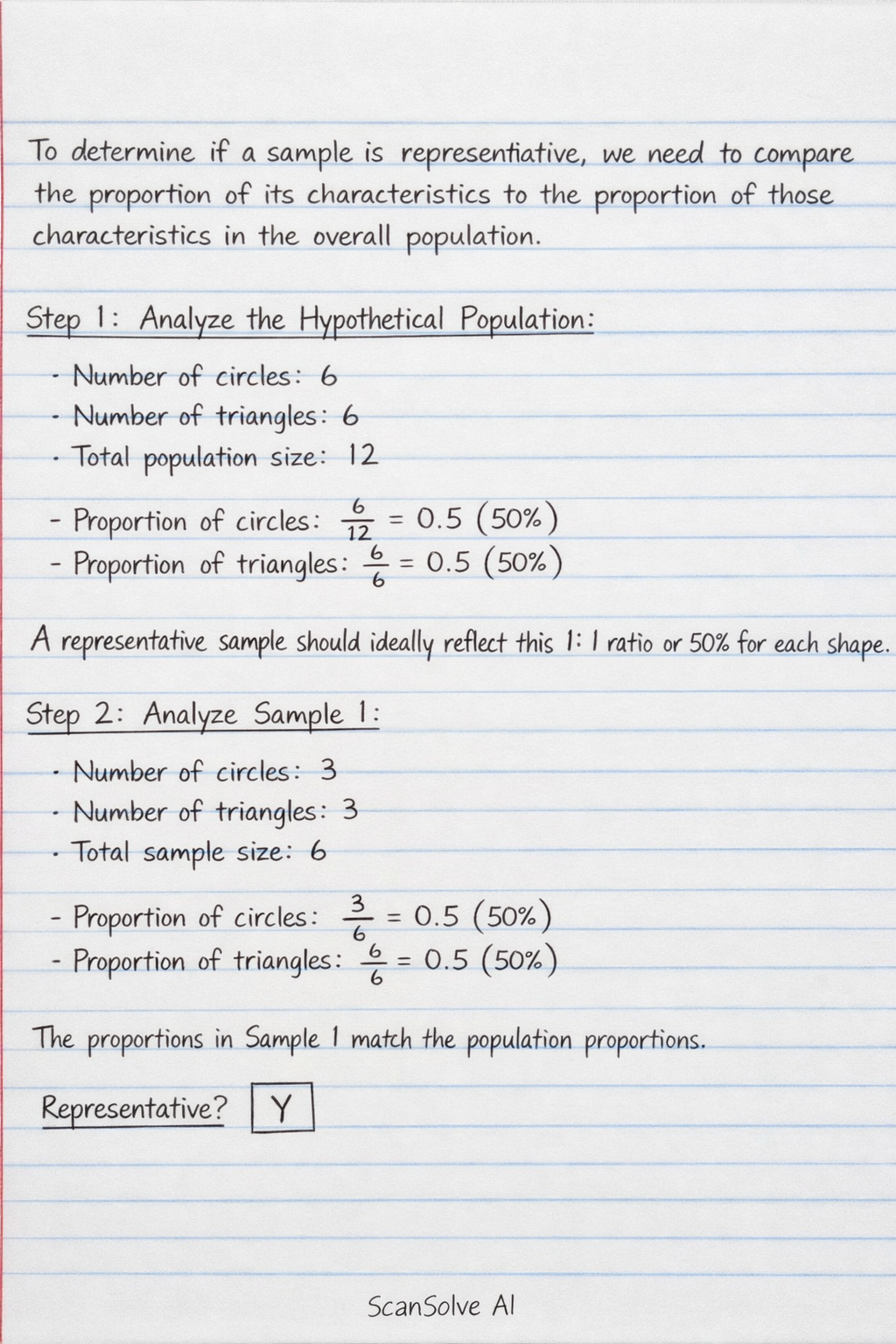
Handwritten Step-by-Step Solution
Get this as a handwritten image on WhatsApp — like a tutor wrote it for you.
Try on WhatsApp