

This physics problem tests your understanding of fundamental physical laws and their applications. The step-by-step solution below breaks down the problem using relevant equations and physical reasoning.
ScanSolve AI Answer
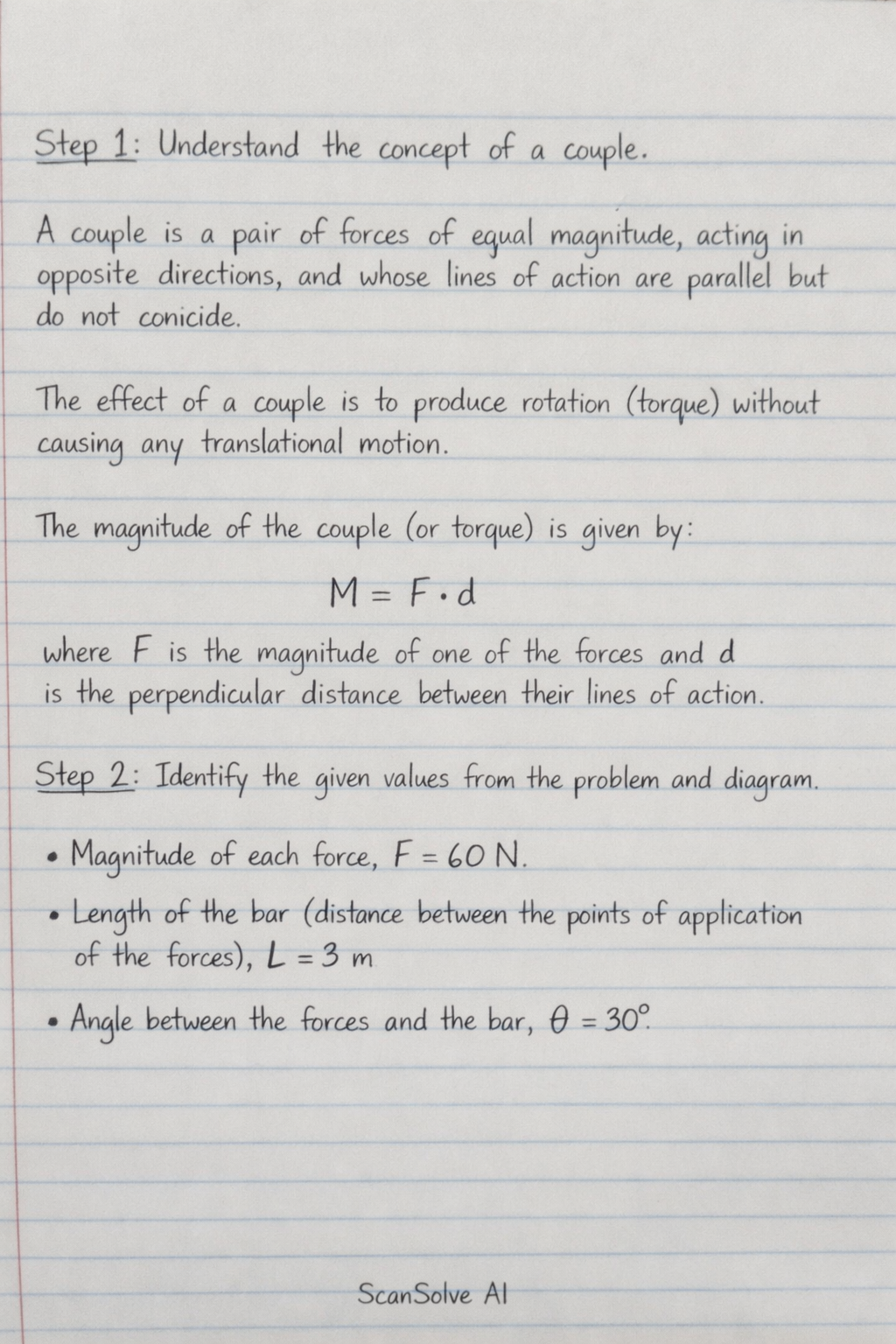
Step 1: Understand the concept of a couple. A couple is a pair of forces of equal magnitude, acting in opposite directions, and whose lines of action are parallel but do not coincide. The effect of a couple is to produce rotation (torque) without causing any translational motion. The magnitude of the couple (or torque) is given by the product of the magnitude of one of the forces and the perpendicular distance between their lines of action. Step 2: Identify the given values from the problem and diagram. • Magnitude of each force, F = 60 N. • Length of the bar (distance between the points of application of the forces), L = 3 m. • Angle between the forces and the bar, = 30^. Step 3: Determine the perpendicular distance between the lines of action of the forces. The perpendicular distance (d_) between the lines of action of the two parallel forces can be found using trigonometry. If the forces are applied at the ends of a bar of length L and make an angle with the bar, then the perpendicular distance between their lines of action is d_ = L . Step 4: Calculate the perpendicular distance. d_ = L d_ = 3 m × (30^) We know that (30^) = (1)/(2). d_ = 3 m × (1)/(2) d_ = 1.5 m Step 5: Calculate the magnitude of the couple. The magnitude of the couple C is given by: C = F × d_ Substitute the values of F and d_: C = 60 N × 1.5 m C = 90 Nm The final answer is 90 Nm.