
We read your photo as:
A 1 kg block is placed on a truck. If the coefficient of static friction is 0.6 and the truck accelerates at 5 m/s², will the block slip?
ScanSolve AI Answer
Answer
Step-by-step solution
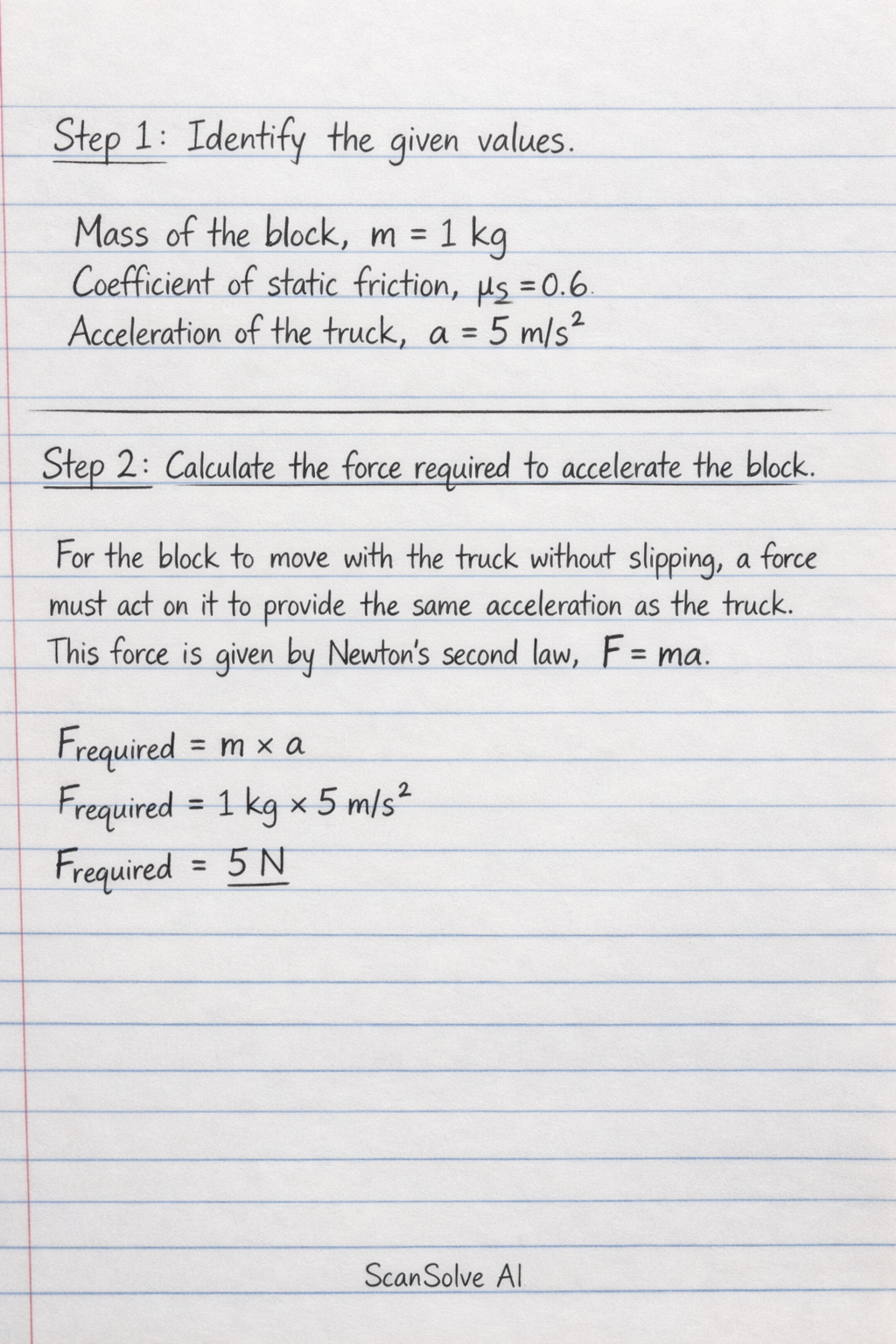
4 stepsIdentify the given values.
Mass of the block,
Coefficient of static friction,
Acceleration of the truck,Calculate the force required to accelerate the block.
For the block to move with the truck without slipping, a force must act on it to provide the same acceleration as the truck. This force is given by Newton's second law, .
Calculate the maximum static friction force.
The maximum static friction force () that can act on the block is given by the formula , where is the normal force.
Since the block is on a horizontal surface, the normal force is equal to the gravitational force acting on the block, . We will use for simplicity, which is a common approximation in such problems.Now, calculate the maximum static friction force:
Determine the actual friction force.
The force required to accelerate the block is .
The maximum static friction force available is .
Since the required force () is less than the maximum static friction force (), the block will not slip relative to the truck. The static friction force will adjust itself to be exactly equal to the required force to keep the block moving with the truck.
Therefore, the friction force acting on the block is .Comparing this with the given options:
(a) 10 न्यूटन
(b) 5 न्यूटन
(c) 2.5 न्यूटन
(d) 20 न्यूटन
The calculated friction force matches option (b).
The final answer is .
Try one yourself
A new problem that tests the same skill.
Still stuck on this one?
Ask a follow-up, and the answer starts from this question.
More Physics Questions
Handwritten Step-by-Step Solution
Get this as a handwritten image on WhatsApp — like a tutor wrote it for you.
Try on WhatsApp