
We read your photo as:
A 2.5 kg jackfruit is plucked from a height of 4 m. Calculate its gravitational potential energy, kinetic energy just before hitting the ground, and velocity at impact, assuming negligible air resista
ScanSolve AI Answer
Answers
2 partsStep-by-step solution
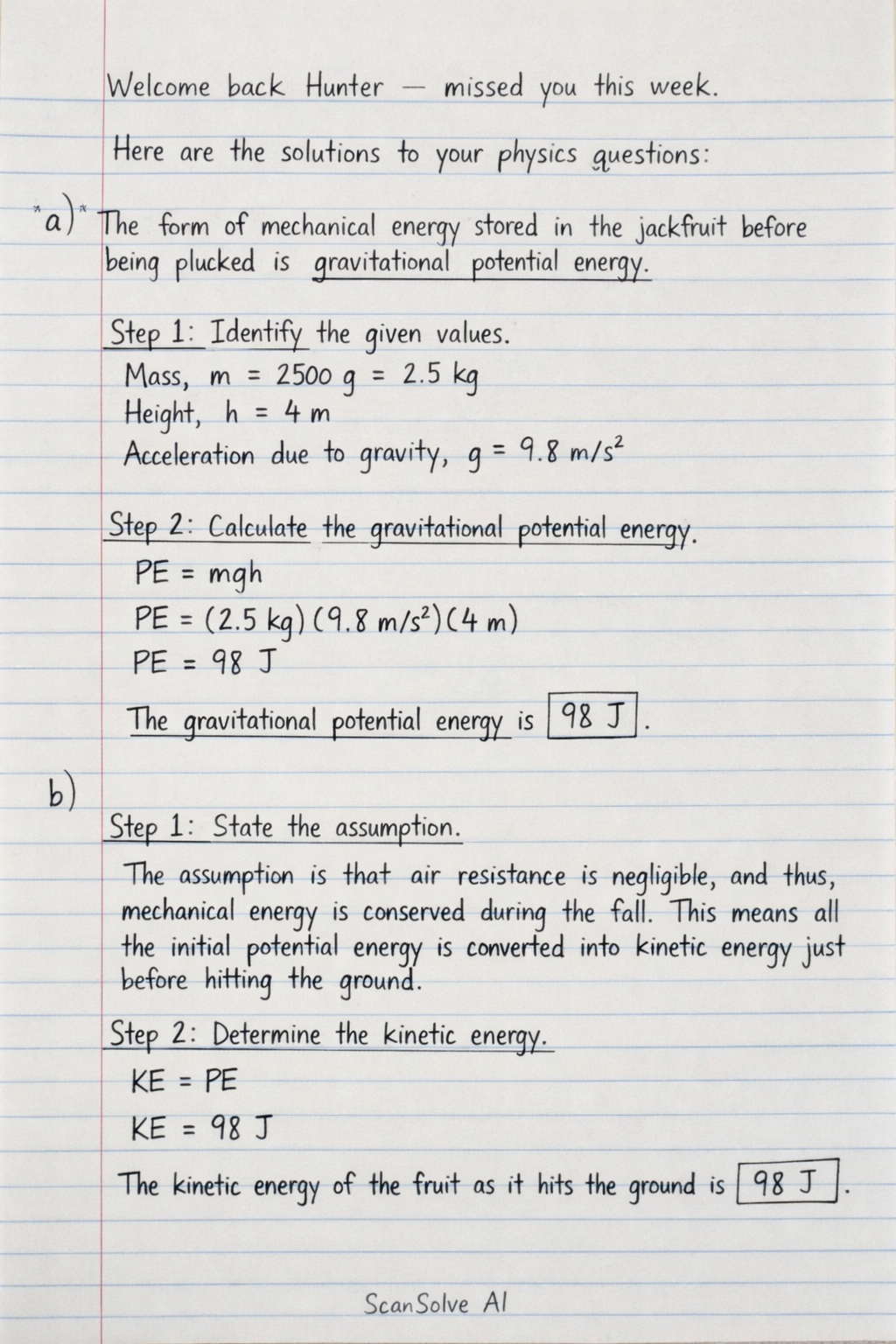
5 stepsHere are the solutions to your physics questions:
Part a· 2 steps
The form of mechanical energy stored in the jackfruit before being plucked is *gravitational potential energy
Identify the given values.
Mass,
Height,
Acceleration due to gravity,Calculate the gravitational potential energy.
The gravitational potential energy is .
Part b
State the assumption.
The assumption is that air resistance is negligible, and thus, mechanical energy is conserved during the fall. This means all the initial potential energy is converted into kinetic energy just before hitting the ground.
Determine the kinetic energy.
The kinetic energy of the fruit as it hits the ground is .
Calculate the velocity.
The velocity with which it hits the ground is approximately .
c) The jackfruit comes to rest after hitting the ground and does not bounce back to its original height because the collision with the ground is inelastic. During an inelastic collision, some of the kinetic energy is converted into other forms of energy, such as heat, sound, and energy used to deform the fruit and the ground. This energy is dissipated into the surroundings, so it is not available to propel the fruit back up.
The law shown by this behavior is the Law of Conservation of Energy. While mechanical energy (potential + kinetic) is not conserved due to the energy conversion, the total energy of the system (including heat, sound, and deformation energy) remains conserved.
Part d
As the jackfruit falls from the top to the ground, the following energy changes occur
- Initially, the jackfruit possesses maximum gravitational potential energy and zero kinetic energy.
- As it falls, its height decreases, causing its gravitational potential energy to decrease.
- Simultaneously, its speed increases, causing its kinetic energy to increase.
- Just before hitting the ground, its gravitational potential energy is at a minimum (or zero, if the ground is the reference point), and its kinetic energy is at a maximum.
- Upon impact with the ground, the kinetic energy is rapidly converted into heat energy (due to friction and deformation), sound energy, and energy used to deform the fruit and the ground.
Try one yourself
A new problem that tests the same skill.
Still stuck on this one?
Ask a follow-up, and the answer starts from this question.
More Physics Questions
Handwritten Step-by-Step Solution
Get this as a handwritten image on WhatsApp — like a tutor wrote it for you.
Try on WhatsApp