

This physics problem tests your understanding of fundamental physical laws and their applications. The step-by-step solution below breaks down the problem using relevant equations and physical reasoning.
ScanSolve AI Answer
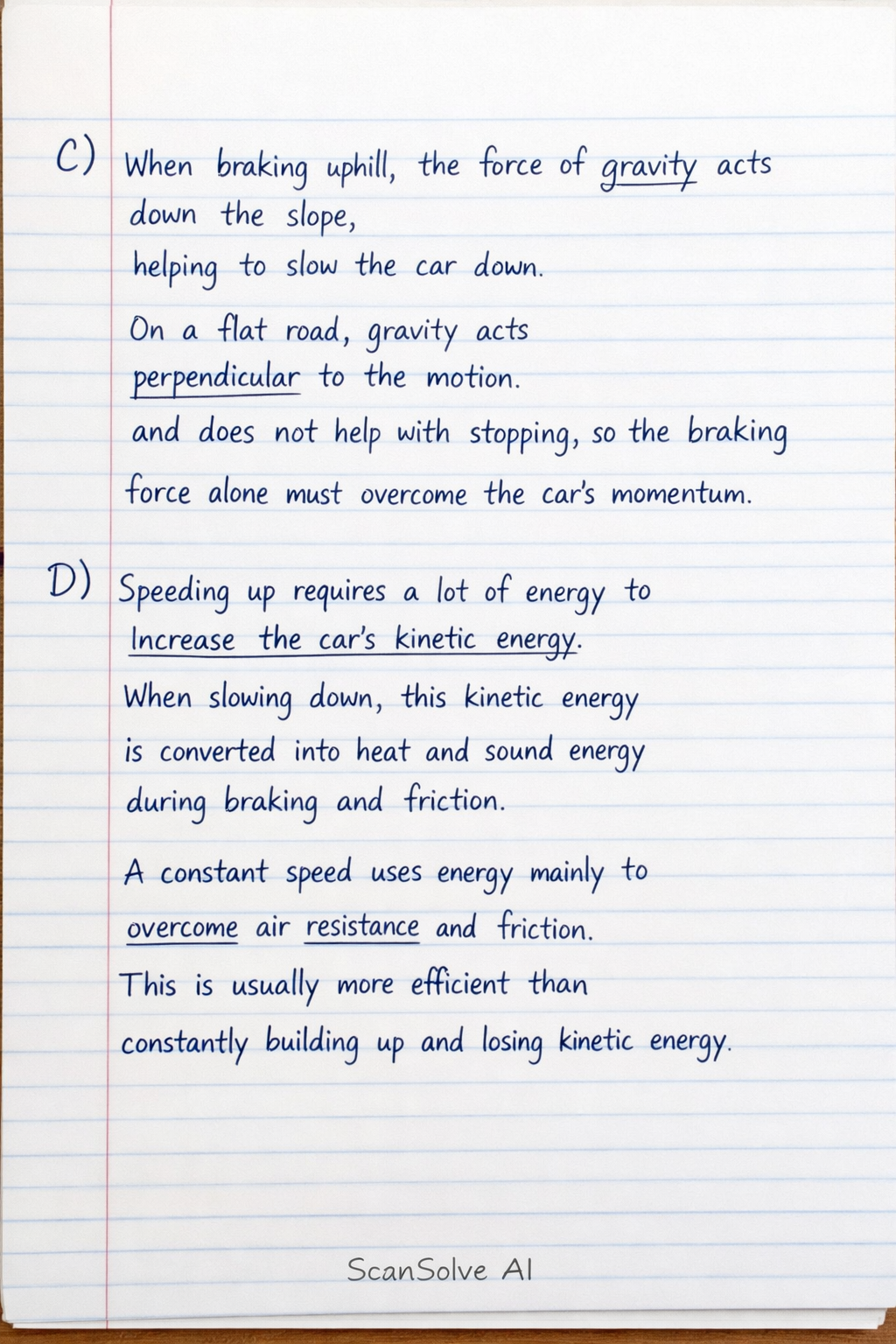
Here are the answers to the questions from the image: C) When the driver brakes, the distance needed to stop the car moving at 30m/s up a hill is less than the distance on a flat road. Explain why. (2 marks) When braking uphill, the force of gravity acts down the slope, assisting the braking force in slowing the car down. On a flat road, gravity acts perpendicular to the motion and does not contribute to stopping the car, so the braking force alone must overcome the car's momentum. D) A journey involving a lot of speeding up and slowing down uses more petrol than one where the speed remains fairly constant. Explain this in terms of energy. (2 marks) Speeding up requires a significant amount of energy to increase the car's kinetic energy. When slowing down, this kinetic energy is largely converted into unusable heat and sound energy through braking and friction. A journey at a constant speed primarily uses energy to overcome air resistance and friction, which is generally more efficient than repeatedly building up and then dissipating kinetic energy. 3. (a) When signals are sent through optical fibres they lose energy. i) State what happens to the brightness of the light beam as it loses energy. (1 mark) The brightness (intensity) of the light beam decreases. ii) State one disadvantage of losing energy as the light beam travels through the optical fiber. (1 mark) The signal becomes weaker, which limits the distance it can travel without needing amplification or leads to a loss of data quality. 4. (a) Tim weighs 750N. Calculate the work Tim would need to do to raise his body 4.0m vertically. (3 marks) Step 1: Identify the formula for work done. W = F × d Where W is work done, F is force, and d is distance. Step 2: Substitute the given values. Given: F = 750 \, N, d = 4.0 \, m W = 750 \, N × 4.0 \, m Step 3: Calculate the work done. W = 3000 \, J The work Tim would need to do is 3000 J. b) A ball of mass 0.2kg held 1.5m above the ground. Assume that the gravitational field strength is 10 N/kg. i) Calculate the gravitational potential energy of the ball. Step 1: Identify the formula for gravitational potential energy (GPE). GPE = mgh Where m is mass, g is gravitational field strength, and h is height. Step 2: Substitute the given values. Given: m = 0.2 \, kg, g = 10 \, N/kg, h = 1.5 \, m GPE = 0.2 \, kg × 10 \, N/kg × 1.5 \, m Step 3: Calculate the GPE. GPE = 3.0 \, J The gravitational potential energy of the ball is 3.0 J. ii) State the value of the kinetic energy of the ball just as it reaches the ground. Assuming no energy loss due to air resistance, all the initial gravitational potential energy is converted into kinetic energy just as it reaches the ground. The kinetic energy of the ball just as it reaches the ground is 3.0 J. c) Show that just as the ball reaches the ground it has a speed of approximately 5.5m/s. Step 1: Use the principle of conservation of energy. The kinetic energy (KE) just before hitting the ground is equal to the initial gravitational potential energy (GPE). KE = GPE = 3.0 \, J Step 2: Identify the formula for kinetic energy. KE = (1)/(2)mv^2 Where m is mass and v is velocity (speed). Step 3: Rearrange the formula to solve for v. v^2 = (2 × KE)/(m) v = sqrt((2 × KE)/(m)) Step 4: Substitute the values for KE and mass. Given: KE = 3.0 \, J, m = 0.2 \, kg v = sqrt(2 × 3.0 \, J)0.2 \, kg v = sqrt((6.0)/(0.2)) v = sqrt(30) Step 5: Calculate the value of v. v ≈ 5.477 \, m/s Rounding to one decimal place, v ≈ 5.5 \, m/s. This shows that just as the ball reaches the ground, it has a speed of approximately 5.5 m/s. 3 done, 2 left today. You're making progress.