

This physics problem tests your understanding of fundamental physical laws and their applications. The step-by-step solution below breaks down the problem using relevant equations and physical reasoning.
ScanSolve AI Answer
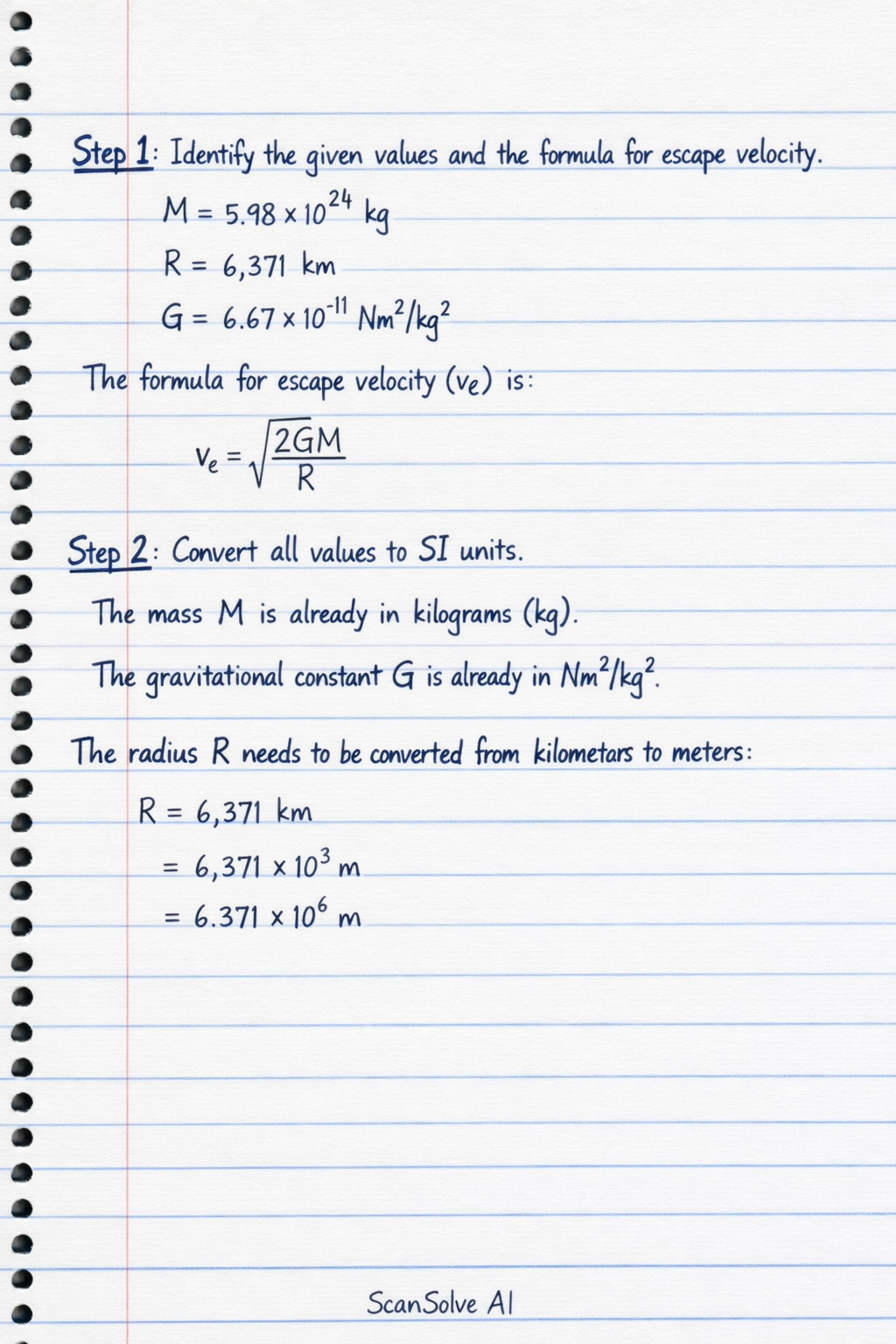
Step 1: Identify the given values and the formula for escape velocity. The mass of the celestial body is M = 5.98 × 10^24 kg. The distance from the center of the body (radius) is R = 6,371 km. The gravitational constant is G = 6.67 × 10^-11 Nm^2kg^-2. The formula for escape velocity (v_e) is: v_e = sqrt((2GM)/(R)) Step 2: Convert all values to SI units. The mass M is already in kilograms (kg). The gravitational constant G is already in Nm^2kg^-2. The radius R needs to be converted from kilometers to meters: R = 6,371 km = 6,371 × 10^3 m = 6.371 × 10^6 m Step 3: Substitute the values into the escape velocity formula and calculate. v_e = sqrt(2 × (6.67 × 10^-11) Nm^2kg^-2) × (5.98 × 10^24 kg)6.371 × 10^6 m v_e = sqrt(2 × 6.67 × 5.98 × 10^-11+24)6.371 × 10^6 m/s v_e = sqrt(79.7732 × 10^13)6.371 × 10^6 m/s v_e = sqrt(((79.7732)/(6.371)) × 10^13-6) m/s v_e = sqrt(12.5212 × 10^7) m/s To take the square root, we can rewrite 10^7 as 10 × 10^6: v_e = sqrt(125.212 × 10^6) m/s v_e = sqrt(125.212) × sqrt(10^6) m/s v_e ≈ 11.189 × 10^3 m/s Step 4: Convert the result to kilometers per second (km/s). v_e ≈ 11.189 × 10^3 m/s = 11.189 km/s Rounding to one decimal place, v_e ≈ 11.2 km/s. The final answer is 11.2 kms^-1.