
We read your photo as:
If the mass of the moon and its radius are 7.40 x 10²² kg and 1.76 x 10⁶ m respectively, find the free fall acceleration g of an object on or near the surface of the moon.
Physics
ScanSolve AI Answer
Answer
Step-by-step solution
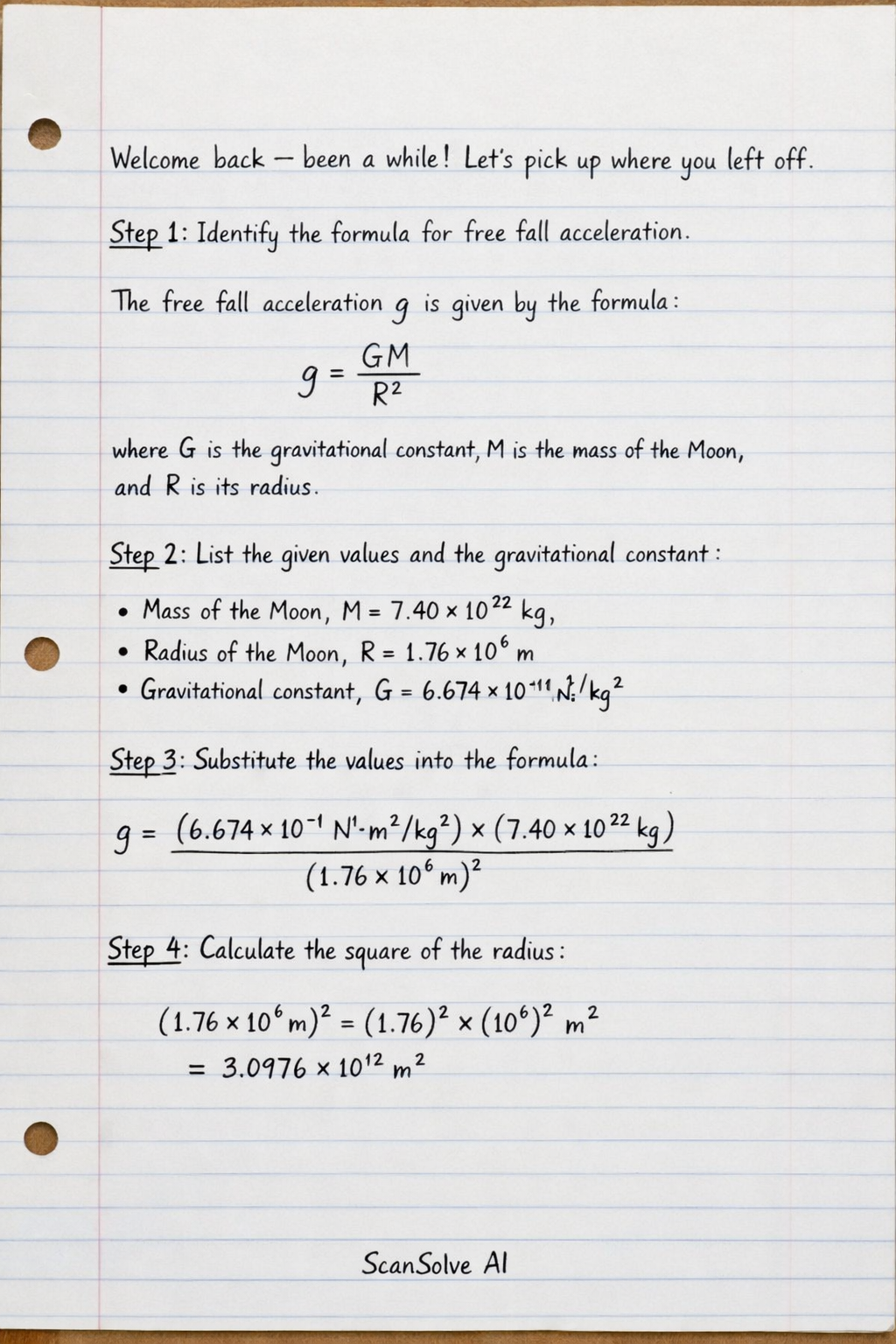
6 stepsIdentify the formula for free fall acceleration.
The free fall acceleration on the surface of a celestial body is given by the formula:
where is the gravitational constant, is the mass of the celestial body, and is its radius.
List the given values and the gravitational constant.
- Mass of the moon,
- Radius of the moon,
- Gravitational constant,
Substitute the values into the formula.
Calculate the square of the radius.
Perform the multiplication in the numerator.
Divide the numerator by the squared radius.
The free fall acceleration on the surface of the moon is approximately:
Was this helpful?
Try one yourself
A new problem that tests the same skill.
Still stuck on this one?
Ask a follow-up, and the answer starts from this question.
Got a different question?Ask your own question
More Physics Questions
QTo find the free fall acceleration on the surface of the moon, we use the formula for acceleration…QWhat is the centripetal acceleration of the moon, given its orbital radius and period?QThe mass of the earth is 80 time that of the moon the distance from the center of the earth from…QA satellite mass 80kg is in orbit around the earth at a distance 7.5R where R is the mean radius of…QThe acceleration due to gravity at earth's surface is g. The acceleration due to gravity at a height…
Browse by topic:Mechanics
Handwritten Step-by-Step Solution
Get this as a handwritten image on WhatsApp — like a tutor wrote it for you.
Try on WhatsApp