We read your photo as:

A conducting spherical shell has inner radius a and outer radius c. The space between these two surfaces is filled with a dielectric for which the dielectric constant is k₁ between a and b, and k₂ between b and c (Figure 10). Determine the capacitance of this system.

Physics

ScanSolve AI Answer

Step-by-step solution

4 steps

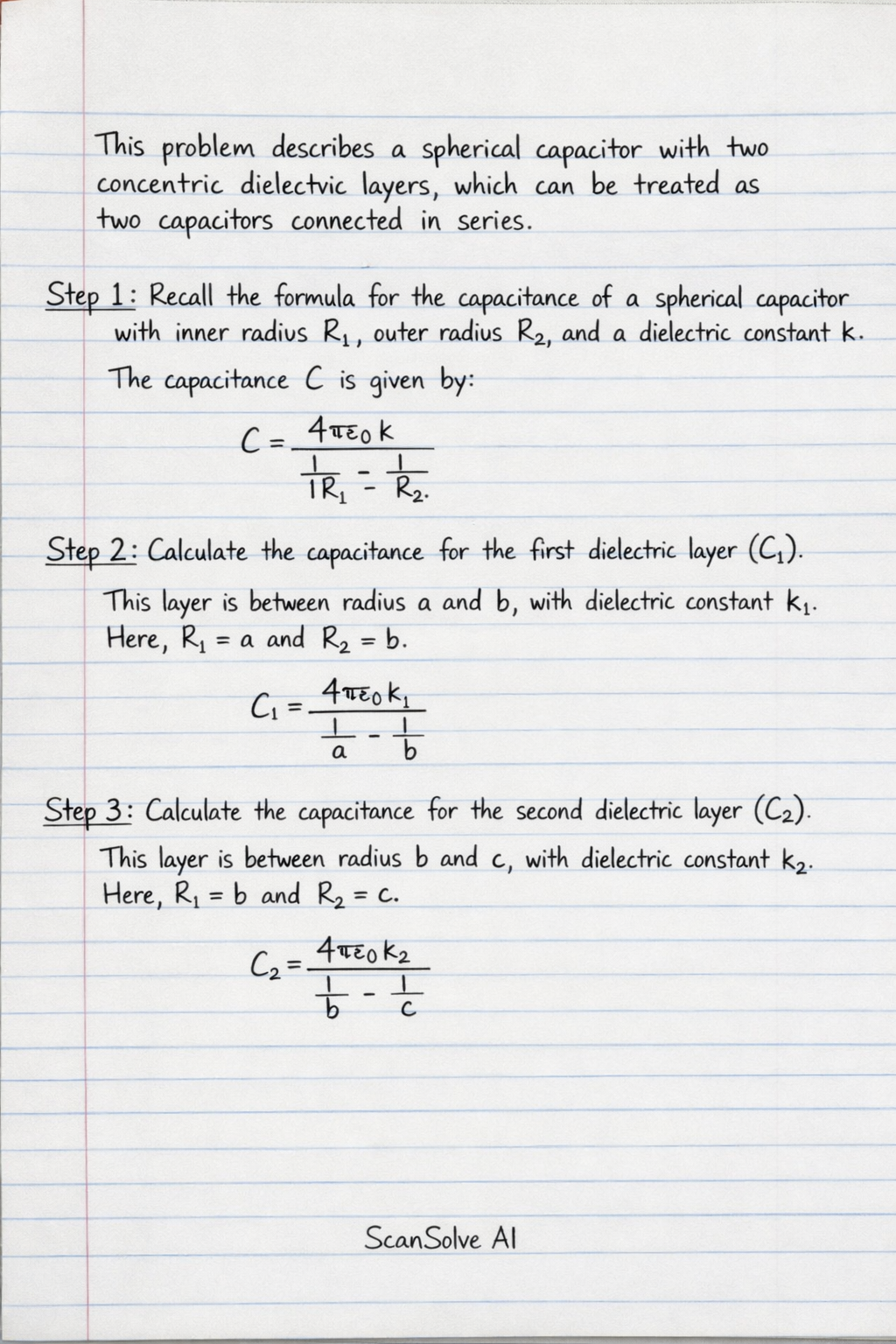
This problem describes a spherical capacitor with two concentric dielectric layers, which can be treated as two capacitors connected in series.

  1. Recall the formula for the capacitance of a spherical capacitor with inner radius R1R_1, outer radius R2R_2, and a dielectric constant kk.

    The capacitance CC is given by:

    C=4πϵ0k1R1−1R2C = \frac{4 \pi \epsilon_0 k}{\frac{1}{R_1} - \frac{1}{R_2}}
  2. Calculate the capacitance for the first dielectric layer (C1C_1).

    This layer is between radius aa and bb, with dielectric constant k1k_1.
    Here, R1=aR_1 = a and R2=bR_2 = b.

    C1=4πϵ0k11a−1bC_1 = \frac{4 \pi \epsilon_0 k_1}{\frac{1}{a} - \frac{1}{b}}
  3. Calculate the capacitance for the second dielectric layer (C2C_2).

    This layer is between radius bb and cc, with dielectric constant k2k_2.
    Here, R1=bR_1 = b and R2=cR_2 = c.

    C2=4πϵ0k21b−1cC_2 = \frac{4 \pi \epsilon_0 k_2}{\frac{1}{b} - \frac{1}{c}}
  4. Combine C1C_1 and C2C_2 in series to find the total equivalent capacitance CeqC_{eq}.

    For capacitors in series, the reciprocal of the equivalent capacitance is the sum of the reciprocals of individual capacitances:

    1Ceq=1C1+1C2\frac{1}{C_{eq}} = \frac{1}{C_1} + \frac{1}{C_2}

    Substitute the expressions for C1C_1 and C2C_2:

    1Ceq=14πϵ0k11a−1b+14πϵ0k21b−1c\frac{1}{C_{eq}} = \frac{1}{\frac{4 \pi \epsilon_0 k_1}{\frac{1}{a} - \frac{1}{b}}} + \frac{1}{\frac{4 \pi \epsilon_0 k_2}{\frac{1}{b} - \frac{1}{c}}} 1Ceq=1a−1b4πϵ0k1+1b−1c4πϵ0k2\frac{1}{C_{eq}} = \frac{\frac{1}{a} - \frac{1}{b}}{4 \pi \epsilon_0 k_1} + \frac{\frac{1}{b} - \frac{1}{c}}{4 \pi \epsilon_0 k_2}

    Factor out 14πϵ0\frac{1}{4 \pi \epsilon_0}:

    1Ceq=14πϵ0(1k1(1a−1b)+1k2(1b−1c))\frac{1}{C_{eq}} = \frac{1}{4 \pi \epsilon_0} \left( \frac{1}{k_1} \left( \frac{1}{a} - \frac{1}{b} \right) + \frac{1}{k_2} \left( \frac{1}{b} - \frac{1}{c} \right) \right)

    Therefore, the equivalent capacitance is:

    Ceq=4πϵ01k1(1a−1b)+1k2(1b−1c)C_{eq} = \frac{4 \pi \epsilon_0}{\frac{1}{k_1} \left( \frac{1}{a} - \frac{1}{b} \right) + \frac{1}{k_2} \left( \frac{1}{b} - \frac{1}{c} \right)}

    The capacitance of the system is:

    4πϵ01k1(1a−1b)+1k2(1b−1c)\boxed{\frac{4 \pi \epsilon_0}{\frac{1}{k_1} \left( \frac{1}{a} - \frac{1}{b} \right) + \frac{1}{k_2} \left( \frac{1}{b} - \frac{1}{c} \right)}}

    2 zimekamilika. Zimebaki 3 leo — tuma inayofuata.

Was this helpful?

Still stuck on this one?

Ask a follow-up, and the answer starts from this question.

Got a different question?Ask your own question
Handwritten step-by-step solution preview

Handwritten Step-by-Step Solution

Get this as a handwritten image on WhatsApp — like a tutor wrote it for you.

Try on WhatsApp